






A SaaS tax and billing rules matrix usually works best as a 6-column decision sheet, and the safest version is one your billing team reviews with a…
Last updated: November 20, 2026
Quick answer: a SaaS tax and billing rules matrix usually works best as a 6-column decision sheet, and the safest version is one your billing team reviews with a qualified tax adviser for your own situation. This article explains how to build a SaaS tax and billing rules matrix for VAT, sales tax, and reverse charge scenarios, using the billing fields, customer locations, and product data you already store.
Key takeaways
- A rules matrix turns tax decisions into repeatable billing logic, so the same customer gets the same treatment every time, but you should still have a tax professional review the rule set for your jurisdictions.
- The matrix must use the billing address, customer status, and product type together; one field on its own is not enough. HMRC and OECD guidance on digital services is a useful starting point: OECD International VAT/GST Guidelines and HMRC VAT on digital services.
- Reverse charge is not a price discount. It changes who accounts for the tax.
- Tax exemption handling needs proof, a status flag, and a clear rule for what the invoice should show.
- The hardest part is not writing the matrix once; it is keeping it current when country rules, thresholds, or customer records change.
What is this matrix for?

This matrix is for billing teams that need one place to decide how SaaS invoices should be taxed across VAT, sales tax, and reverse charge cases. It assumes the team already has a product catalog, customer master data, and a billing system that can store tax status fields such as billing address, tax registration number, and exemption flag.
The matrix is not for setting tax law, arguing edge cases from scratch, or replacing local advice. It is for translating known rules into operations so support, finance, and billing do not make different calls on the same customer record. For cross-border SaaS, that matters because the answer can change with the country, the customer type, and the way the invoice is issued.
A useful matrix usually has 6 columns: scenario, customer type, location rule, tax treatment, evidence needed, and invoice output. This is a practical structure, but you should confirm it with a qualified tax adviser for your own setup. One row might cover B2B sales into the UK with a valid VAT number and reverse charge. Another might cover US sales tax where the billing address controls the result. The point is consistency, not legal commentary.
For background on the tax concepts behind digital services, the OECD International VAT/GST Guidelines and HMRC’s digital services VAT guidance are good reference points: OECD International VAT/GST Guidelines and HMRC VAT on digital services. Those sources explain the concepts; the matrix turns them into a billing rule set.
How do I build the matrix?
Build the matrix by defining the rule source, then translating each tax case into one billing decision. The cleanest way is to use a spreadsheet or policy table with one line per scenario and one rule per line.
- List the tools: Use your billing system, CRM, tax engine, and spreadsheet before writing rules, then map the fields each one already stores. Verify that you can capture billing address, customer type, tax ID, and product code in at least 4 separate fields. A problem shows up when the tax rule depends on data you do not store anywhere.
- Define the scope: Use a country list and product list before adding tax logic, then restrict the matrix to the jurisdictions and SaaS plans you actually bill. Verify that VAT, sales tax, and reverse charge are all named in the scope. A problem shows up when “all countries” is written as a placeholder and no one owns updates.
- Map the location rule: Use the billing address before any tax decision, then record which location wins for each case. Verify whether the billing address is the primary location rule and whether a tax registration number changes the outcome for B2B cases. A problem shows up when shipping address, IP address, and billing address are all treated as equal without a rule order, so confirm the hierarchy with a qualified tax adviser.
- Separate B2B from B2C: Use customer classification before tax calculation, then mark each scenario as business or consumer. Verify that a valid VAT number or similar business proof is required where reverse charge may apply. A problem shows up when consumer invoices are allowed to carry a business rule by mistake.
- Write the tax outcome: Use a tax engine or rules table before invoice creation, then set the outcome as VAT charged, sales tax charged, reverse charge, or exempt. Verify that each outcome has one clear invoice label. A problem shows up when “tax handling” is written as a note instead of a machine-readable value.
- Define evidence fields: Use a document checklist before approving exemption or reverse charge, then require the specific proof your process accepts, such as a tax exemption certificate or VAT number validation result. Verify that the evidence is stored against the customer record. A problem shows up when support can override the tax rule without any record attached.
- Set the invoice text: Use invoice templates before release, then decide what the customer sees for each tax case. Verify that the invoice shows the right tax label, amount, and reason, especially for reverse charge and exemption cases. A problem shows up when the invoice says one thing and the rules table says another.
- Test edge rows: Use sample invoices before launch, then run at least one example for each major scenario. Verify that the system handles a UK B2B reverse charge, a US taxable sale, and a tax-exempt customer without manual edits. A problem shows up when the test set covers only domestic B2C sales.
A practical matrix row can be as simple as this: “EU B2B SaaS sale, valid VAT number, customer established in another member state, reverse charge applies, no VAT charged, invoice notes reverse charge, tax ID stored, proof checked.” The same structure can be repeated for sales tax jurisdictions, where the billing address and nexus logic matter more than VAT wording.
Which fields belong in the matrix?
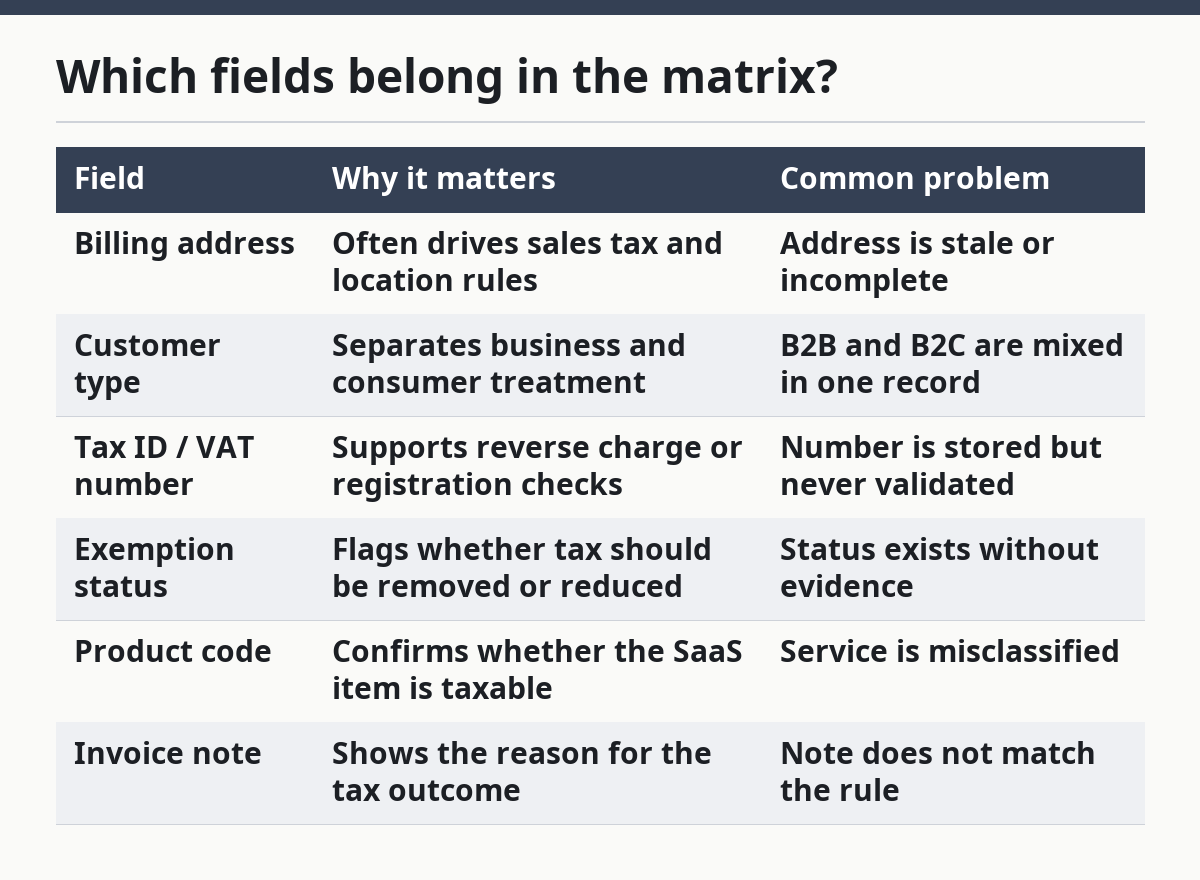
The matrix needs a small set of fields, not a long note field, because billing needs ruleable data. A good version uses 5 to 8 fields, each with one job.
| Field | Why it matters | Common problem |
|---|---|---|
| Billing address | Often drives sales tax and location rules | Address is stale or incomplete |
| Customer type | Separates business and consumer treatment | B2B and B2C are mixed in one record |
| Tax ID / VAT number | Supports reverse charge or registration checks | Number is stored but never validated |
| Exemption status | Flags whether tax should be removed or reduced | Status exists without evidence |
| Product code | Confirms whether the SaaS item is taxable | Service is misclassified |
| Invoice note | Shows the reason for the tax outcome | Note does not match the rule |
This is also where many teams go wrong with reverse charge. Reverse charge is a tax accounting method, not a discount and not an exemption certificate. If the matrix treats it as “0% tax” with no reason code, the invoice may look wrong even if the tax result is technically correct. For the matrix design, this is the sort of point a tax professional can confirm before launch.
The same caution applies to tax exemption certificates. A certificate is only useful if the matrix says when it is required, who reviews it, how long it stays valid in the system, and what happens if it is missing. Without those rules, the billing team ends up improvising on each invoice.
How does reverse charge fit in?
Reverse charge fits in as a separate tax outcome, not as a variant of VAT charged to the customer. In the matrix, it should only appear where your process says the customer accounts for the tax instead of the seller, and the invoice should reflect that.
The first rule is to define the trigger. For many SaaS teams, that trigger is a B2B sale into a jurisdiction where reverse charge applies and the customer has a valid tax registration number. The second rule is to define what proof is required before billing can use that outcome. The third rule is to define the invoice message so the customer sees why no tax was added.
A matrix row for reverse charge should therefore include: customer type, location rule, proof required, tax outcome, and invoice wording. If any of those are missing, the billing team may either overcharge, undercharge, or create an invoice the customer rejects. A rejected invoice can slow cash collection even when the underlying tax logic is sound.
What should happen when a customer claims exemption?
Tax exemption handling should block automatic tax relief until the matrix sees the right proof and the right customer flag. A practical review sequence is usually “claim received,” “document checked,” “document accepted,” and “tax treatment active,” though your own controls may differ; confirm the sequence with a tax professional.
The matrix should also say what happens when the proof is incomplete. Common choices are to charge tax until proof arrives, hold the invoice, or route the case to review, but the right choice depends on the jurisdiction and the company’s billing policy. That is why the matrix needs the action field, not just the tax field.
A tax exemption certificate should be tied to the customer record, the product or service covered, and the date it was accepted. If the certificate lapses or the customer moves location, the old treatment should not remain by default. The matrix needs a rule for recheck timing, even if that timing is driven by internal policy rather than a tax statute.
When should this approach stop?
This approach should stop when the tax decision depends on facts the billing team cannot verify from the record. It is a billing control tool, not a substitute for legal or tax analysis in unclear cases.
The customer has no valid billing address: The location rule is missing, so sales tax or VAT treatment may be wrong — pause invoicing until the address is corrected.
The VAT number cannot be validated: Reverse charge may not be supportable on the current record — route the case for review before tax is removed.
The invoice mixes multiple services with different tax treatment: One row is not enough, so the matrix needs split lines — separate the items before billing.
The exemption certificate is expired or absent: The exemption is not documented — charge according to the default rule until proof is updated.
The country rule is unclear or changing: The matrix may be stale — stop automated treatment for that jurisdiction and confirm the rule before the next billing run.
The customer record says business, but support says consumer: The classification is inconsistent — resolve the master data conflict before the invoice goes out.
What mistakes do teams make?
The most common mistake is building the matrix around tax labels instead of billing actions. If the row says “VAT applies” but does not say who calculates it, what evidence is needed, and what the invoice should show, the team still has to guess. The correct alternative is to write one operational decision per row.
Another mistake is using one rule for every country. VAT, sales tax, and reverse charge do not behave the same way, and a single global rule usually breaks at the first cross-border invoice. The correct alternative is to split by jurisdiction family and then by customer type.
A third mistake is trusting the billing address without checking whether it is complete or current. A stale address can send the invoice into the wrong tax bucket. The correct alternative is to add a validation step before billing, not after a complaint.
A fourth mistake is accepting exemption claims with no document trail. That creates audit risk and makes support depend on the stored record instead of memory. The correct alternative is to require a stored certificate, a status field, and a date accepted.
A fifth mistake is leaving the matrix outside the billing workflow. If the spreadsheet lives in a folder nobody checks, it will not control invoices. The correct alternative is to connect it to the billing rule set and assign one owner for updates.
When do the rules need special handling?
The standard matrix needs modification when the same sale can produce more than one tax result. That happens most often with mixed customer bases, mixed product bundles, and cross-border billing.
If the SaaS bundle contains taxable and non-taxable items, split the bundle into separate lines before the tax decision. If the customer has more than one legal entity, create separate records so the billing address and tax ID are not blended. If the tax status changes mid-contract, apply a dated rule so the change starts on the correct invoice rather than retroactively across 12 months.
Manual review is also needed when a tax engine cannot decide from the available fields. A matrix is only as good as the data feeding it. If the system cannot tell whether the customer is B2B or B2C, the answer should be review, not assumption.
How do you keep the matrix current?
Keep the matrix current by reviewing it on a fixed cycle and after any rule change in a target country. A quarterly review is common in operations teams, but the real trigger is a change in tax treatment, billing fields, or customer onboarding flow.
The review should compare three things: the country rule, the customer data fields, and the invoice output. If those three no longer match, the matrix has drifted. The fix is to update the rule row, the field mapping, or the invoice template, not just one of them.
The best sign of a good matrix is boring invoices: the right tax shows up without a ticket, an override, or a manual note. That is the point of the exercise. It reduces surprises in VAT, sales tax, and reverse charge handling by making the decision visible before the invoice is sent.
How do SaaS taxes work?
SaaS taxes work by applying a location rule, a customer classification, and a product rule to decide whether VAT, sales tax, reverse charge, or no tax applies. The answer depends on the country and the transaction facts, so the billing system should not guess from price alone. A tax and billing rules matrix turns those facts into one repeatable decision.
When does reverse charge apply to SaaS?
Reverse charge applies to SaaS when the seller’s process says the customer, not the seller, accounts for the tax, usually in a B2B cross-border case with valid proof on file. The exact rule depends on the jurisdiction and the evidence required there. The matrix should require a valid tax ID or VAT number before it uses the reverse charge outcome.
How should SaaS billing tax rules be documented?
SaaS billing tax rules should be documented in one matrix that shows the scenario, the decision, the proof needed, and the invoice result. The document should be readable by billing, finance, and support, not only by tax specialists. It should also record who owns updates, because rules change and stale logic causes bad invoices.
Drafted with AI; not yet reviewed by a person.
