






How to Build a SaaS Content Approval Matrix for Writers, Editors, Legal, and Product Reviewers: a SaaS content approval matrix usually needs 4 roles for…
Last updated: November 15, 2026
Quick Answer: a SaaS content approval matrix usually needs 4 roles for low-risk pieces and 6 roles for high-risk pieces. A SaaS content approval matrix tells writers, editors, legal, product, and brand reviewers who signs off, in what order, and when a piece is done. The fix is a role-by-role matrix with clear gates, not a long chain of “please review” emails. The steps below settle who approves what, who gets skipped, and where content stalls. For the broader workflow, see the SaaS content operation systems hub.
What a SaaS content approval matrix is
A SaaS content approval matrix is a simple decision map that ties each content type to the people who must review it before publication. It usually covers 4 to 6 roles, the order of review, and the final approver, so no one guesses on deadline day.
Think of it as a routing rule, not a style guide. A blog piece about a product update may need a writer, editor, product manager, and legal reviewer; a top-of-funnel explainer may need only writer, editor, and brand reviewer. The matrix says which path each piece follows.
For SaaS teams, the matrix matters because content can carry product claims, pricing language, compliance risk, or support promises. A missing reviewer can turn into a launch delay, a rework loop, or a public correction. The truth is, those delays usually come from unclear ownership, not from too few meetings.
Use the matrix with the larger SaaS content operation systems hub, then keep this page focused on approval order and sign-off rules. That keeps the workflow clean and makes the next steps easier to use. For templates, the content brief template can carry the required reviewers.
Who should approve SaaS content?

The right approvers depend on the claim risk, not on the number of people in the room. A 3-role piece may only need writer, editor, and brand reviewer; a launch piece with product claims often needs legal and product manager review too.
Here is the usual split:
- Writer: drafts the piece and fixes line-level issues.
- Editor: checks structure, clarity, and whether the piece matches the brief.
- Brand reviewer: checks voice, terminology, and messaging consistency.
- Product manager: checks feature names, roadmap language, screenshots, and claims.
- Legal reviewer: checks statements that could create legal exposure, especially around pricing, comparisons, privacy, endorsements, or regulated claims.
A common mistake is letting every reviewer comment on everything. That slows the process and muddies accountability. The better rule is: each role reviews only the parts tied to its job, then the editor or content owner merges the final result.
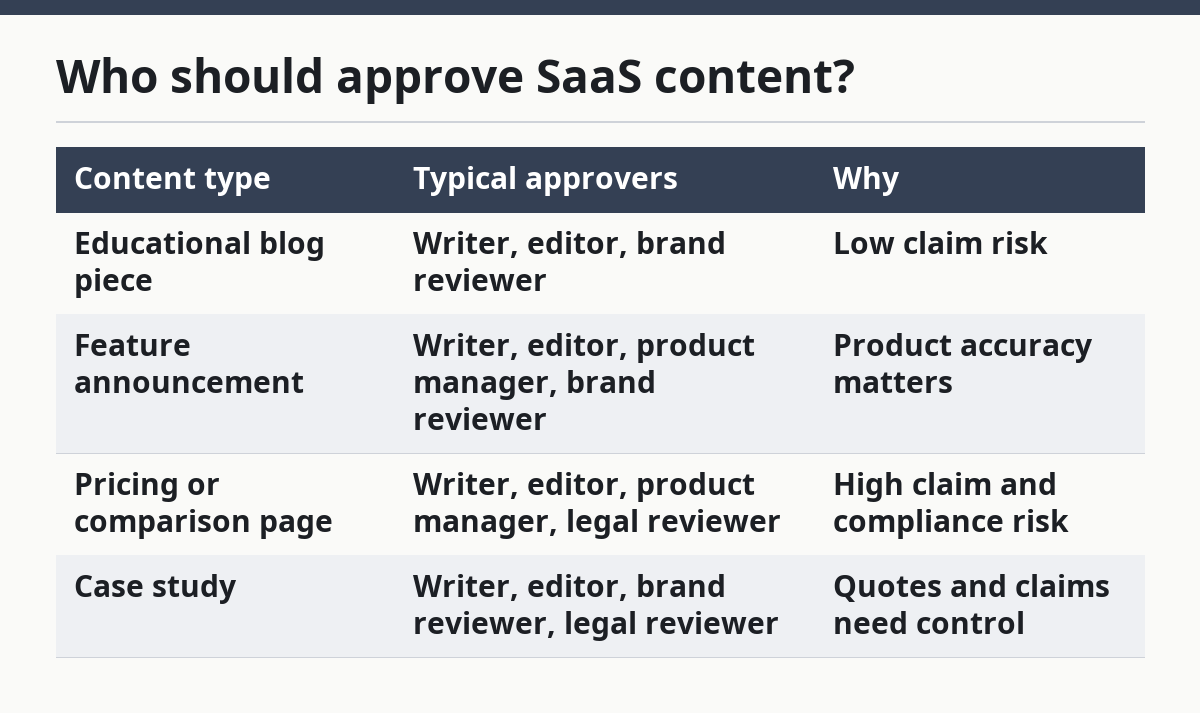
| Content type | Typical approvers | Why |
|---|---|---|
| Educational blog piece | Writer, editor, brand reviewer | Low claim risk |
| Feature announcement | Writer, editor, product manager, brand reviewer | Product accuracy matters |
| Pricing or comparison page | Writer, editor, product manager, legal reviewer | High claim and compliance risk |
| Case study | Writer, editor, brand reviewer, legal reviewer | Quotes and claims need control |
How do you build the matrix step by step?
You build the matrix by assigning each content type to a review path, then defining who has final sign-off and when a piece can move forward. Start with 7 steps and keep the rules visible in one place.
-
List your content types. Group them into 4 to 8 buckets, such as blog piece, product page, landing page, case study, email, and release note. Verify that each bucket has one owner. If a piece can fit two buckets, the matrix is too vague.
-
Map the risk level. Mark each content type as low, medium, or high risk based on claims, legal language, pricing, customer data, or regulated terms. Verify that the level matches the real stakes. If everything is marked high risk, nothing is.
-
Assign one primary approver per function. Use one writer owner, one editor owner, one product reviewer, one legal reviewer, and one brand reviewer. Verify that each role has a backup. If two people can approve the same thing at the same time, delays will follow.
-
Set the review order. Use a fixed sequence such as writer draft → editor review → product or legal review → brand review → final approval. Verify that the order reduces duplicate edits; for legal-sensitive work, confirm the sequence with a qualified professional and a review source such as the FTC Endorsement Guides. If legal sees a draft before the product facts are set, expect rework.
-
Define the sign-off rule. Say whether approval means “no further edits needed,” “approved with tracked changes,” or “approved once final screenshots are inserted.” Verify that the language is plain. If the team argues about what “approved” means, the rule is not done.
-
Choose the escalation path. Decide what happens when reviewers disagree or miss the deadline: for example, the content owner breaks the tie within 1 business day. Verify that escalation reaches one named person, and confirm the handoff with a professional if the team handles legal or regulated content. If escalation goes to a group chat, it is not a process.
-
Publish the matrix where people will use it. Put it in the project tool, the content brief, or the operating doc, and date the version. Verify that everyone uses the same copy. If different teams keep different versions, the matrix will fragment fast.
The best part is that this can fit on a single page if it is written clearly.
What should the sign-off rules say?
The sign-off rules should say who can approve, what “approved” means, and when the piece is officially done. A strong rule is short enough to fit in 3 lines and specific enough that nobody has to interpret it on the fly.
A good sign-off rule usually answers these questions:
- Does approval mean no comments, or can small edits still happen?
- Can the editor approve after legal comments are incorporated?
- Does the final approver need to be the same person every time?
- What happens if a reviewer approves but later finds a factual issue?
The cleanest setup is to reserve final approval for one role, often the content owner or editor, after required reviewers have signed off. That avoids the “approved by five people, changed by six” problem.
For legal-sensitive content, the rule should also say that approval covers the reviewed version only. If a headline, screenshot, price, or claim changes after legal sign-off, the piece goes back through review. That is not bureaucracy; it is version control, and a review process should handle it before publication.
If the team publishes across regions, name the jurisdiction in the rule set, or say that the rule varies by jurisdiction. Legal review in the U.S. can differ from review for the UK or EU, so the matrix should reflect the region being published. General information is not legal advice, and a qualified lawyer should be consulted for the content and jurisdiction in question. The UK ICO is one place to check region-specific privacy guidance, and the FTC is another for U.S. advertising rules.
Key Takeaways
- A matrix tells each role when to step in, not just who exists on the team.
- The cleanest setups route low-risk content through fewer eyes and high-risk content through more.
- One named final approver helps keep approval from becoming a group vote; if the setup is sensitive, consult a professional.
- If the content changes after legal or product review, the piece should return to the right gate.
Where does approval usually break?
Approval usually breaks when the matrix is too broad, too vague, or not tied to a deadline. The most common failure is a 48-hour delay that starts because no one knows who owns the last sign-off.
Watch for these trouble spots:
- Too many reviewers on low-risk content. A short blog piece gets trapped in the same path as a pricing page. The result is slower publishing and more comments that do not matter. Use a lighter path for low-risk pieces.
- No backup reviewer. If the only legal reviewer is out, work can stop unless there is a named deputy for that role.
- Mixed authority. One reviewer says yes, another says no, and no one knows which one wins. The fix is a single final approver.
- Late product changes. A feature name changes after review, so the content no longer matches the product. The fix is to require a fresh pass after any material change.
- No deadline for review. Reviewers do the work “when they can,” and the draft sits for days. The fix is to set an SLA, such as 1 or 2 business days per stage.
Here’s the catch: the matrix only works if the team treats it like a routing rule, not a suggestion, so the process should be backed by a clear owner and reviewed as part of the workflow. If people can bypass it whenever they are busy, it becomes decoration.
When should the standard matrix change?
The standard matrix should change when the content has higher legal, product, or brand risk than usual. These are the cases where the normal 3-role path is not enough, or where a special review route is the better fit.
Pricing, discounts, or comparisons: These pieces can create misleading claim risk if the wording is loose — route them through legal and product review before final approval.
Customer quotes or case studies: These can expose consent and accuracy problems — require brand review and check any approved quote text before publication.
Feature claims tied to a roadmap item: These can age fast if the feature changes — add product review and re-check screenshots at the final stage.
Regional publishing: Rules can differ by jurisdiction — use a jurisdiction-specific review path and do not rely on a single global approval step.
Emergency corrections: If a published piece needs a fast fix, the regular matrix may be too slow — use the separate escalation path and log the change after the fix.
When the standard path does not fit, do not stretch it until it breaks. Use a narrower route for low-risk content and a stricter route for content with legal or product exposure. That is simpler than forcing one process to cover every case.
For more context on how content operations fit together, this page sits inside the SaaS content operation systems hub. For workflow details, the editorial workflow page is a useful next step.
How do you keep the matrix from turning into shelfware?
You keep the matrix alive by tying it to real work, reviewing it on a schedule, and removing dead rules. A matrix that is not checked every 90 days usually becomes stale.
Do three things:
- Use it in briefs. The content brief should show the required reviewers before writing starts.
- Audit a small sample. Look at 5 to 10 recent pieces and compare the actual approval path to the matrix.
- Remove duplicate approvals. If editor and brand reviewer always make the same note, clarify the split.
- Update after process changes. New product lines, new jurisdictions, or a new legal team member can change the path.
- Keep one source of truth. One doc, one owner, one version number.
A good matrix saves time because it removes guesses. A bad one adds another document to ignore.
What does a good matrix look like in practice?
A good matrix is short, named, and boring in the best way. It gives each content type a path, gives each role a limit, and gives the final approver clear authority. If a reviewer can scan it in 2 minutes and know what happens next, it is probably working.
The reader should be able to answer three questions from the matrix alone:
- Who reviews this piece?
- In what order do they review it?
- Who has the final say?
That is enough for most SaaS teams to stop the back-and-forth. It is not flashy, and that is the point.
Who should approve SaaS content?
The approvers should match the content’s risk. A low-risk educational piece may need only a writer, editor, and brand reviewer, while a product launch or pricing page often needs product and legal review too. The right answer depends on what the piece claims and where it will be published.
How do you assign approval responsibilities?
You assign approval responsibilities by role, not by whoever is available. The writer drafts, the editor checks structure and clarity, product checks feature facts, legal checks risky claims, and brand checks voice. Put one named owner on each role so approvals do not drift between people.
What is an approval matrix?
An approval matrix is a chart that shows who reviews each type of content, in what order, and who gives final sign-off. It turns an informal process into a clear path. In SaaS, that helps prevent delays when legal, product, and content teams all touch the same draft.
Drafted with AI; not yet reviewed by a person.