






How to Build a SaaS Editorial Brief Template for Angle, Sources, and Deliverables: A SaaS editorial brief template should give a writer the angle, the…
Last updated: November 15, 2026
A SaaS editorial brief template should give a writer the angle, the source rules, and the deliverables in one page, so the first draft starts with judgment instead of guesswork. Use it to reduce rewrite loops without turning the brief into a 10-page handoff doc. It suits teams that publish often and need the same fields every time, but it is not for workflows that still need a full routing system or a draft approval process.
Key takeaways
- A good brief template answers three questions fast: what is the story, what proof does it need, and what must be handed in.
- Keep the brief short enough to scan in under a minute, but specific enough to stop back-and-forth on sources and format.
- Separate angle guidance from source requirements so the writer knows both the point of view and the evidence standard.
- Add audience notes, deadline notes, and deliverables only if they change the draft in a real way.
- Use one template for consistency, then leave room for editor judgment where a subject needs judgment.
What should the template include?
A SaaS editorial brief template should include the minimum fields that keep a draft on brief: title, angle, audience, source list, content outline, deliverables, and deadline notes. That set gives a writer enough context to start without turning the brief into a contract.
The safest way to think about it is in layers. The first layer is the story itself: what the piece is supposed to say. The second layer is proof: which sources, data points, or product signals the writer should use. The third layer is output: what has to be delivered, in what format, and by when.
A useful template usually has 7 fields, not 17. If the brief starts collecting every possible note, the important items get buried under housekeeping. A writer should be able to scan the page in under 1 minute and answer three things: what angle to take, what source standard to meet, and what final package to hand back.
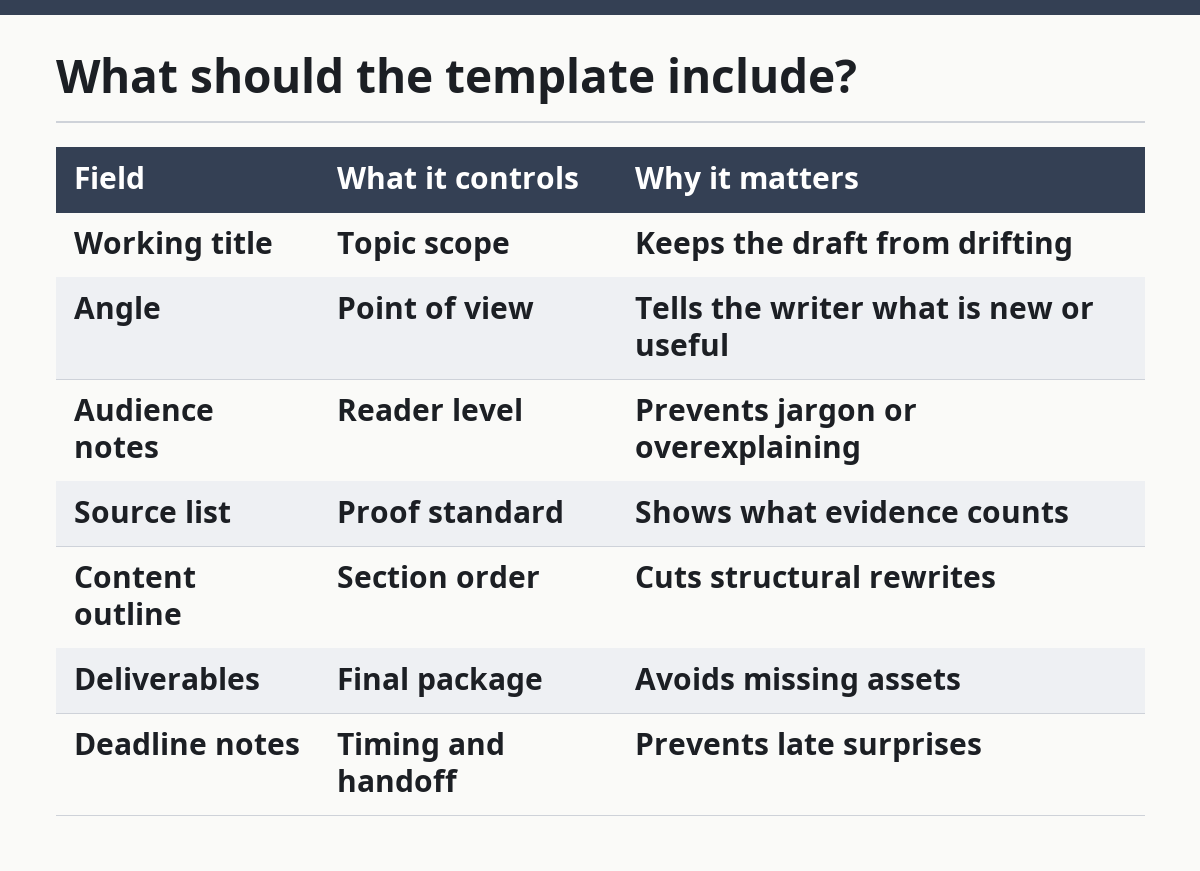
Here is the kind of structure that works:
| Field | What it controls | Why it matters |
|---|---|---|
| Working title | Topic scope | Keeps the draft from drifting |
| Angle | Point of view | Tells the writer what is new or useful |
| Audience notes | Reader level | Prevents jargon or overexplaining |
| Source list | Proof standard | Shows what evidence counts |
| Content outline | Section order | Cuts structural rewrites |
| Deliverables | Final package | Avoids missing assets |
| Deadline notes | Timing and handoff | Prevents late surprises |
The trade-off is simple. The shorter the template, the more judgment the editor must add later. The longer the template, the less likely anyone is to read it twice. For a SaaS content operation, the sweet spot is a brief that stays usable on a phone and still carries enough detail to guide one article without turning into a full workflow map.
How do you write the angle?
You write the angle by naming the reader problem, the promise, and the point of difference in one or two sentences. The angle is not the title, and it is not the keyword. It is the reason this piece should exist now, in this form, for this audience.
A weak angle sounds like a topic: “SaaS customer churn metrics.” A stronger angle sounds like a decision: “How a small SaaS team should choose the one churn metric it can trust before it builds a dashboard.” That second version tells the writer what to argue, what to exclude, and what kind of evidence belongs in the draft.
A good brief template should ask for 3 angle prompts:
- What question is the reader trying to answer?
- What is the useful stance or takeaway?
- What should the draft not become?
That third prompt matters. It keeps a piece from wandering into sibling topics. If the brief says the article is about brief templates for angle, sources, and deliverables, it should not slide into assignment routing or final editorial review. Those are separate pages for a reason.
This is also where the editor’s judgment matters most. Some topics need a hard point of view. Others need a narrower scope and a cleaner map of choices. The template should allow both. If every brief forces the same style of angle, the content will read like a copy of itself. If no brief asks for an angle at all, the draft will usually arrive flat and overgeneral.
A good rule is to make the angle field short and specific enough to fit in 2 sentences. If it takes a paragraph, the editor has not finished the thinking yet.
What sources belong in the brief?
The brief should list the exact source types the writer is expected to use, not just a vague note to “research competitors.” Source rules belong in the brief because they change the shape of the draft and the level of trust in it.
For SaaS content, a source list usually falls into 3 buckets: product signals, public material, and editorial references. Product signals can include release notes, help center pages, pricing pages, changelogs, or public docs. Public material can include customer reviews, comparison pages, or official feature pages from the company being discussed. Editorial references can include style guidance, prior coverage, or approved source standards.
The point is not to pile on sources. The point is to tell the writer what counts. A brief that says “use 2 public sources and 1 internal source” is more useful than one that says “research thoroughly.” A writer can work with that. “Thoroughly” cannot be checked.
The template should also say when a source is required, not just suggested. If the article makes a claim about product behavior, the brief should name the evidence type that supports it. If the piece is more opinion-led, the brief can say the source list is for context only. That difference saves time and cuts rewrites caused by mismatched evidence.
A simple source section can include:
- required sources
- optional sources
- source types to avoid
- note on whether quoting is needed
That last line matters. A draft that needs only factual grounding is different from one that needs quoted lines or direct citations. Keeping the rule in the brief helps the writer choose the right material from the start.
What deliverables do you need?
You need the deliverables section to say exactly what gets handed in, in what shape, and with what extras. This is the part that turns a content brief into an executable job.
Deliverables are often where briefs go vague. A writer may know the article length and the angle, but still not know whether the handoff needs a meta description, a source list, alternate headlines, or a short editor note. If those items matter, they belong in the brief, not in a side message later.
For a SaaS editorial brief template, the deliverables section should name the final package in plain language. For example:
- main draft
- headline options
- source list
- editor notes
- image or chart notes, if needed
That list can stay short. Not every article needs every item. The goal is not to force the same 5 deliverables onto every assignment. The goal is to stop confusion about what “done” means.
This is also the place to note format details that affect production. If a piece needs 2 subheads, say so. If it needs 3 examples, say so. If the writer should deliver a source file in a named doc, say that too. Small format rules save more time than they look like they should.
The trade-off is clear. More deliverables create more control, but they also create more handoff friction. If the editorial team asks for a draft, 3 headlines, and a source list on every assignment, the brief should justify that cost. If not, keep the output lean. A template that asks for too much on every job will eventually be ignored.
How do you keep the brief short but useful?
You keep the brief short by removing anything that does not change the draft. That means no field earns a place just because it feels organized.
A short, useful brief usually works best in 5 moves:
- State the working title and target reader.
- Define the angle in 2 sentences.
- List the source requirements and what counts as evidence.
- Add the content outline with only the sections that matter.
- Name the deliverables and deadline notes.
That procedure keeps the brief moving from strategy to execution without turning it into a checklist dump. The result should be a page that can be read quickly and still guide the draft.
The main mistake is trying to make one template solve every content problem. A brief is not the place for assignment routing, draft approval logic, or topic ownership rules. Those belong in other systems. If the brief starts carrying 12 different jobs, the core fields get weaker, not stronger.
Another mistake is overexplaining the audience. A note like “for SaaS marketers at small teams” is better than a paragraph about every possible reader state. The brief should help the writer choose tone and examples, not recreate a brand strategy deck.
A third mistake is treating the outline as a script. An outline should set the order and the major beats, not police every paragraph. Writers need enough room to make the piece sound human. If the template leaves no room for judgment, the article will read like it was assembled from parts.
The balance is practical: enough structure to prevent rework, enough room to let the writer do the actual writing.
What belongs in the editor notes?
Editor notes belong in the brief when they change how the writer should handle tone, evidence, or scope. They should not be a dumping ground for every thought in the editor’s head.
The best editor notes are small and actionable. A note like “avoid feature hype” is clearer than “keep this grounded.” A note like “use one comparison with a direct alternative” tells the writer what shape the argument should take. A note like “exclude implementation steps” prevents scope creep before it starts.
In a SaaS brief template, editor notes are useful for 3 things:
- tone guardrails
- scope limits
- special source rules
Those notes should be short enough to fit in 4 lines. If they run longer, the brief is probably trying to compensate for a missing editorial conversation. That is a process problem, not a template problem.
This section also helps with consistency across assignments. Two writers can read the same template and still write very different drafts if the editor notes are too loose. On the other hand, if every note repeats the same general advice, the field adds noise instead of clarity. The template should reserve this space for specifics that apply to this story, not boilerplate.
One good test: if a note would make sense on 10 different articles, it probably belongs in the standard editorial guide, not in the brief.
How do you know the template is working?
You know the template is working when the first draft arrives with fewer questions about scope, sources, and format. That is the cleanest signal that the brief is doing its job.
A useful test is simple. After 3 to 5 assignments, look at the revisions and sort them by cause. If most changes are about missing sources, the source field is too weak. If most changes are about the wrong angle, the angle field needs sharper prompts. If most changes are about missing deliverables, the output section is not specific enough.
The template should also reduce repeated clarification messages. If the editor still has to explain the same 2 things every time, the brief is not capturing them. A good template removes predictable questions and leaves only the ones that need judgment.
This is where many generic articles go wrong: they describe the parts of a brief but not the failure modes. A template is only useful if it reduces rewrite loops. If it does not, it is just a prettier form.
A final check is whether the brief still leaves room for reporter judgment. The goal is not to freeze every decision before writing starts. The goal is to make the next decision obvious. A strong SaaS editorial brief template gives enough shape for speed and enough space for the writer to make the piece worth reading.
FAQ
What should be included in an editorial brief?
An editorial brief should include the topic, angle, audience notes, source rules, outline, deliverables, and deadline notes. The exact list can stay short if each field changes the draft in a real way. If a field never changes the writing, it probably does not belong in the template.
How do you brief a SaaS writer?
You brief a SaaS writer by telling them what the article should argue, which sources they must use, and what the final handoff must include. Clear source rules matter because SaaS writing often depends on product details, public signals, and specific claims. A writer can work fast when the brief says what evidence counts and what format the draft should follow.
How detailed should a content brief be?
A content brief should be detailed enough to stop repeat questions, but not so detailed that it becomes a second outline. In practice, that usually means a few sharp fields, not a long policy document. If the brief is longer than the writer will read twice, it is probably too detailed for the job.
Drafted with AI; not yet reviewed by a person.