






How to Build a SaaS Editorial Review Checklist for Factual, Legal, and Brand Checks: a 7-step SaaS Editorial Review Checklist is enough for most teams to…
Last updated: November 15, 2026
Quick Answer: a 7-step SaaS Editorial Review Checklist is enough for most teams to catch factual, legal, and brand issues before publish, and this article shows how to use it. Your SaaS team needs a clear editorial review checklist before anything goes live. The right editorial review checklist should separate factual, legal, and brand checks into named steps, with an owner and a stop point for each one. The sections below settle what to include, who should touch it, and where weak review systems usually fail.
Key Takeaways
- A good checklist is a control system, not a style sheet.
- Split review into three lanes: facts, legal risk, and brand voice.
- Name the reviewer for each lane, the source they verify against, and the sign-off you need.
- Keep the checklist short enough to use on every draft, but strict enough to stop bad claims before publish.
- If the article touches regulated claims, contracts, or jurisdiction-specific rules, a lawyer should review it before publication.
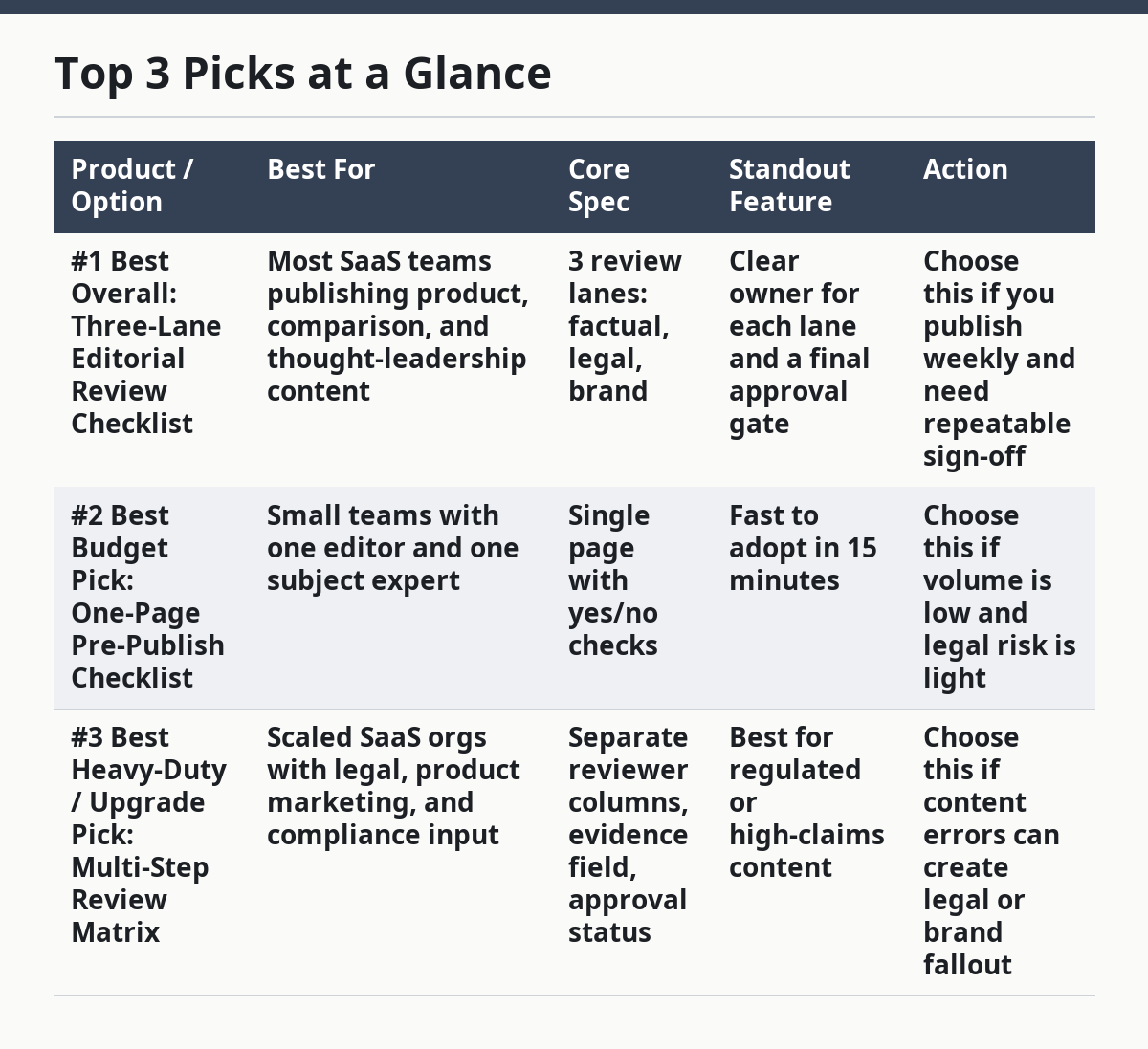
Top 3 Picks at a Glance
Pick the structure that matches how much risk your content carries. The wrong setup is the one that looks tidy but leaves legal review and fact checking in the same box. If you want a related walkthrough, see our content approval workflow, editorial style guide, and fact-checking process.
| Product / Option | Best For | Core Spec | Standout Feature | Action |
|---|---|---|---|---|
| #1 Best Overall: Three-Lane Editorial Review Checklist | Most SaaS teams publishing product, comparison, and thought-leadership content | 3 review lanes: factual, legal, brand | Clear owner for each lane and a final approval gate | Choose this if you publish weekly and need repeatable sign-off |
| #2 Best Budget Pick: One-Page Pre-Publish Checklist | Small teams with one editor and one subject expert | Single page with yes/no checks | Fast to adopt in 15 minutes | Choose this if volume is low and legal risk is light |
| #3 Best Heavy-Duty / Upgrade Pick: Multi-Step Review Matrix | Scaled SaaS orgs with legal, product marketing, and compliance input | Separate reviewer columns, evidence field, approval status | Best for regulated or high-claims content | Choose this if content errors can create legal or brand fallout |
Picture this: you have a draft ready, but the claim about a feature, the comparison chart, and the tone all need different checks. A single “review it” task will miss something. A useful checklist keeps those checks separate. If you are mapping the workflow for the first time, the SaaS content workflow and editorial QA checklist can help you place each review step in order.
Here’s the catch: a long checklist often dies in the real world. If it takes more than 3 minutes to scan, editors start skipping it. That is why a short, specific version tied to a publish gate usually works better.
Who should use this editorial review checklist — and who should skip it?

Picture this: you publish SaaS content that mentions features, integrations, pricing language, customer outcomes, or competitive comparisons. You need a checklist that catches bad facts and risky wording before an article reaches a homepage, newsletter, or sales team. For teams building a broader review system, the content governance checklist is a useful companion.
This approach fits teams with at least 2 people in the review loop, even if one person wears several hats. It assumes you already have a draft, a source list, and a style guide or brand guidelines document. It does not assume a legal department on every article, but it does assume someone can review claims against a source.
Use it if your content can affect buying decisions, vendor trust, or claims about your own product. Skip the light version if you publish in a regulated space, or if your articles mention pricing, security, compliance, uptime, data handling, or legal rights. Those topics need a stricter pass. If you are unsure whether a claim needs escalation, consult a qualified professional and a relevant source before publish.
- Use this checklist if you need repeatable pre-publish checks across 10+ articles a month.
- Use a lighter version if one editor handles all content and the risk is low.
- Skip a DIY-only process if legal review is mandatory in your market.
- Escalate if the article contains statements that could be read as contractual, comparative, or jurisdiction-specific.
The truth is, not every article needs the same depth. A top-of-funnel explainer about “what is SaaS onboarding” can move through a leaner path than a comparison article or one that mentions privacy handling. For a closer look at risk tiers, see how to audit SaaS content.
How do you build the checklist step by step?
Picture this: you want one checklist that a writer, editor, and reviewer can use without argument. The answer is to build it around decisions, not opinions—then attach each step to a source, a reviewer, and a stop rule.
Start with a 7-step structure. Put it in one doc or one ticket template so people stop asking which version is current. If the checklist lives in three places, it will drift. For teams that publish across several channels, a single source of truth for editorial ops can reduce that drift.
- Define the article type. Mark it as explainer, comparison, product-led, or thought leadership. Verify the format before review begins. If the type is wrong, the checks will be wrong too.
- List the factual claims. Pull out every statement that names a feature, date, standard, number, integration, or outcome. Verify each claim against a source note or primary page. If a claim has no source, treat it as a problem and consult a professional or relevant source before publication.
- Check source quality. Require the source name, page title, and date accessed in the fact-checking notes. Prefer primary documentation over a blog summary. If the note says “heard from sales,” that is not verification. For sourcing discipline, the [fact-checking guide](/fact-checking-guide) can help.
- Run a legal pass. Flag comparative claims, testimonials, warranty language, privacy statements, security language, and any claim that could vary by jurisdiction. Verify whether the article needs lawyer review. If the wording could mislead a buyer, stop here. The FTC’s guidance on endorsements and marketing claims is a useful reference point. FTC Endorsements, Influencers, and Reviews
- Run a brand voice pass. Compare the draft to brand guidelines: terms to use, terms to avoid, preferred capitalization, tone, and product naming. Verify that the article sounds like your site, not like a generic affiliate page. If the voice shifts, revise before approval.
- Check internal consistency. Match headline, intro, subheads, and call to action. Verify that the article does not promise one thing and deliver another. If the angle changed in the draft, fix the whole article, not just the intro.
- Record approval. Add a final sign-off field with reviewer name, date, and status: approved, approved with edits, or blocked. Verify that blocked items have an owner and due date. If there is no sign-off, the checklist is decorative.
This structure scales well. A 600-word article and a 2,500-word guide can use the same spine. You only change the number of claims and the number of reviewers. For process design, NIST’s guidance on managing risk can be a helpful frame. NIST Risk Management
What should an editorial review checklist include?

Picture this: you are staring at a draft and asking, “What exactly belongs on the form?” The answer is simple: facts, law, and brand—plus a place to prove each check happened. If you are standardizing the template, the editorial checklist template and brand voice checklist are natural companions.
A strong checklist includes six named fields. First, the article title and URL slug. Second, the claim list. Third, the source list. Fourth, the legal risk flag. Fifth, the brand voice check. Sixth, the final approval status. That is enough for most SaaS content teams.
For factual review, ask whether every statement can be traced to a source note. For legal review, ask whether the wording could create liability in a specific jurisdiction. For brand review, ask whether the tone matches your style guide and brand guidelines. If one field is missing, the reviewer is left guessing.
Use a simple pass/fail logic:
- Pass: claim is supported, wording is clear, reviewer signs off.
- Needs revision: the claim is vague, the source is weak, or the tone drifts.
- Blocked: legal risk, missing source, or unsupported comparison.
That is a better system than a giant comment thread. A comment thread can explain the problem. It cannot prove the problem was resolved. Fact-checking notes can.
On the legal side, rules vary by jurisdiction. A claim that is fine in one country can be a problem in another. This is general information, not legal advice, and a qualified lawyer should be consulted for your matter when the article touches contracts, advertising claims, privacy, or consumer law.
What mistakes do teams actually make?
Picture this: the draft has nice prose, but the review process is sloppy. That usually means the team is checking spelling and skipping the parts that matter most.
The biggest mistake is putting everything in one reviewer’s hands. That reviewer may catch tone issues and miss a factual claim buried in the third subhead. Another common error is using a checklist that says “verify accuracy” without saying how. A vague instruction invites false confidence.
Here are the errors that cause the most damage:
- No source field: reviewers cannot trace claims back to proof.
- No legal flag: risky wording slips through because nobody owns it.
- No brand guide link: the article sounds off-brand in small but visible ways.
- No approval status: people assume someone else signed off.
- One pass for all issues: factual errors and legal problems get mixed together.
The consequence is not just cleanup. It can mean a correction request, a pulled article, a sales rep quoting a bad claim, or a lawyer rewriting a published page after the fact. That is expensive in time and trust.
The fix is boring, and that is the point. Break the review into lanes, assign each lane, and make every reviewer answer the same question: “What did I verify, and where is the proof?” If you need a practical example, the content QA workflow shows how to separate those steps.
Who should approve a SaaS article before publishing?
Picture this: the draft is clean, the sources are solid, and the brand voice is right. Now you need to know who gets the last look before the article goes live.
The answer depends on the article’s risk level. For low-risk educational articles, an editor and one subject expert may be enough. For articles with comparisons, product claims, privacy language, or compliance references, the approval set should usually include the editor, the subject owner, and a legal reviewer when needed.
A practical approval chain looks like this:
- Writer completes the draft and source notes.
- Editor checks structure and evidence.
- Legal reviewer checks risky language when the article touches regulated or sensitive topics.
- Brand reviewer checks voice and naming.
- Final approver records sign-off.
If one person fills multiple roles, that is fine on a small team. What matters is that each role is still performed. A 1-person review process can work for simple articles, but it gets weak fast when the article makes promises about performance, security, or customer outcomes.
One useful rule: if the article would be embarrassing to correct publicly, it deserves at least 2 pairs of eyes before publish. That is not a law. It is a practical threshold.
When should you stop and get qualified help?
Picture this: your checklist finds a problem, but the problem is not just editorial. It involves law, claims, or a market where the rules vary by country. That is the moment to stop the normal workflow and route the article to qualified help.
Use a stricter path in these situations:
- The article makes legal claims: it could affect rights, obligations, or dispute risk — pause and get legal review.
- The copy mentions pricing, discounts, or guarantees: the wording can mislead buyers — tighten the claim or rewrite it.
- The article covers privacy, security, or compliance: small wording errors can create large risk — add specialist review.
- The article compares competitors: comparison language can be challenged — verify every comparison line by line.
- The content targets more than one jurisdiction: rules may differ by country — local review matters before publish.
Those are not edge notes. They are the places where a normal checklist stops being enough. If the article is only about basic product education, the standard process is fine. If the article can be read as advice, a promise, or a legal claim, it needs a different level of review. For more context, the SaaS compliance content guide can help you decide when to escalate.
What does a good result look like?
Picture this: the article goes live without a correction, a retraction, or a backchannel note from sales asking what the copy means. That is what success looks like.
A good editorial review checklist produces the same outcome every time. The factual claims are tied to notes. The legal pass is visible where needed. The brand voice is steady. The approval is recorded. And the reviewer can explain why the article was cleared in under 5 minutes.
If you want a simple test, ask three questions before publish:
- Can I point to the source for every factual claim?
- Did I check the legal risk in the right jurisdiction?
- Does this sound like our brand, not a template?
If the answer to any one of those is no, the checklist still has a hole. Fix the hole before the article ships. That is the whole job of an editorial review checklist: not to make content longer, but to make publish decisions safer, clearer, and easier to repeat.
Drafted with AI; not yet reviewed by a person.