How to Read a SaaS Case Study for Baseline, Intervention, and Outcome Credibility: A credible SaaS case study gives enough context to judge the claim, not…
Last updated: November 16, 2026
Quick Answer: a credible SaaS case study usually gets stronger when it gives you 3 things clearly: the starting point, the intervention, and the measured outcome. In How to Read a SaaS Case Study for Baseline, Intervention, and Outcome Credibility, the first check is whether those 3 pieces are present and specific enough to judge the claim; if they are missing or unclear, consult a qualified professional before treating the result as evidence. If it skips baseline context, hides the intervention details, or turns correlation into causation, treat the headline result as marketing, not evidence.
Key takeaways
- Start with the starting point, not the ending number. A result without a baseline is hard to trust.
- Separate the product change from the business change. One case study can mention both, but it should not blur them.
- Look for the measurement method, the time window, and the specific metric definition. A 30-day lift is not the same as a same-quarter lift.
- Strong case studies name limits, partial wins, or other factors. That is often a better sign than a perfect story.
- If the story relies on one quote and one big number, it is weak evidence, even if the quote sounds sharp.
What makes a SaaS case study credible?

A credible SaaS case study gives enough context to judge the claim, not just the result. In plain terms, it should answer three questions: where did the customer begin, what exactly was done, and how was the change measured over a stated period such as 30 days, 90 days, or a quarter. For a fuller background on evaluating evidence quality, see the guide to reading SaaS proof points and the breakdown of customer story structure.
A useful way to test a case study is to separate case studies, metrics, customer story language, before-and-after claims, and testimonial quotes. A testimonial can support a story, but it does not prove the claim by itself. A metric can look strong and still be thin if the baseline is missing or the time window is vague.
A useful standard here is the reporting logic used in research. The CONSORT statement and the STROBE statement are not SaaS documents, but they point to the same discipline: report the context, method, and outcome clearly enough that a reader can judge the evidence. A case study does not need to be a trial, but it should borrow that habit of disclosure.
A weak case study often reads like this: “The team improved pipeline efficiency after adopting the platform.” That line has a result, but no baseline, no method, and no way to tell whether the software caused the change. A strong one says what the team used before, what they switched, what changed in the process, and what metric moved over a stated interval.
This is not the right page if you want to compare case studies for industry fit or use case fit. It is for the narrower job of checking whether the evidence itself holds together.
How do I check the baseline first?
You check the baseline first by asking what the customer’s starting point was before the SaaS product entered the picture. The baseline is the anchor for every later claim, and without it a before-and-after story can sound more impressive than it is.
Use this 4-step read:
- Find the starting metric. Look for the first number, not the best number. If the case study says conversion moved from 2% to 4%, the 2% is the baseline that matters.
- Look for the time frame before change. A baseline over 1 week is weaker than one over 3 months because short periods are easier to skew.
- Check whether the baseline is absolute or relative. “Reduced churn” is vague; “reduced monthly churn from 6% to 4%” is concrete.
- See whether the baseline is broad enough to matter. One team member, one campaign, or one channel is narrower than a company-wide number. Narrow baselines can still be useful, but they should not be sold as company-level proof.
The most common missing piece is the denominator. A case study may say “qualified leads doubled,” but if the starting number was 4 and the ending number was 8, the absolute change is small even if the percentage sounds large. That does not make the story false, but it changes how much weight the reader should give it.
Baseline context also includes what was happening before the tool. If the customer had just hired 5 sales reps, changed pricing, or launched a new campaign, the baseline is already in motion. A good case study makes that visible. A weak one hides it and leaves the product looking like the sole cause.
If the baseline is absent, the safe judgment is simple: the story may be interesting, but it is not strong evidence.
What counts as a real intervention?
A real intervention is the specific change the customer made, not just the brand name of the software. A SaaS case study is more credible when it explains which product features, workflow changes, or implementation steps were involved, because “used the platform” tells you almost nothing.
This is where many stories blur the line between software and outcome. A team may have added automation, changed the approval path, cleaned up data entry, and retrained staff in the same month. If the case study treats all of that as one neat software win, the causal claim gets weaker, and readers may want to consult a qualified professional before relying on it.
Look for details such as:
- Which module or function was used
- Whether the change replaced a manual process
- Whether the team switched from one tool to another
- Whether the rollout was partial or company-wide
- Whether the implementation took days, weeks, or months
The phrase “intervention” sounds technical, but the test is simple: can you describe the change in one sentence without saying “the customer improved operations”? If not, the intervention is too vague to trust.
A case study gets stronger when it names the trade-off against the obvious alternative. For example, if the old process was a spreadsheet and the new one was a workflow tool, the reader should know whether the gain came from automation, visibility, or fewer handoffs. That distinction matters because each one has a different reason to improve. A product that reduces manual entry is not proving the same thing as a product that improves forecasting.
This is also where a generic story often hides the hardest question: did the customer actually do anything differently, or did the metric improve for other reasons? If the intervention is just a logo and a quote, the evidence is weak. If it names the workflow change and the rollout scope, the reader can at least judge plausibility.
Which outcome claims are worth trusting?
Outcome claims are worth trusting when the metric is clear, the measurement period is stated, and the result is tied to the same thing the baseline measured. A 90-day gain in one metric tells you more than a vague claim of “better performance” across several goals.
A good outcome section answers four things at once: what improved, by how much, over what time, and according to which measurement method. If the case study says “cut support response time,” the reader should see whether that means first response, full resolution, or average handle time. Those are not the same metric.
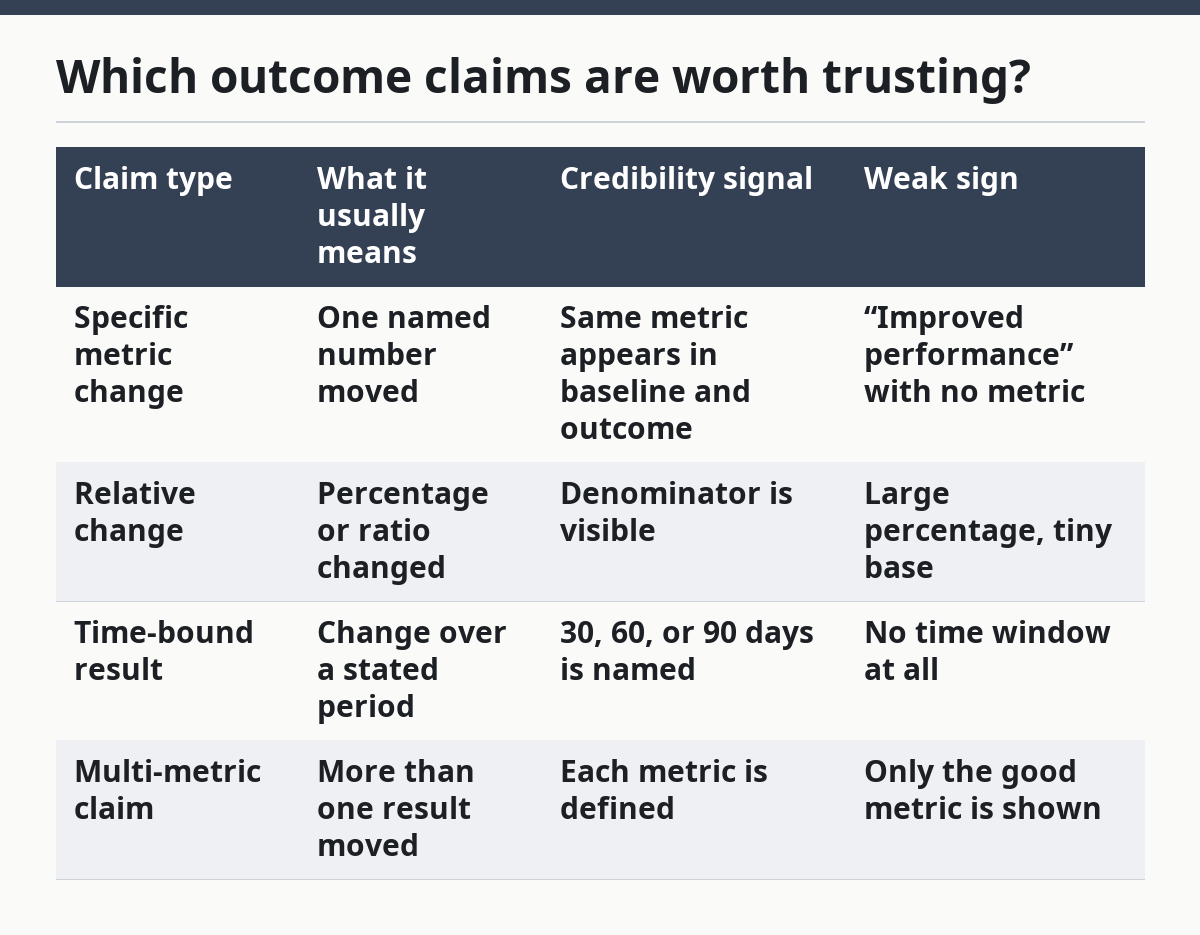
Use this comparison to sort the claim:
| Claim type | What it usually means | Credibility signal | Weak sign |
|---|---|---|---|
| Specific metric change | One named number moved | Same metric appears in baseline and outcome | “Improved performance” with no metric |
| Relative change | Percentage or ratio changed | Denominator is visible | Large percentage, tiny base |
| Time-bound result | Change over a stated period | 30, 60, or 90 days is named | No time window at all |
| Multi-metric claim | More than one result moved | Each metric is defined | Only the good metric is shown |
Outcome claims are also more believable when they include a cost or limit. If a product improved one process but added setup time, training overhead, or reporting work, a frank case study may mention that. Honest friction is a credibility signal because real operations almost never improve in a straight line.
Be wary of claims that use only a testimonial quote to stand in for evidence. A quote can tell you the customer liked the change. It cannot tell you whether the result was measured well. A sentence like “We saw huge gains” is not a substitute for the number and the method behind it.
How do I judge whether the outcome is actually attributable?
You judge attribution by asking whether the SaaS product is the most likely reason for the result, or only one factor among several. The stronger the causal language, the more evidence the case study needs to support it.
A reader should look for three markers of real causality, although they are best treated as general checks rather than proof on their own:
- Temporal order: the product came first, then the metric moved
- Mechanism: the case study explains why the product would affect that metric
- Competing causes: the case study names other changes that could have driven the result
If a customer saw a 20% lift after a platform rollout, that still does not prove the software caused the lift. The lift could also come from seasonality, a price change, a new team, a campaign push, or a process cleanup. A credible case study does not need to eliminate every other cause, but it should show that it thought about them.
This is where causal language matters. Phrases like “helped,” “supported,” or “was part of” are softer than “caused,” and that softness is often appropriate. Hard causal claims need stronger backing than soft ones. If the case study uses “drove” or “delivered” in the headline, the body should earn that verb.
The cleanest evidence uses a before-and-after structure with a clear mechanism and a limited scope. For example, a single team, a single workflow, and a single metric over 2 quarters gives the reader more to work with than a whole-company success story with no method. The narrower claim is often the more believable one.
Because of that, a generic article would stop here and say “look for proof.” That is too vague. The better question is: does the story make a plausible causal chain from intervention to measured outcome, or does it just place a software logo next to a happy number?
What red flags should make me slow down?
You should slow down when the case study has a strong headline and weak supporting detail. The most common red flags are missing baseline data, vague intervention language, and outcome numbers with no time frame or measurement method.
Here are the patterns that should trigger caution:
- A result appears without the starting number
- The product is named, but the workflow change is not
- The metric changes, but the definition is unclear
- The quote is vivid, but the evidence is thin
- The story uses absolute language like “transformed” without showing the mechanism
One red flag is not fatal. Five in one page is a problem. The more the story depends on clean marketing copy, the less you should trust it as evidence.
Also watch for a polished before-and-after story that skips the messy middle. Real implementations often have setup time, training, partial rollout, and a lag before results show up. A case study that jumps from “we adopted the tool” to “we saw the outcome” in two lines may be simplifying away the part that matters.
The right response is not to dismiss every case study. It is to treat them as evidence of varying strength. A weak case study may still point to a real customer benefit. It just should not be used as if it were a controlled comparison or a verified benchmark.
What is the fastest way to read one well?
The fastest way is to read the case study in the order of baseline, intervention, outcome, then attribution, because that sequence tells you whether the claim stands on its own. If you reverse the order and start with the headline result, it is easier to miss the gaps.
A quick 60-second check works like this:
- Find the baseline number or condition. If it is missing, mark the story down at once.
- Name the intervention in one sentence. If you cannot, the case study is too vague.
- Look for the outcome metric and the time window. A 30-day result is not the same as a 12-month result.
- Ask what else could have changed. If the case study does not address other causes, weaken the claim.
- Judge the language. “Helped” is easier to believe than “proved,” unless the evidence is unusually strong.
This order matters because it forces the evidence to earn trust from the ground up. The headline may still be useful, but the body has to carry the claim. That is the right way to read a SaaS case study if the goal is credibility, not cheerleading.
The hardest part is staying with the facts that are actually on the page. If the case study does not say how the metric was measured, assume the method is unknown, not brilliant. If it does not name the baseline, assume the comparison is weak. That discipline keeps a polished customer story from masquerading as reliable proof.
What makes a SaaS case study credible?
A SaaS case study is credible when it shows the starting point, the exact change made, and the way the outcome was measured. The more specific the baseline and the more visible the method, the more trust it earns. A shiny quote without those pieces is a story, not strong evidence.
How do you spot missing baseline data in a case study?
You spot missing baseline data by checking whether the story gives the original metric, the original condition, or the original time frame. If you only see the result, such as “doubled pipeline” or “cut churn,” the baseline is incomplete. Without that starting point, the size of the change is hard to judge.
How do you judge whether the outcome is actually attributable?
You judge attribution by asking whether the case study shows a plausible chain from product use to measured change. Look for timing, mechanism, and competing causes such as seasonality, pricing changes, or staffing shifts. If those are absent, the outcome may still be real, but the claim that the software caused it is weak.
Drafted with AI; not yet reviewed by a person.