



SaaS customer evidence and outcome proof — The Complete Guide: SaaS customer evidence and outcome proof is the system a buyer can trust when a sales page…
Last updated: November 16, 2026
SaaS customer evidence and outcome proof is the system a buyer can trust when a sales page sounds nice but does not prove results. It combines quotes, case studies, product signals, and outcome data so a prospect can see what changed, for whom, and under what conditions.
Key takeaways
- Customer evidence is not just testimonials; it is the full set of proof points that shows a product works in a real setting.
- Outcome proof gets stronger when the story includes a baseline, a change, a time frame, and the method used to measure the change.
- The best proof is specific about the customer type, the use case, and the limit of the result.
- Weak proof often fails because it uses vague praise, no before/after data, or claims that cannot be checked.
- A proof system works best when sales, marketing, product, and support use the same evidence library.
What is SaaS customer evidence?
SaaS customer evidence is the set of public signals and customer-backed materials that show a software product creates a real result. That usually includes reviews, case studies, quotes, user stories, usage screenshots, comparison pages, analyst mentions, and support proof such as implementation notes or workflow examples.
The phrase matters because a single testimonial is weak on its own. A quote can sound polished and still tell the buyer almost nothing about setup time, team size, data source, or the before state. Evidence becomes useful when a reader can answer three questions in one pass: who used it, what changed, and how that change was measured.
For SaaS product intelligence from public signals, this also means looking beyond the marketing site. A buyer may see review patterns, job posts, release notes, help docs, app marketplace listings, community posts, and customer logos. Each one adds a small piece. Together, they form a picture that is much harder to fake than a single landing page claim.
The strongest evidence usually does 4 jobs at once. It proves the product exists in the market, shows the customer uses it for a real task, records a measurable change, and hints at the conditions that made the result possible. If one of those parts is missing, the proof is thinner than it looks.
Why does outcome proof matter?
Outcome proof matters because buyers do not want features alone; they want a believable path from software to result. A list of functions can sound impressive and still fail to answer the real question: “What changes if I adopt this?”
That question is sharper in SaaS because the buying risk is not only price. There is also setup time, switching cost, team adoption, data quality, and the chance that the product solves the wrong problem. Proof lowers that risk by making the result concrete. It shows the reader what happened after the tool was in place, not just what the vendor promised on day one.
Outcome proof also helps separate broad fit from narrow fit. A product may work well for a 20-person team but struggle in a 2,000-person roll-out. It may be strong for outbound sales but weak for finance workflows. Good proof tells the buyer where the product fits and where it does not.
This is where many generic SaaS pages go wrong. They treat proof as decoration: a logo row, a short quote, a vague “saved time” line, and maybe a case study buried in the footer. That is not enough for a buyer who needs to justify a purchase internally. A stronger proof set gives the buyer language, numbers, and context they can repeat in a meeting.
If the proof is credible, it also reduces friction later in the funnel. Sales calls are shorter, procurement questions are cleaner, and marketing claims are easier to defend. A weak proof system creates the opposite: more skepticism, more discount requests, and more time spent explaining what should have been obvious.
What counts as real customer evidence?
Real customer evidence is proof that a skeptical buyer can inspect, compare, and repeat back in plain language. It is not just praise. It is evidence that names the customer type, the setting, the change, and the source of the claim.
The most useful forms are simple to recognize:
| Evidence type | What it proves | Strength | Common weakness |
|---|---|---|---|
| Case study | A customer outcome in context | High | Too polished, too generic |
| Customer quote | Human validation | Medium | No numbers, no baseline |
| Review platform entry | Broad market feedback | Medium | Short, inconsistent detail |
| Product screenshot | Real workflow proof | Medium | Can be staged if not explained |
| Usage metric | Adoption or activity proof | High | Says nothing about business value alone |
| Third-party mention | External validation | Medium | Often lacks detail |
| Comparison page | Positioning proof | Low to medium | Can become self-serving fast |
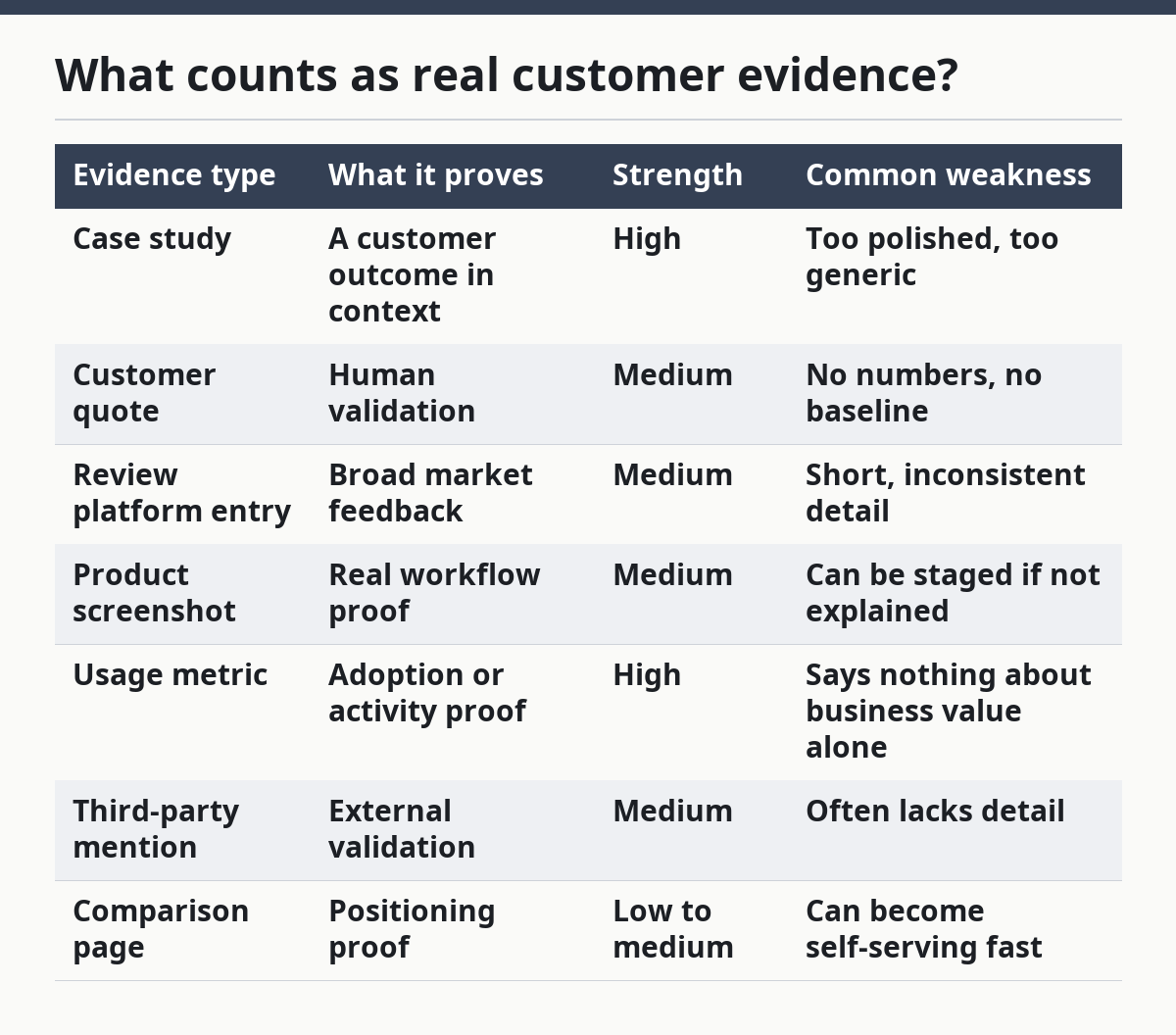
A few details make evidence stronger. First, it should name the job to be done, not only the product category. “Lead routing” is clearer than “sales efficiency.” Second, it should identify the baseline. A reader needs to know what the team was doing before the software entered the process. Third, it should show the time frame, because a 2-week improvement and a 6-month improvement are not the same claim.
The best evidence is also selective about what it does not promise. A quote that says the tool improved one workflow is more believable than a claim that it solved everything. Buyers are used to exaggerated software copy. Narrow proof often feels stronger because it sounds harder to fake.
There is one useful standard here: evidence should be specific enough that another buyer in the same category could judge whether the case resembles their own. If the language is so broad that any SaaS product could wear it, it is not customer evidence. It is packaging.
How do you build outcome proof from scratch?
You build outcome proof from scratch by starting with a measurable change, then working backward to the evidence needed to support it. The mistake many teams make is starting with the asset type first, such as “we need a case study,” and only then asking what the proof should say.
A better sequence is 5 steps:
- Pick one business outcome.
- Define the baseline.
- Choose the evidence sources.
- Record the timeline.
- Write the claim in a form a buyer can check.
The outcome should be narrow. “Better retention” is too broad for most proof assets. “Faster onboarding for new support hires” is better because it names the work, the audience, and the likely place to measure change. Once the outcome is clear, the baseline can be defined with the same precision. That may be a manual spreadsheet, a long approval chain, a low activation rate, or a slow handoff between teams.
The evidence sources should match the claim. If the claim is about adoption, product usage logs may be the right source. If the claim is about trust or satisfaction, a review, survey, or interview may matter more. If the claim is about revenue influence, the proof must connect to pipeline or expansion data, not just clicks.
Timeline matters because it tells the buyer how long to expect before value shows up. A workflow fix that takes 3 days is not the same as a system change that takes 3 months. Even without exact numbers, the proof should make the pace visible. That helps the reader judge feasibility.
The final claim should stay close to the source. If the record shows faster approvals, do not turn that into a sweeping “transformed the business” line. That kind of inflation breaks trust. It is better to say less and be believed than say more and sound made up.
What evidence types work best at each stage?
Different evidence types work best at different buying stages because the question changes as the reader moves from curiosity to evaluation to approval. Early readers need orientation. Later readers need detail they can defend in a meeting.
At the top of the funnel, short proof works best. A quote, logo, product screenshot, or a one-paragraph customer note can show that the product exists in the market and solves a real job. At this stage, the buyer is still asking, “Is this relevant to me?” Long documents can be too much too soon.
In the middle of the funnel, proof needs structure. Case studies, side-by-side comparisons, workflow examples, and implementation notes become more useful because the buyer is now comparing options. They want to know what changed, what the setup looked like, and what kind of team achieved the result. If the product has multiple use cases, this is also the stage where you match the proof to the right use case.
At the bottom of the funnel, proof needs to help with internal approval. That means cleaner claims, clearer sourcing, and enough detail to support procurement, legal, or finance questions. The best bottom-funnel proof often includes a baseline, a method, and a note on limits. A buyer does not need a glossy story here; the buyer needs material that survives scrutiny.
Here is the trade-off against the obvious alternative. Short proof is easier to consume, but it is weaker in a hard sale. Deep proof is more persuasive, but it is slower to create and harder to maintain. A strong SaaS team usually needs both. If all you have is short proof, the funnel may leak later. If all you have is deep proof, the top of the funnel may never engage.
What makes proof believable to skeptical buyers?
Proof becomes believable when it is specific, bounded, and sourced in a way a buyer can understand without guessing. Skeptical readers are not looking for perfect language. They are looking for signs that the claim survived contact with reality.
The first sign is a named context. A proof line that says “for enterprise support teams using Zendesk” is more credible than “for teams everywhere.” The second sign is a before state. Buyers want to know what the old process looked like, even if it was messy. The third sign is a measurable change that does not overreach. If the proof uses a number, that number should belong to a source in the same sentence or be softened to a plain statement of change.
The fourth sign is a human limit. A believable case often mentions the constraint that shaped the result: data quality, team size, rollout delay, or limited scope. This is one of the most missed parts of SaaS proof. A case study that admits where the result was narrow often wins more trust than one that sounds polished end to end.
The fifth sign is consistency across sources. If the website says one thing, the review sites say another, and the release notes tell a different story, the buyer notices. That does not mean every source must say the same sentence. It means the same basic claim should hold up across places where the company cannot fully control the wording.
This is also where public signals matter. A proof stack built from a single marketing asset is easy to question. A proof stack built from product docs, customer language, reviews, and observed usage patterns is harder to dismiss. The reader sees the same shape from multiple angles.
What are the biggest mistakes in SaaS proof?
The biggest mistakes in SaaS proof are vagueness, cherry-picking, and pretending that a quote is the same thing as evidence. These errors are common because they are easy to publish and hard to challenge at a glance.
Vagueness is the first problem. Words like “improved,” “streamlined,” and “saved time” do not tell the buyer enough on their own. Without the metric, the baseline, or the setting, those words collapse into noise. A claim that could fit 50 products helps none of them.
Cherry-picking is the second problem. One strong customer story can be useful, but it can also mislead if it is presented as typical when it is not. If the result came from a rare combination of team size, data cleanliness, or internal expertise, the proof should say so. A buyer who discovers the exception later will trust the vendor less than if the limit had been stated upfront.
The third problem is treating marketing polish as proof. A clean design does not make a claim true. A sharp quote does not show causation. A logo row does not prove outcomes. These assets have a place, but they need to sit inside a larger evidence system.
There is also a quiet failure that hurts many SaaS teams: stale proof. A case study from 2 years ago may still matter, but only if the product and market have not moved far past it. If the workflow changed, the numbers changed, or the positioning changed, the proof can start to feel off. Evidence needs maintenance, not one-time publication.
A final mistake is ignoring the buyer’s internal audience. The champion may care about usability, but finance may care about cost, and security may care about control. Proof that only persuades the first contact often stalls before signature. Good evidence helps more than one person in the buying group.
How should you measure success from public signals?
You should measure success from public signals by tracking whether the evidence changes what a buyer can infer, not just whether the asset exists. A proof asset is successful if it makes the product easier to understand, easier to trust, and easier to compare.
For a public-signals model, that usually means watching 4 areas. First, look at whether the claim is repeated accurately across channels. Second, look at whether the customer type and use case are clear enough to match to target accounts. Third, look at whether the proof includes a time frame and a before/after shape. Fourth, look at whether the evidence is fresh enough to match current product reality.
A simple internal review can use a 1-to-5 score for each asset against these questions, though the exact scale matters less than the habit. Does the asset name the customer context? Does it state the change? Does it show a source? Does it reveal the limit? Does it fit the current product? That kind of review is more useful than counting pretty assets in a content library.
The trade-off here is speed versus certainty. Fast publishing gives you more proof assets, but the risk of weak claims goes up. Slow publishing gives you cleaner evidence, but the library may grow too slowly to support sales. Most teams need a middle path: publish only the proof that can stand up to a buyer’s follow-up question, then refresh the rest on a set schedule.
Because this page is about SaaS product intelligence from public signals, the real job is not only to collect proof but to interpret it. A single customer story can hint at product maturity, customer type, or implementation complexity. A cluster of stories can show where the product is strongest. A gap in proof can be just as informative as a proud case study.
How do you use customer evidence in sales, marketing, and product?
You use customer evidence in sales, marketing, and product by giving each team the same source material and a different job to do with it. Sales uses it to answer objections. Marketing uses it to shape market perception. Product uses it to learn where outcomes are real and where they are still thin.
Sales needs proof that is short, current, and easy to quote in a call or email. That usually means 1-sentence claims, customer names where allowed, and a few concrete use cases. Marketing needs the fuller story: the setup, the change, the timing, and the conditions. Product needs the rawest version possible because it is looking for patterns, not slogans.
This is one of the reasons proof libraries break down. Teams keep evidence in separate places and format it differently each time. The result is duplicated work and inconsistent claims. A stronger system stores the source once and repurposes it with discipline. The case study may become a quote card, a sales snippet, a webinar slide, and a homepage block, but the factual core stays the same.
There is also a strategic use for proof inside product decisions. If a certain workflow appears in 4 customer stories and 2 review themes, that is a signal. If one segment praises a feature while another segment barely mentions it, that is a signal too. Customer evidence should not only sell the product; it should help decide what to build, what to document, and what to stop overpromising.
The limitation is that evidence is not a substitute for product-market fit. It can make the fit easier to see and easier to communicate, but it cannot invent a result that the product does not reliably deliver. If the proof library has to do too much work, the product or the positioning may be the real problem.
What should a strong proof library contain?
A strong proof library should contain 6 things: a baseline, a result, a time frame, a customer type, a source, and a limit. Without those pieces, the library may still look full, but it will not answer buyer questions well.
The baseline tells you what changed from. The result tells you what changed to. The time frame tells you how fast it happened. The customer type tells you who the story fits. The source tells you where the claim came from. The limit tells you where the story should not be stretched.
If a library has these 6 parts, it becomes useful far beyond the homepage. It can support ads, sales decks, product pages, investor updates, support training, and analyst briefings. It also becomes easier to update, because each entry has a structure instead of a free-form write-up that nobody wants to touch again.
This structure helps with compliance too. Many SaaS teams need to stay careful about endorsements, review usage, and implied performance claims. The FTC Endorsement Guides are a useful reference for this area: https://www.ftc.gov/business-guidance/resources/ftcs-endorsement-guides. Google Search Central also explains review-related structured data rules and spam policy in its documentation: https://developers.google.com/search/docs/appearance/structured-data/review-snippet. Those two references do not solve every marketing decision, but they are a good check against sloppy claim handling.
A proof library is not just a folder of nice stories. It is a record system for claims. The more clearly each claim is sourced and bounded, the more useful it becomes to a skeptical reader.
FAQ
What is the difference between a testimonial and customer evidence?
A testimonial is one voice saying the product helped. Customer evidence is the larger set of proof behind that voice, including the customer context, the workflow, the result, and the source of the claim. A testimonial can be part of evidence, but it is rarely enough on its own.
What kind of proof works best for SaaS buyers?
The best proof is the kind that matches the buyer’s stage and question. Early buyers usually respond to short quotes and screenshots, while later-stage buyers need case studies, baselines, and clear time frames. If the buying committee is larger, the proof needs to hold up under internal review, not just initial interest.
How much data should a case study include?
A case study should include enough data to show a real before and after, but not so much that the reader loses the thread. In practice, that means a clear baseline, one or two outcome measures, and the time frame that connects them. If the claim cannot be explained simply, it is probably too vague or too broad.
Can public signals really prove SaaS outcomes?
Public signals can strongly suggest outcomes, but they do not prove every claim in a lab sense. They work best when several signals point in the same direction: reviews, product docs, customer quotes, usage patterns, and third-party mentions. The more independent the signals, the more credible the picture becomes.
What should I avoid when building proof assets?
Avoid vague claims, inflated language, and numbers that do not have a source. Avoid using one strong story as if it represents every customer. Avoid hiding the baseline or the time frame, because that makes the result hard to trust and hard to compare.
Drafted with AI; not yet reviewed by a person.