





A SaaS audience and positioning system works best when it is built around 4 decision areas and reviewed monthly or quarterly. A SaaS audience and…
Last updated: November 15, 2026
Quick answer: a SaaS audience and positioning system works best when it is built around 4 decision areas and reviewed monthly or quarterly. A SaaS audience and positioning systems — The Complete Guide is a repeatable way to decide who the product is for, what job it solves, and how to say that in a way buyers believe. It is not a slogan. It is a working method that ties customer evidence, product facts, and market language into one living set of decisions.
Key takeaways
- A positioning system is better than a one-off messaging doc when the product, market, or buyer changes more than once a quarter.
- The work has 3 parts: define the audience, prove the problem, and turn that into words sales, marketing, and product can all use.
- If the audience is too broad, the positioning gets weak; if the audience is too narrow, growth can stall.
- A good system keeps a record of what was learned, what was rejected, and why the current message exists.
- Static positioning fails most often because no one owns updates after the first launch.
What is a SaaS audience and positioning system?
A SaaS audience and positioning system is a set of rules, inputs, and outputs that keeps audience choice and market position from turning into guesswork. In plain terms, it answers three questions: who is this for, what pain matters most, and why is this product the better fit right now?
The phrase “system” matters. A positioning statement alone can live in a deck and die there. A system keeps the work connected to research notes, customer calls, trial objections, win-loss comments, sales decks, homepage copy, and release notes, so the message does not drift every time a new campaign starts.
This is especially useful in SaaS because the product changes, the buyer changes, and the category language changes. A product that starts with small teams may later sell to operations leads, then to finance, then to enterprise admins. If the audience definition stays frozen, the copy starts lying.
A good system usually contains 4 parts: audience segments, problem hierarchy, category choice, and proof points. It also needs a rule for what not to say. Without that, every team writes its own version of the truth.
The easiest way to think about it is this: audience tells you who cares; positioning tells you why you win; the system tells you how to keep both true over time.
Why a static positioning doc breaks
A static positioning doc breaks because it cannot keep up with 3 moving parts: buyer behavior, product scope, and market language. A one-time brief may work for a launch, but SaaS rarely stays still for long.
The most common failure is overbreadth. A company says the product is for “modern teams” or “growing businesses,” which sounds inclusive but tells nobody what problem is being solved. The result is a homepage that attracts traffic and repels qualified buyers. No one sees themselves in it, so no one feels urgency.
The second failure is message drift. Sales starts using one story, marketing uses another, and product uses a third. That creates a weak market memory. Prospects hear different answers in every channel, which makes trust harder to earn and easier to lose.
The third failure is false certainty. Teams often pick an audience because it sounds strategic, not because the evidence supports it. That leads to positioning that is neat on paper and brittle in the field. When objections show up, the team has no shared method for deciding whether the issue is the audience, the proof, or the wording.
A system helps because it creates update points. A useful cadence is simple: review the audience after new segments appear, after major product changes, and after repeated objections show up in calls. Even a 60-minute monthly review is better than a yearly rewrite.
What should go into the system?
A strong system should hold the minimum facts that make messaging defensible. That usually means 6 building blocks: segment, trigger, job-to-be-done, pain, proof, and disqualifier.
The segment is the group of buyers or users the product is meant to serve. The trigger is what pushes them to look for a solution now. The job-to-be-done is the outcome they want, not the feature they ask for. The pain is the cost of not solving it. The proof is what makes the promise believable. The disqualifier is the condition where the product should not be sold as the answer.
That last piece is often skipped, but it matters. If the product is weak for low-volume users, say so. If implementation takes a heavy admin lift, say so. If the buyer needs a regulated workflow and the product does not support it, say so. Honest limits sharpen the message because they stop the team from sounding like every other vendor.
The system also needs named owners. If no one owns audience definition, the document turns stale. If no one owns proof points, testimonials and case notes vanish into folders. A system with no owner is just a file.
A practical setup is one page for decisions and one page for evidence. The decision page holds the current audience, message, and proof. The evidence page holds the calls, notes, objections, and rejected hypotheses that got the team there. That split keeps the final message clean without hiding the work behind it.
How do you choose the right audience?
You choose the right audience by checking who feels the pain most, who can act fastest, and who can buy with the least resistance. The best audience is not always the largest one, especially if the smaller one can move sooner.
Start with 3 filters. First, look for repeated pain. If the same problem appears across calls, support tickets, and sales objections, it is probably real enough to build around. Second, check urgency. An audience that feels the pain but has no deadline will not move as fast as one with a monthly or quarterly target. Third, check access. If the buyer can approve the tool without long procurement, that audience is often easier to grow first, though legal, finance, or procurement review may still change the path in practice.
This is where many SaaS teams get trapped. They chase the biggest market and ignore the most reachable one. That often leads to vague positioning because the product is trying to speak to 5 different buyers at once. The message gets flatter, not stronger.
A useful test is to ask: if the product disappeared tomorrow, which audience would complain first and most loudly? That group is not always the final market, but it is often the clearest starting point.
There is a trade-off here. Narrow audience choice can improve conversion and clarity, but it can also cap early reach. Broad audience choice can create more top-of-funnel volume, but it usually forces the message toward generic language. The right choice depends on whether the company needs focus, speed, or expansion in the next 2 quarters.
Which positioning inputs matter most?
The most important positioning inputs are customer language, category context, product proof, and competitive contrast. If one of those is missing, the message gets fuzzy.
Customer language comes first because buyers trust the words they already use. A good system collects exact phrases from calls, demos, tickets, and reviews. The goal is not to copy every quote. The goal is to find the words that repeat when people describe the problem, the failed workaround, or the desired outcome.
Category context comes next. A product can be framed as a replacement, an alternative, or a new category entry. That choice changes the burden of proof. A replacement needs to show better execution. An alternative needs to explain why the old category misses the point. A new category needs more teaching and more patience.
Proof points turn claims into something a buyer can believe. That proof may come from workflow fit, time saved, lower setup burden, stronger controls, or a more precise use case. The proof does not need to be flashy. It needs to connect directly to the pain the segment already feels.
Competitive contrast is the final piece. Positioning gets sharper when it says what the product is not for. That does not mean naming every rival. It means being clear about the kind of solution the product should replace and the kind it should not.
A common mistake is to start with features. Features matter, but they are not the first draft of positioning. Features are evidence. Audience and pain come first; features explain why the promise is real.
The honest side-by-side
The honest side-by-side is this: a static messaging doc is faster to write, but a living system is better for any SaaS company that expects the product or market to change. The doc wins for speed; the system wins for durability.
| Criteria | Static positioning doc | Living audience and positioning system | Winner for this condition |
|---|---|---|---|
| Speed to create | Faster in 1 sitting | Slower at first | Doc, when the team needs a launch asset quickly |
| Update ability | Weak once the market shifts | Built for revision | System, when product scope changes often |
| Cross-team use | Easy to share, easy to ignore | Harder to build, easier to reuse | System, when sales and marketing both need the same story |
| Evidence tracking | Usually light or absent | Keeps research and objections linked | System, when buyer insight matters |
| Message consistency | Good at first, then drifts | Better over time | System, when multiple people write copy |
| Ease of ownership | Simple if one person owns it | Better with named owners and cadence | Doc, if the company is very small |
| Fit for new segments | Weak unless rewritten | Stronger because rules are reusable | System, when expansion is likely |
| Risk of stale language | High | Lower | System, when releases happen every quarter |
| Proof of what not to say | Often missing | Explicitly recorded | System, when differentiation is hard |
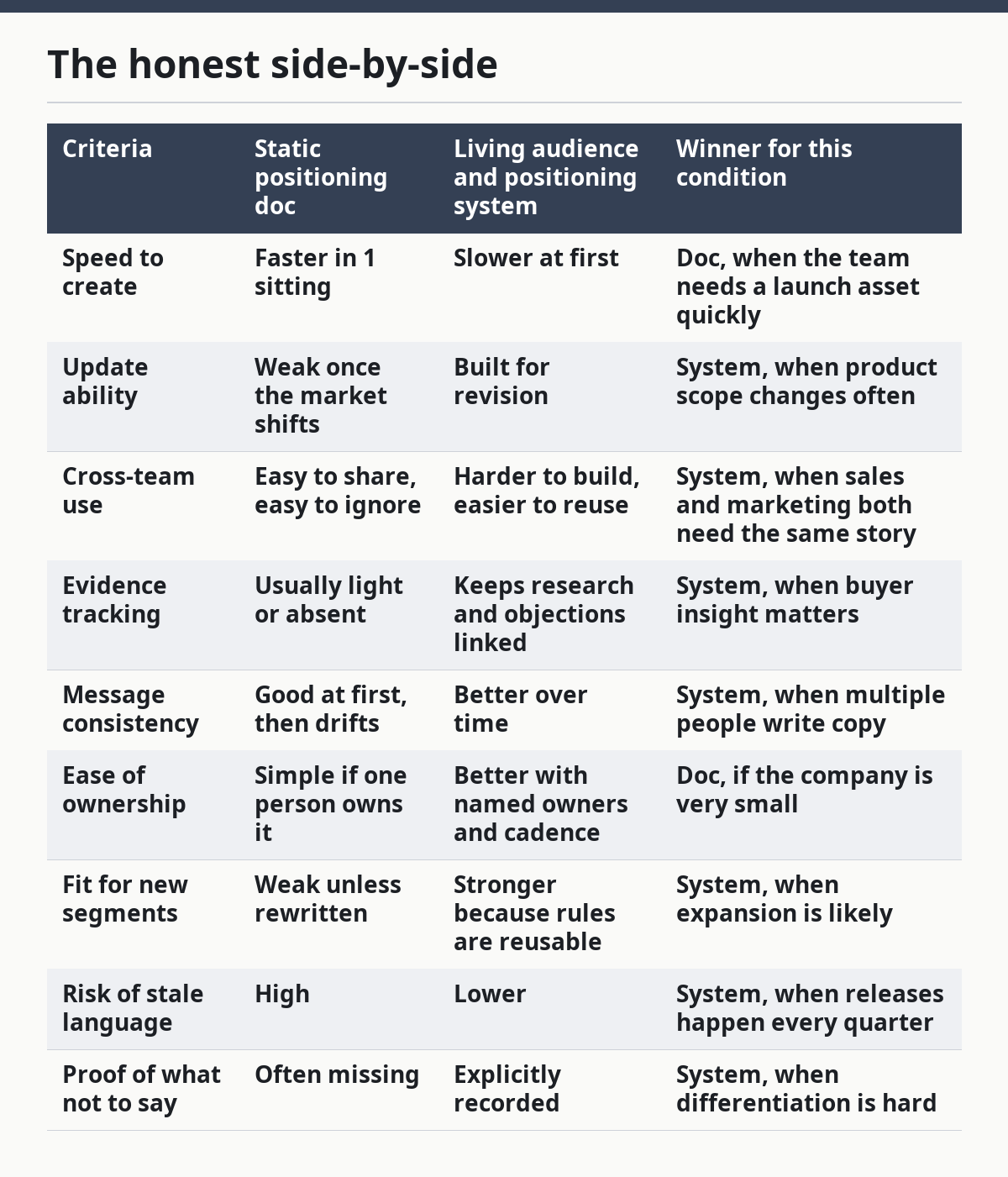
The table shows the real trade-off. A doc is a snapshot. A system is a process. If the company is pre-product-market fit, a snapshot may be enough for a short period. If the company is already selling, changing, and hiring, the system pays off because it keeps the market story from splitting into fragments.
How do you build one step by step?
You build one by moving from evidence to decisions in 5 steps. Each step should be documented, even if the document is short.
First, gather the raw material. Pull notes from sales calls, support tickets, demo questions, churn reasons, and win-loss comments. The goal is not volume for its own sake. The goal is enough signal to spot repeated patterns.
Second, sort the audience into 2 or 3 meaningful segments. Avoid endless slicing. If the segments cannot change the message, they are probably not separate enough to matter. A system should simplify choices, not multiply them.
Third, choose the primary segment and define the trigger, pain, and desired outcome in plain language. This is where many teams add jargon and lose clarity. Use the words the buyer would use in a call, not the words that sound best in a deck.
Fourth, write the positioning hypothesis. This is the current best answer to the question: why this product for this audience now? A strong hypothesis includes the category choice, the main pain, and the proof point that makes the claim believable.
Fifth, test it against real work. That means homepage copy, outbound messaging, demo script, and product update notes. If the same message works across those places, the system is doing its job. If each channel needs a different story, the audience or the claim is still too loose.
A useful rule is to keep one page for the current decision and one page for the evidence trail. That makes the system small enough to use and big enough to trust.
What does good evidence look like?
Good evidence is specific, repeated, and tied to behavior, not just opinion. A single strong quote is useful. Three repeated patterns are better.
The best evidence usually shows up in 4 forms. First, exact buyer language that repeats across calls. Second, behavioral evidence such as the same objection, workaround, or use case appearing again and again. Third, proof from outcomes that matter to the buyer, even if the result is qualitative rather than numeric. Fourth, negative evidence, which tells you who does not fit.
A generic article often treats testimonials as proof enough, but that is too weak for a positioning decision. Praise is not the same as positioning evidence. A buyer saying “this is great” tells you little unless the same person also explains what problem it solved, what they had tried before, and why the old approach failed. For research on using real user language and evidence, see the Nielsen Norman Group and the Christensen Institute on Jobs to Be Done.
Evidence also needs a date trail. A positioning system should show what the team believed before a change and what changed after new information arrived. That makes future decisions easier because the team can see the logic, not just the final sentence.
Two authoritative references are useful here for framing, even if the team’s own evidence should carry the most weight: the Nielsen Norman Group’s work on personas and user research, and the Jobs to Be Done material associated with the Christensen Institute. Both point in the same direction: decisions get better when they are tied to real user behavior, not internal preference.
What are the common mistakes?
The most common mistake is trying to please too many audiences at once. That usually leads to soft claims, vague headlines, and proof that never feels specific. The result is a positioning system that sounds broad but converts weakly.
The second mistake is treating positioning as a copy task. Copy is the output. Positioning is the decision behind the output. If the decision is wrong, better wording only makes the wrong message louder.
The third mistake is copying competitor language too closely. That can make the company sound familiar, but it also makes it forgettable. If every vendor says the same thing, the buyer has no reason to remember one over another.
The fourth mistake is leaving out the disqualifier. If the product is not ideal for a certain company size, workflow, or buying process, that should be written down. Without that boundary, the team wastes time chasing bad-fit leads and loses time on better-fit ones.
The fifth mistake is no review cadence. A system needs a check-in rhythm, even if it is only monthly or quarterly. Without a review point, the audience definition slowly drifts away from the market that actually buys.
When should the choice flip?
The choice flips in 4 situations. In each one, the “system” answer may be too heavy, and a simpler document can be the better move.
If the company is in a 30-day launch sprint, a short positioning memo can be enough. The team needs speed, not architecture. In that case, write the best current message and plan the deeper system after launch.
If the product is extremely stable and the buyer is simple, a lighter process may be enough. A narrow SaaS tool with one clear buyer and one clear use case does not need a complex framework. The risk of overbuilding is real.
If the team is tiny and one person owns sales, marketing, and product, the system can become process overhead. A 2-page decision record may work better than a larger operating model. Clarity matters more than structure at that stage.
If the market is already crowded and the company keeps changing segments, a system becomes more valuable, not less. In that case, the flip goes the other way: the product needs a repeatable way to decide what it stands for, because every new campaign creates a new risk of drift.
The real question is not “system or no system?” It is “how much structure does the current stage justify?” The answer changes with team size, market speed, and how often the message must be revised.
Which option should you choose?
Choose the living audience and positioning system if the SaaS product will change, the market will change, or more than one team will use the message. Choose the static positioning doc if the company needs a short-term launch asset or the offer is narrow and stable. Neither if the team has no real buyer evidence yet, because no amount of writing can fix an audience guess.
That is the clean recommendation. The system is the better long-term choice for most SaaS companies because it prevents drift and keeps evidence attached to the message. The doc is only the better choice when time is tight or the business is too small for a full process.
The wrong move is trying to do both at once without deciding. A half-system becomes a cluttered folder. A half-doc becomes a message that nobody owns.
FAQ
What is the difference between audience and positioning?
Audience is the group of people the product is for. Positioning is the reason that group should choose this product instead of another option. A company can know its audience and still have weak positioning if the message does not explain why the product fits better.
How often should a positioning system be updated?
It should be reviewed after major product changes, after repeated sales objections, and on a regular cadence such as monthly or quarterly. The right rhythm depends on how fast the product and market move. A fast-changing SaaS category needs more frequent review than a stable niche.
Can one SaaS product have more than one audience?
Yes, but only if the product can support each audience with a clear message and proof set. If the audiences require different pains, different buying triggers, or different category language, they may need separate positioning tracks. If not, the message will get muddy.
What is the biggest sign that positioning is wrong?
The biggest sign is that the same product gets described in different ways by sales, marketing, and product. Another warning sign is when prospects say the product sounds useful but not urgent. That often means the audience is too broad or the pain is not sharp enough.
Do small SaaS teams need a formal system?
Yes, but it can be simple. A small team may only need one current decision page, one evidence page, and a monthly review. The point is not bureaucracy. The point is to stop the message from changing every time a new campaign starts.
Drafted with AI; not yet reviewed by a person.
