



How to Build a SaaS Proof Source Map for Customers, Partners, and Third-Party References: A SaaS proof source map for customers, partners, and third-party…
Last updated: November 17, 2026
A SaaS proof source map for customers, partners, and third-party references is a simple inventory of where your SaaS evidence comes from, who owns it, and which claims each source can support. Build this proof source map when customer quotes, partner mentions, review site mentions, analyst notes, and case studies are scattered across sales, marketing, and customer success, and you need one place to see what is usable, approved, and stale.
Key takeaways
- A proof source map sorts evidence by where it came from before you judge how strong it is.
- Customer references, partner references, and third-party proof need different owners and different approval paths.
- The map is not a content library; it is a control layer that tells you what can be used and what still needs checking.
- If a source cannot be traced to a person, publication, or file, it is not ready for sales or marketing use.
- A small proof source map is often easier to maintain in a spreadsheet, while still being clear enough that a rep can trust it in under 2 minutes.
What is a proof source map?
A proof source map is a source register for SaaS evidence, grouped by origin so you can see what came from customers, partners, or third parties. That matters because a customer quote, a partner mention, a review site snippet, an analyst note, and a case study do not carry the same weight or the same risk.
The map is not the same thing as a proof library. A library stores the assets themselves; the map tells you where each asset came from, who approved it, and what it can be used to support. If a case study came from one customer in March 2024 and a review site mention came from a public page last week, those sources should sit in different buckets even if they support the same product claim.
This structure is useful for SaaS product intelligence from public signals because the signal quality changes fast. A partner reference may help with channel trust, while a review site entry may help with market perception, and an analyst note may help with category positioning. A proof source map keeps those roles separate so teams do not treat all proof as equal, and teams should still use legal, compliance, or other professional review where needed.
The trade-off is simple. A source map is slower to set up than a loose folder of quotes, but it saves time every time someone asks, “Can I use this claim?” It is not for teams that only need one or two static testimonials.
What should you map first?
Map the sources that you use most often in customer-facing work first: customer references, partner references, third-party proof, and case studies. Then add source categories for analyst notes, review site mentions, webinar quotes, and press mentions if those sources affect your sales motion.
Use one row per source, not one row per claim, at the start. A single case study can support several claims, but it still has one origin, one owner, and one approval path. That is the cleaner unit because a source can be reused, while a claim can drift from the evidence that supports it.
Start with these fields in a sheet or database:
- source type
- source name
- origin
- owner
- date captured
- approval status
- allowed use
- expiry or review date
- supporting claim
- link or file path
That set is enough to make the map useful without turning it into a legal archive. If you add too many fields on day one, people stop updating it after a week. If you keep it to the minimum, you can expand later by category rather than by random habit.
Do not group everything under “social proof.” That label hides the real difference between first-party proof, like a customer quote, and third-party proof, like a review site or analyst note. The map should show origin first, then credibility, then permission.
How do you organize customer evidence sources?
You organize customer evidence sources by consent, context, and recency, not by how flattering the quote sounds. A customer quote from a named customer is different from an anonymous comment in a case study, and both are different from a support email that was never approved for external use.
Use a simple source map row for each customer source and record three things right away: who said it, where it appeared, and what it can support. A case study can support product fit, implementation ease, or business outcome claims, but only if the wording matches the approved source. If the wording changes, the approval needs to be checked again.
A useful customer-source section usually includes:
- Customer quote — record the exact speaker name, title, and setting. A quote from a webinar is not the same as a quote from a published page.
- Case study — record the customer, the problem, the product area, and the publication date.
- Reference call — record who can be contacted, what the rep may ask about, and whether the reference is active.
- Logo use — record whether the logo can appear in a deck, on a site, or only in a closed environment.
The main mistake here is mixing permission with proof. A customer may allow logo use but not a named quote, or allow a quote but not a public case study. If the map does not show that split, reps will assume more is allowed than really is. That can create a last-minute scramble when a deal team wants to use material that was never approved for public use.
A second mistake is keeping stale customer sources alive. A case study from 2022 can still be useful, but it should not sit in the same active bucket as a recent quote unless the map flags the age. Old proof is not useless; it just needs a visible date so people know when it should be reviewed.
How do partner and third-party proof fit in the same map?
Partner proof and third-party proof belong in the same map, but they need separate source labels because they answer different buyer questions. A partner mention tells a buyer that another vendor or channel player trusts the product; a review site entry tells a buyer how the market talks about it; an analyst note tells a buyer how the category is framed.
Use one column for source origin and another for source type. That sounds small, but it keeps “partner mention” from being treated like “review site” or “analyst note.” The distinction matters when a rep wants to use the source in a deck, and teams should still check with a legal or compliance professional when the source will support an external claim.
Here is the practical split:
| Source type | What it shows | Common risk | Best use |
|---|---|---|---|
| Partner mention | Ecosystem trust | Sales bias | Co-sell decks, joint pages |
| Review site | Public sentiment | Selective quoting | Competitive pages, sales enablement |
| Analyst note | Category context | Overreading a brief note | Market framing, board updates |
| Case study | Customer outcome | One-customer bias | Landing pages, sales proof |
| Customer quote | Direct voice | Out-of-date wording | Ads, slides, website proof |
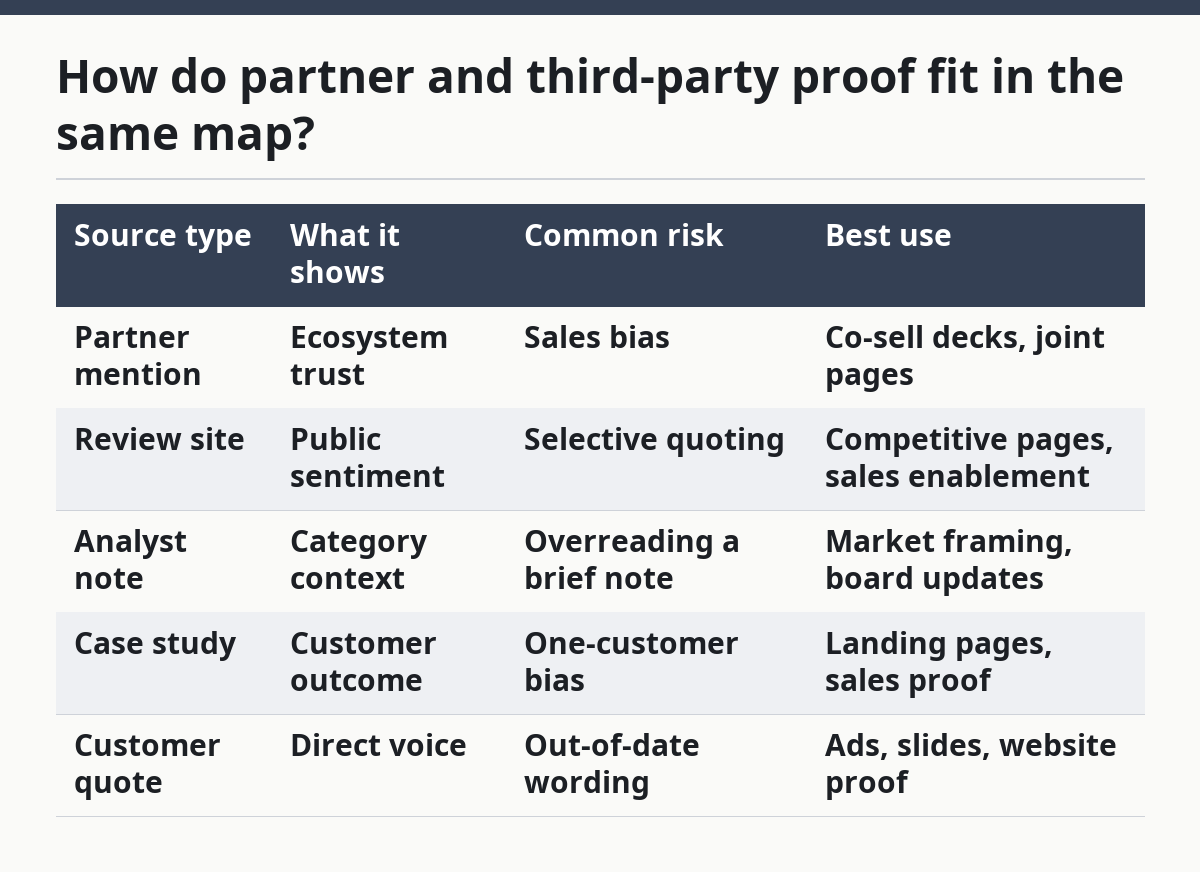
The honest trade-off is that third-party proof is often more persuasive to some buyers, but it is also less controllable. A review site can change. An analyst note may be behind a paywall or written in broad language. A partner mention can sound strong in a slide and weak in the source file if the wording is thin. The map should show those limits so no one confuses “public” with “strong.”
Use the map to mark whether the source is direct, indirect, or derived. Direct means the person or publication said it themselves. Indirect means your team summarized it. Derived means the team turned it into a claim. That last step is where people usually lose track of what was actually said.
How do you judge credibility without overcomplicating the map?
You judge credibility by origin, specificity, and permission, not by trying to assign a perfect score. A source map works best when it uses simple labels such as high, medium, and low confidence, or approved, review needed, and blocked.
If you want a plain rule, use this order:
- First-party proof: customer quote, case study, reference call, internal note approved for use.
- Partner proof: joint mention, integration page, channel quote, co-marketing asset.
- Third-party proof: review site, analyst note, press mention, community post.
That order does not mean first-party proof is always better. It means it is easier to trace and control. Third-party proof can be stronger for trust, but weaker for precision. A review site may carry more weight with some buyers, yet it may not match the exact claim your team wants to make.
A good map also records freshness. A source from 2021 may still be valid, but if your product changed in 2024, the map should not make old proof look current. Put a review date on every active source, even if the date is only every 12 months. That gives the team a reason to check whether the source still reflects the product.
Do not turn credibility into a math exercise unless your team already has a scoring model. A complex formula often hides the one thing the map must answer: can this source be used now, and by whom? If the answer is not obvious in 15 seconds, the map is too complicated.
For teams that want a source-checking reference, the FTC’s endorsement guidance is useful background on disclosure and claims control: FTC Endorsement Guides. For public review context, a review platform like G2 is a natural example of third-party proof: G2 Reviews. Those are not substitutes for your own approval rules, but they help anchor the categories.
What does the build process look like in practice?
The build process is to create one source inventory, label each item by origin, and assign an owner before you try to use the proof in sales or marketing. The fastest version is a spreadsheet with one row per source and a short controlled list of source types.
- Create a sheet in Excel or Google Sheets and add columns for source type, source name, origin, owner, date, status, and allowed use.
- Collect existing items from customer success, sales, marketing, and partnerships, then enter only one source per row.
- Label each row as customer quote, partner mention, review site, analyst note, or case study so the origin is visible at a glance.
- Assign one owner per row so someone can answer permission and freshness questions quickly.
- Mark the use rights for each source, such as public, internal only, or sales-only, so nobody has to guess.
- Review the oldest active rows first, starting with anything older than 12 months, and flag what needs renewal or removal.
- Share the map with revenue teams in read-only form so they can find sources without editing the record.
A spreadsheet is fine for the first pass because it is simple, visible, and easy to maintain. A more complex tool is only worth it if your team already updates source records often and needs automation. If the team cannot keep a sheet current, a database will not fix the process.
The key habit is to update the source map before you distribute a proof asset. That one step prevents the common mess where a slide deck says one thing, the source record says another, and nobody knows which version is safe to use.
What goes wrong when teams skip the map?
Teams skip the map and end up with proof that looks strong but cannot be traced, reused, or defended. That usually shows up in three ways: old quotes keep getting reused, partner mentions are treated like customer proof, and third-party references get copied without checking the source.
The cost is not abstract. Sales loses time hunting for the right asset, marketing uses a source outside its permission, and customer success gets asked to reapprove something that should have been tracked months earlier. A case study can be excellent proof, but if nobody knows where it came from or whether the customer still approves it, the asset becomes risky the moment it is pulled into a new deck.
Another failure mode is source drift. A rep shortens a customer quote, a marketer pulls a line from an analyst note, or someone screenshots a review site entry without noting the publication date. The map should make those shortcuts harder, not easier.
This is also where honest limits matter. A proof source map is not the right tool if the only goal is to collect testimonials for a launch page. It is for teams that need a durable record of where proof came from and what it can support over time. If the team does not share proof across sales, marketing, and partnerships, the map may be more process than payoff.
FAQ
What counts as a proof source in SaaS?
A proof source in SaaS is any traceable item that can support a product claim or trust signal. That includes a customer quote, a case study, a partner mention, a review site entry, or an analyst note. If the item has an origin and can be checked back to that origin, it belongs in the map.
How do you organize customer evidence sources?
You organize customer evidence sources by who said it, where it appeared, what it can support, and whether it is still approved. A named customer quote, a case study, and a reference call should not sit in the same bucket unless the map clearly shows the permission for each one. Date and owner matter as much as the quote itself.
How do you separate first-party and third-party proof?
You separate first-party and third-party proof by origin, not by how persuasive it feels. First-party proof comes from your customer or your team with customer approval, while third-party proof comes from outside sources such as review sites or analyst notes. The map should label both, because they carry different levels of control and credibility.
Drafted with AI; not yet reviewed by a person.