





How to Build a SaaS Launch Signal Escalation Path for Conflicts, Missing Evidence, and Late Updates: A launch signal escalation path is the rule set that…
Last updated: November 18, 2026
A launch signal escalation path is the rule set that hands uncertain SaaS launch signals to the right human fast, before product managers, marketing leads, support leads, legal reviewers, and release owners act on the wrong read. Build it around three triggers—conflict, missing evidence, and late updates—and force one owner, one checkpoint, and one deadline for each.
Key takeaways
- A good escalation path does not list every signal; it tells people when to stop guessing and hand the case off.
- Conflict, missing evidence, and late updates need different owners, even if they all start from the same launch note.
- A simple 3-level routing model is easier to run than a long approval chain.
- The fastest path is the one with one decision maker at each checkpoint, not a group chat full of opinions.
- This setup is for uncertain launch signals, not for collecting every source or building a full audit log.
How do you build a launch signal escalation path?
Build it by defining 3 trigger types, naming 1 owner for each, and writing the handoff rules before the next launch cycle starts. The path should be short enough that someone can use it in under 5 minutes and clear enough that no one has to guess who answers next.
-
Use a routing sheet to label the signal type first. Mark each case as conflict, missing evidence, or late update before anyone tries to resolve it. That first label stops product managers from chasing evidence when the real issue is a contradiction, and it stops legal reviewers from being pulled into a timing problem.
-
Use an owner map to assign one release owner per case. Give the release owner the job of routing, not solving every issue. A marketing lead can own message timing, a support lead can own customer impact, and a legal reviewer can own approval risk.
-
Use a decision checkpoint to set the next action. Write one checkpoint for the first human review and one for final approval. NIST SP 800-61r2 is a useful model here because it treats triage, escalation, and handoff as separate steps, not one blended decision. See the guide at NIST SP 800-61r2.
-
Use a time box to stop open-ended waiting. Set a short deadline for the first response, then a second deadline for the final call. A 1-day delay may be acceptable for low-risk copy, while a launch page with customer promises should move faster.
-
Use a status note to close the loop. Record the decision, the owner, and the next checkpoint in plain language. That note should be short enough to fit into one screen so the next person does not need a second channel to understand it.
A simple path works better than a long chain because launch work gets messy fast. A 4-person approval queue looks tidy on paper and slows everything down in practice.
What counts as a conflict, missing evidence, or late update?
These are three different problems, and the escalation path should treat them that way. A conflict means two public signals disagree; missing evidence means a claim has no support; a late update means the signal arrived after the team needed it.
| Signal type | What it means | Who owns the first look | What happens next |
|---|---|---|---|
| Conflict | Two launch signals say different things | Release owner | Send to product managers or marketing leads for the first read |
| Missing evidence | The claim exists, but the support is thin or absent | Support lead or legal reviewer, depending on risk | Request source material before approval |
| Late update | The change arrived after the launch checkpoint | Release owner | Re-open the decision or push it to the next checkpoint |
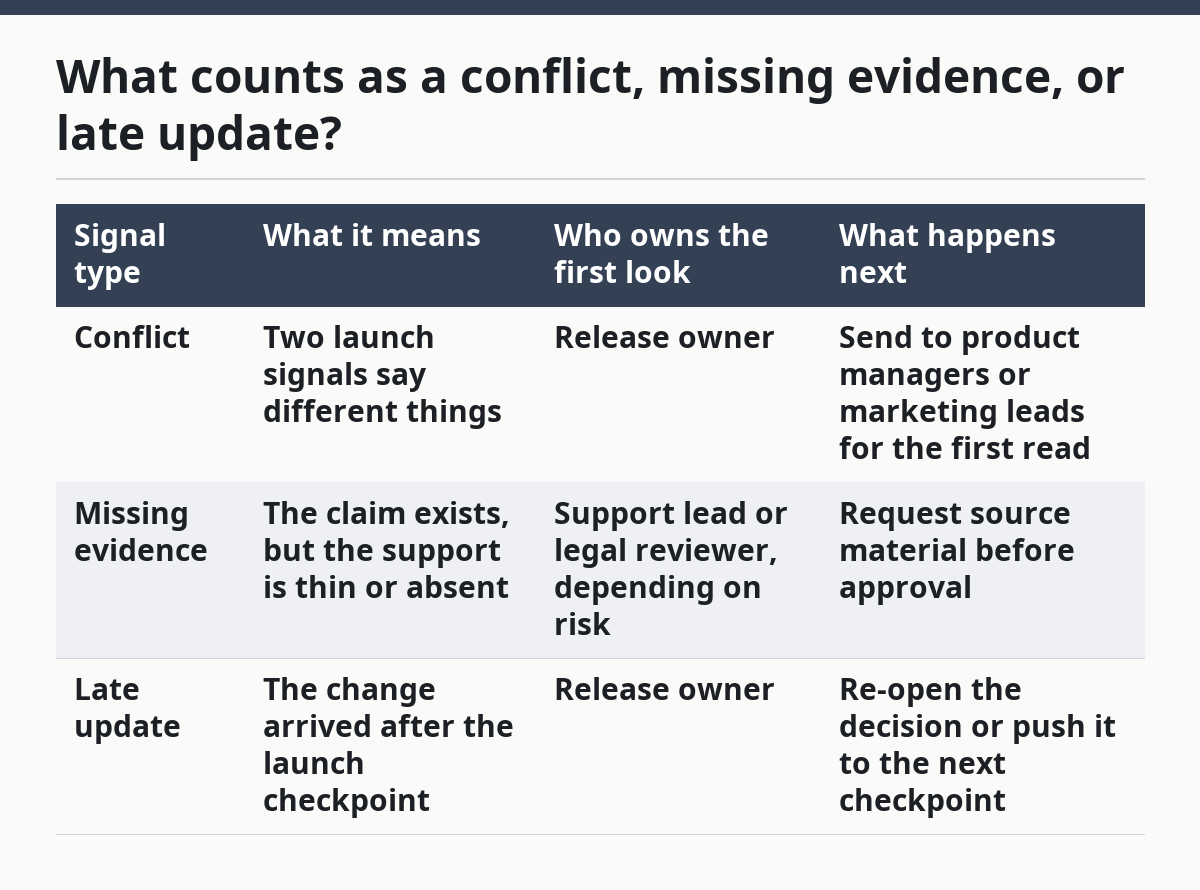
This split matters because each case burns time in a different place. A conflict wastes review time if it stays in one queue for 24 hours; missing evidence wastes trust if people guess; late updates waste launch slots if the team keeps waiting for a cleaner moment.
The honest trade-off is speed versus certainty. If the path moves too fast, weak signals slip through. If it waits for perfect proof, the launch window closes and the team still has no decision. ISO 31000 is a useful reference point for that balance because it treats risk treatment as a choice about timing and control, not just a yes or no. See ISO 31000.
A generic article often says “escalate when unsure.” That sounds useful and solves nothing. The better rule is simple: escalate when the case changes owner, changes risk, or changes timing. That gives product managers, marketing leads, support leads, legal reviewers, and release owners the same trigger language, even if their next step differs.
Who should own each step?
The release owner should own the route, while subject specialists should own the call. That split keeps the process from becoming a single overloaded inbox, and it keeps one person from acting as judge, witness, and clerk on the same launch.
Use this 3-part ownership model:
- Release owner: routes the case, logs the checkpoint, and decides when the issue leaves the queue.
- Product managers: resolve product meaning, launch scope, and message fit.
- Marketing leads: resolve copy, timing, channel order, and public wording.
- Support leads: resolve customer risk, ticket impact, and internal response needs.
- Legal reviewers: resolve wording risk, claims risk, and approval blocks.
The common mistake is giving every team equal veto power. That sounds fair, but it creates a 5-way stalemate the moment two people disagree. The path should give each team a clear lane and a clear limit.
Use one rule to keep ownership clean: the person who can answer the question with the fewest handoffs should own the first response. For example, a late update about a release note should go to the release owner first, not legal. A claim about product behavior that affects messaging should go to the marketing lead or product manager before it reaches legal review.
This model is not for teams that want committee-style control. If every launch decision already needs 4 signatures, this path will feel too narrow. That is a real drawback, but it is also the point: launch signal escalation works best when it reduces the number of people who have to speak before action can happen.
How do you handle conflict without slowing the launch?
Handle conflict by forcing a single comparison point, then asking one owner to decide within a fixed window, often 1 review cycle. The goal is not to collect more opinions; it is to decide which signal should drive the next action.
Start with a 2-column view: claim A and claim B. Put the source, the date, and the owner next to each one, then ask which claim matters for this launch checkpoint. If the conflict is between a product note and a marketing draft, the product manager and marketing lead should resolve it together, with the release owner recording the decision.
The most useful question is not “Which source is true?” It is “Which signal should control this launch step?” That wording helps when both signals are partially right. A support lead may be right about a customer edge case while a marketing lead is right about the public message, and the path still needs one launch decision.
A hard rule helps here: if the conflict changes the promise to customers, it moves to legal review. If it changes the route to launch but not the promise, the release owner can keep it inside the launch team. That keeps legal reviewers out of routine timing disputes and reserves them for wording risk.
This is where many teams overcorrect. They turn every conflict into a formal review, then wonder why the launch drags for 48 hours. The better pattern is narrower: product managers and marketing leads solve most conflicts, support leads step in when customer impact is unclear, and legal reviewers join only when wording or claims risk changes.
How do you handle missing evidence and late updates?
Handle missing evidence and late updates by asking for one specific item and one new deadline, not a full rework. A missing source should trigger a request for the exact file, post, note, or ticket that supports the claim. A late update should trigger a new checkpoint so the team knows whether the launch decision still stands.
For missing evidence, use a 3-part request:
- what claim needs support,
- what form of support is acceptable,
- when the support is due.
That keeps the request focused. A vague ask like “send proof” invites delay and back-and-forth. A better ask says the exact support needed and names the reviewer who will accept it.
For late updates, use a 2-step reset:
- confirm whether the change affects the current launch window,
- move the case to the next checkpoint if the window has already closed.
The cost of getting this wrong is simple: the team either ships on stale information or waits too long for information that no longer changes the decision. Both outcomes are avoidable if the path treats timing as a first-class trigger.
A launch signal escalation path is not a storage system for every source, and it is not a postmortem template. It is the handoff rule for the 3 moments when a human has to take over: the evidence is thin, the signals disagree, or the update came too late. That narrower job is what makes it useful.
When should this not be used?
Do not use this path as the only control when a launch needs formal sign-off outside the launch team. If a legal reviewer must approve a claim before publication, or if support leads need a separate readiness check, the escalation path should sit beside that process, not replace it.
It also should not be used as a catch-all for every release detail. If the team tries to route every minor note through the same 1-page flow, the path will slow down and lose trust. Keep it for the cases that need human judgment: conflict, missing evidence, and late updates.
The cleanest version is small enough to fit on one screen and strict enough to say no. That means a limited set of owners, 3 trigger types, and one decision checkpoint per case. A larger workflow can always sit behind it, but the escalation path itself should stay short.
If a team expects the path to solve source collection, version control, or full governance, it is the wrong tool. Those need separate pages and separate rules. This page is for the moment when someone says, “This launch signal is not clear enough to act on yet.”
When should a launch signal be escalated?
A launch signal should be escalated when the case changes owner, changes risk, or changes timing. That includes a direct conflict between public signals, a claim with no support, or an update that arrives after the current checkpoint.
The trigger should be clear enough that a release owner can apply it in a minute. If the team needs a long debate before deciding whether to escalate, the rule is too vague.
Who should resolve conflicting launch evidence?
The release owner should route the case, but product managers, marketing leads, support leads, or legal reviewers should resolve the conflict based on the type of issue. The first resolver should be the person closest to the decision that is actually at risk.
If the conflict changes customer-facing wording, legal review belongs in the loop. If it changes launch scope or message fit, product or marketing should answer first.
What happens when a launch update is missing evidence?
The case should pause, the missing item should be named, and a new deadline should be set. That stops the team from guessing and gives the release owner a clean place to reopen the decision.
If the evidence still does not arrive by the deadline, the path should move the case to the next checkpoint or defer the launch step. The point is to make the absence visible, not to let it disappear into chat.
Drafted with AI; not yet reviewed by a person.