




How to Build a SaaS Launch Source Attribution Guide for Internal Notes, Public Pages, and Third-Party Mentions: a SaaS Launch Source Attribution Guide can…
Last updated: November 20, 2026
Quick answer: a SaaS Launch Source Attribution Guide can work in 3 labels, 5 fields, and 1 conflict rule. A SaaS Launch Source Attribution Guide tells you how to record where each launch claim came from, then how to label it in internal notes, public pages, and third-party mentions. Build it around one rule: every claim needs a source type, a source path, and a quote or note that shows why that source matters.
Key takeaways
- Use one guide for three places: internal notes, public pages, and outside mentions.
- Record the origin of a claim first, then decide whether the source is primary, secondary, or unsupported.
- Keep the labels short and consistent so a person can scan 10 launch items in under 2 minutes.
- Separate source type from claim confidence; they solve different problems.
- If a launch claim appears in 2 places with different wording, the guide should show which version came first.
What does a launch source attribution guide do?

Therefore, a launch source attribution guide turns scattered launch references into a single set of rules for labeling evidence. It tells a reviewer how to mark a claim in an internal note, a public launch page, a partner mention, press coverage, or product documentation. The goal is not to prove the claim true; it is to show where the claim came from and how it was presented.
This matters because the same launch often appears in more than one place with slightly different wording. A launch page may say one thing, a partner post may repeat it, and documentation may phrase it more carefully. Without a guide, the team ends up with the same launch item labeled three different ways.
A good guide is narrow. It should handle source labeling, origin tracing, attribution rules, quote mapping, and evidence provenance. It should not try to solve date validation or claim confidence scoring, since those belong on separate pages. That keeps this page useful instead of bloated.
Since a launch usually has at least one public page and one outside mention, use the guide when those sources exist or when internal notes and public copy disagree. It is less useful for a single blog post with one claim and no secondary references.
How do you build the guide?
Therefore, build the guide by defining 5 source classes, 4 fields per source, and 1 decision rule for conflicts. That structure is enough for a clean first version and keeps the process usable for a person reading on a phone.
-
List the source classes in a doc editor: define internal notes, public pages, partner mentions, press coverage, and documentation as the main classes on version 1.
This gives the team a fixed 5-part frame instead of a long free-text list. -
Set the required fields in a spreadsheet: add source class, source label, claim text, origin note, and reviewer note as the default columns.
Five columns are enough to trace a claim without turning the sheet into an audit log. -
Write one rule for each label in the guide: mark a source as primary when it states the launch directly, and secondary when it repeats or paraphrases another source.
This split can help teams avoid treating a repost like original evidence; for edge cases, consult a records or legal professional and use a provenance standard such as W3C PROV. -
Map quotes to the claim in the note field: copy the exact phrase that supports the launch item, then note whether it came from the first public announcement or from a later reference.
One quote per claim keeps the record readable and cuts down on vague summaries. -
Record the origin path in a short text line: name the source type, the page or note name, and the order in which the claim appeared.
The guide should show the route from claim to source in one line, not in a paragraph. -
Set a conflict rule in the last column: if public copy and partner wording differ, keep both labels and mark the earlier source as the origin.
That makes the guide honest about mismatch without forcing a rewrite.
The best format for the guide is usually a spreadsheet plus a 1-page written rule sheet. A doc alone gets hard to scan after 20 or 30 launch items, while a sheet alone does not explain how to classify edge cases. If the team only has time for one piece, the spreadsheet wins.
Which source labels should you use?

Use 3 labels for most launch work: primary, secondary, and derivative. Those three labels cover most launch evidence without creating fake precision.
| Label | What it means | Best use | Limit |
|---|---|---|---|
| Primary | The source states the launch directly | Internal notes, public pages, documentation | Can still be incomplete |
| Secondary | The source repeats or summarizes another source | Press coverage, partner mentions | May paraphrase loosely |
| Derivative | The source is built from a prior source | Roundups, reposts, summaries | Can hide the original wording |
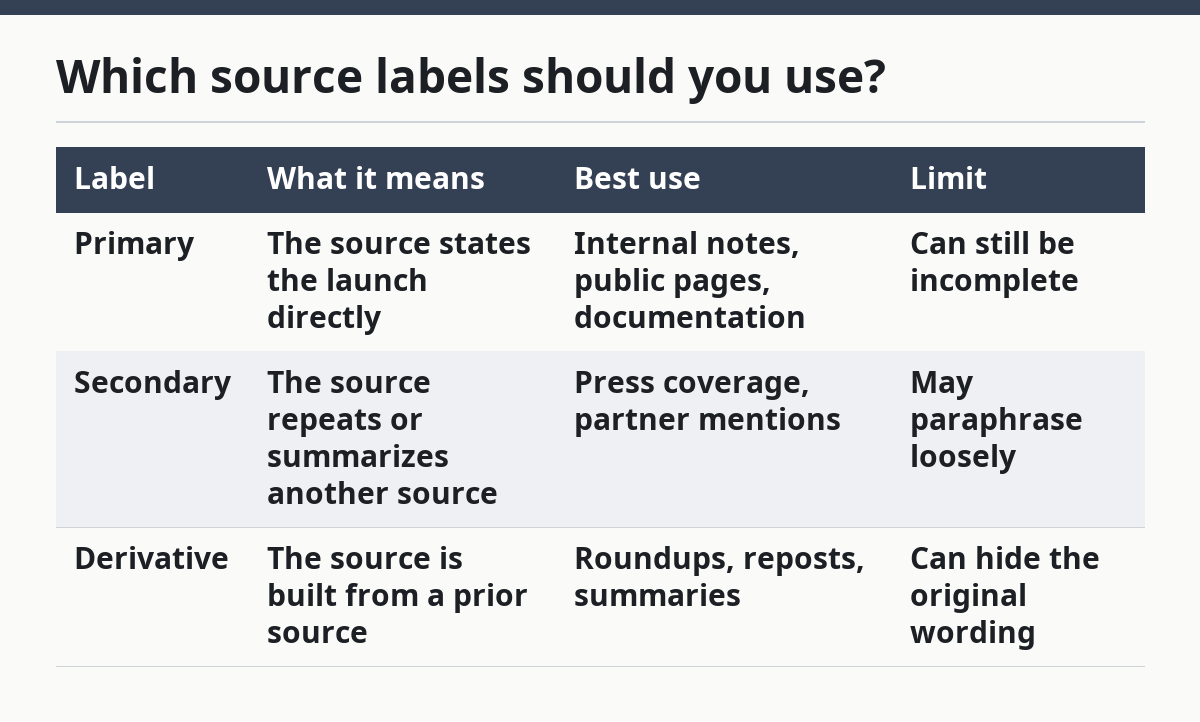
This table works better than a long rating scale because it keeps the job simple. A 3-label system is easier to train on than a 10-point scale, and it still tells a reviewer what to trust first. If the team needs more nuance later, that should go into a separate confidence guide, not into this page.
The main trade-off is speed versus detail. A short label set is fast to use, but it does not capture every edge case. That is fine for source attribution, because the point is to identify the source class, not to judge the truth of the claim in full.
How do internal notes, public pages, and third-party mentions differ?
Because each place serves a different job, the guide should treat those jobs differently. Internal notes are for capture and handoff, public pages are for the official version, and third-party mentions are for outside echo.
Internal notes usually hold the roughest text. They may include shorthand like a product name, a launch date, or a one-line summary that later gets rewritten. The guide should allow a note to be tagged as source material even when it is not polished enough for public use.
Public pages deserve the cleanest label because they are the version most people will quote. A launch page, release note, or documentation update often becomes the source that other pages repeat. That is why the guide should ask for the exact page title, not just the domain.
Third-party mentions need the most caution. Press coverage and partner posts can be useful, but they often compress the original claim into a shorter line. If a partner mention says the launch happened but does not name the exact feature or date, the guide should mark it as secondary, not as the origin.
The right rule here is simple: the closer the source is to the original announcement, the stronger the attribution. That rule is not perfect, but it is easy to apply across 10 or 100 launch items. It also keeps a reviewer from overtrusting a summary that sounds polished.
What should you record for evidence provenance?
So, record 4 things for evidence provenance: who said it, where it appeared, what exact wording it used, and how the claim was carried forward. That is enough to show where the evidence came from without turning the guide into a legal file.
A useful provenance note is short. It should say something like “public launch page, exact wording in headline, later repeated in partner post” rather than a full paragraph. Short notes are easier to keep current when 2 versions of the same launch appear in the same week.
The common mistake is to write only the claim and skip the path. That creates a source label with no trail behind it, which makes later review slow. Another mistake is to store the same launch item in 3 places with different note styles; the guide should use one format so a reviewer can compare entries in under a minute.
For provenance, the guide should also name the standard used for metadata when a team wants consistency. W3C PROV is a useful reference for provenance thinking, and Dublin Core Terms is a useful reference for basic metadata fields. Those standards do not solve the launch problem for you, but they give the team a shared vocabulary for source and relation fields.
A simple provenance line can be:
- Source class
- Source name
- Exact quote
- Origin order
- Reviewer note
Five fields is enough for most launch tracking work.
What does a good attribution rule set look like?
Therefore, a good rule set answers 3 questions: which source wins, how to handle paraphrase, and what to do when two sources disagree. If those rules are missing, the guide turns into opinion.
The first rule should say that the original public statement outranks later repetition. The second should say that a paraphrase does not replace the exact wording if the wording changes the meaning. The third should say that a repeated claim can still be recorded, but it should point back to the original source rather than standing alone.
The guide should also draw a hard line around vague language. If a source says “launching soon” and another says “launching in March,” the guide should not flatten them into the same label. That is a common error because the words look close, but the timing is different enough to matter.
Use one exception rule for documentation. Documentation can be a primary source for feature behavior even when it is not the first place the launch was announced. That is why documentation needs its own field in the guide, not just a general “other” bucket.
The main drawback of a strict rule set is maintenance. It takes time to train people to use the same labels the same way, and the guide will need edits when a new source type shows up. That cost is worth paying if launch records are used by more than one team.
How should the guide fit the launch intelligence hub?
Therefore, the guide should sit under the launch intelligence hub as the source-label layer, not as a full research method. It belongs next to broader release tracking work because it explains how claims are named and traced, while the hub covers the larger system around launch signals.
The cleanest way to think about it is in layers. One layer tells you where a claim came from, another layer tracks how complete the launch picture is, and another layer checks whether the claim is consistent across pages. This page stays on the first layer only.
That matters because mixing layers makes the guide harder to use. If a source attribution page starts judging confidence, coverage, and discrepancy handling at the same time, it becomes a catch-all and loses clarity. Readers need a place that answers one question well: “Where did this launch claim come from?”
The practical payoff shows up when a person opens a public page and a partner post side by side. The guide gives them a 1-step answer about which source is original and which one is repeating the claim. That saves time during launch review and keeps handoffs cleaner.
FAQ
How do you attribute a launch claim to its original source?
Then trace the claim back to the earliest place where the exact wording appears. Then you label later repeats as secondary or derivative, even if they are more polished. If the wording changes, keep the original text in the note so the trail stays visible.
What is source attribution in launch tracking?
Source attribution is the practice of naming where a launch claim came from and how it was passed along. In launch tracking, it keeps internal notes, public pages, partner mentions, press coverage, and documentation from getting mixed together. The result is a cleaner record of origin and reuse.
How do you record provenance for launch evidence?
You record provenance by noting the source class, the source name, the exact quote, and the order in which the claim appeared. That gives a reviewer enough context to follow the evidence without digging through a long narrative. A short, consistent format is easier to maintain than a free-form note.
Why not use one label for every source?
Because one label hides the difference between an original announcement and a repost. A launch page, a partner mention, and documentation do different jobs, so they should not look the same in the guide. A 3-label system is usually clearer because it shows source strength without pretending all evidence is equal.
Drafted with AI; not yet reviewed by a person.