






SaaS pricing and packaging evidence systems — The Complete Guide: a SaaS pricing and packaging evidence system should track at least 5 kinds of proof…
Last updated: November 18, 2026
Quick Answer: a SaaS pricing and packaging evidence system should track at least 5 kinds of proof: customer voice, product use, revenue impact, market context, and execution risk. A SaaS pricing and packaging evidence system is the place where a team collects, tags, and compares the proof behind price changes, plan changes, and bundle choices so the next decision is based on evidence, not opinion. It suits pricing, product, and revenue teams that need to explain why a tier exists, why a limit moved, or why an add-on should stay separate. This guide is written for SaaS teams that read ARR, MRR, and package design as operating data, not as marketing copy. For related context, see SaaS pricing strategy, SaaS packaging, and revenue operations.
Key takeaways
- A pricing evidence system is not a spreadsheet dump. It is a repeatable way to store proof, decisions, and outcomes in one place.
- Evidence often works best when it combines 5 sources: customer interviews, win-loss notes, usage data, support tickets, and market signals.
- A weak system fails when facts are not tied to a decision, owner, and date.
- The right setup depends on team size, sales motion, and how often pricing changes.
- If the team cannot trust the source trail, the packaging debate will stay political.
What is a pricing evidence system?
A pricing evidence system is a decision record for SaaS pricing, packaging, and monetization. It keeps the reason for a change next to the proof behind it, so the team can see why a plan was renamed, why a feature moved, or why a limit changed from one tier to another.
That matters because pricing decisions usually involve several kinds of evidence at once. A product team may see usage heat in one feature, sales may hear objections about seat minimums, finance may watch MRR mix shift, and support may see repeated questions about usage caps. A system of evidence gives each of those signals a home, with a date, a source, and a link to the decision it shaped.
The system is not the same thing as a pricing page archive, though the two overlap. A page archive shows what the market saw. An evidence system shows why the team chose that version in the first place and what it expected to happen next. That difference matters when a later change fails and someone has to find the original assumption. See also pricing page archive.
A useful system also keeps the type of evidence separate from the conclusion. “Customers asked for more flexibility” is not enough on its own. The stronger record says which segment asked, through which channel, how often the same objection appeared, and what package change followed. That is the difference between a memory and a decision file.
The clearest sign a team needs one is simple: pricing debates keep restarting from zero. If the only record lives in slide decks, meeting notes, and one pricing lead’s inbox, the company will keep arguing over the same plan names and feature gates. A pricing evidence system makes the argument shorter the next time because the facts are already there.
Which evidence belongs in it?
A good pricing evidence system usually holds 5 kinds of proof: customer voice, product use, revenue impact, market context, and execution risk. Each one answers a different question, and no single source can answer all of them well.
Customer voice includes sales calls, win-loss notes, support tickets, surveys, and interviews. This is where the team learns which limits feel fair, which bundles feel confusing, and which add-ons sound like a tax. It is easy to overvalue loud accounts here, so the system should record segment, company size, and deal stage with every note.
Product use evidence comes from telemetry, feature adoption, seat activity, usage frequency, and expansion patterns. This is the proof that says whether a feature deserves to sit in a higher tier or be sold as usage-based capacity. A feature with heavy use and clear cost to serve is not the same as a feature that is popular but cheap to deliver. For measurement discipline, see the National Institute of Standards and Technology.
Revenue impact belongs in the same record because a package can “feel right” and still hurt MRR mix, net revenue retention, or sales velocity. The team needs to know what changed after the launch, not just what it hoped would change. A clean system stores the before state, the change date, and the outcome window together.
Market context is the external proof: public pricing pages, packaging changes from peers, job posts that hint at strategy, release notes, and customer reviews. This is useful for spotting category norms, but it is weak if treated as a vote count. If you are using market signals to make a pricing decision, consider validating them with customer data or a pricing professional before you act. One rival moving to a usage plan does not mean your team should do the same. See the ISO documentation on structured records and information management.
Execution risk is the fifth category, and it is the one teams forget. A price change can be right on paper and still fail because billing cannot support it, the sales team cannot explain it, or the help center is not ready. Good evidence systems track these blockers before launch, not after the customer sees the bill.
The strongest systems also keep a “what this is not” field. That field stops a single note from becoming a false rule. For example, a request from enterprise customers should not be treated as proof that SMBs want the same package change. If the decision affects contracts or invoices, consider a finance, billing, or pricing review before you roll it out.
Why do teams get this wrong?
Teams usually get pricing evidence wrong because they collect facts without a decision path. The result looks busy, but it does not help the next pricing meeting.
The first mistake is source overload. A team saves every interview clip, every Slack message, and every dashboard screenshot, then no one can find the item that mattered. A better system tags each record to a pricing question, such as “raise minimum seats,” “split admin tools,” or “move analytics to Pro.”
The second mistake is mixing observations with conclusions. “Three prospects asked about annual discounts” is an observation. “We should discount all annual plans” is a conclusion, and the system should force a gap between them. That gap is where the team checks segment mix, deal size, and churn risk before it acts.
The third mistake is treating one metric as the truth. A packaging change can improve conversion and still damage expansion. A new tier can lift ARPA and still cause support confusion. Pricing work usually sits on trade-offs, which is why any evidence system that only tracks one KPI will mislead the team. If the decision has customer or billing impact, ask a pricing or finance expert to review the full evidence set before you act.
The fourth mistake is poor chronology. Pricing work depends on sequence: what the team knew before the change, what it launched, and what happened afterward. Without dates, it becomes impossible to tell whether a spike in objections came from the new package or from a separate sales issue.
The fifth mistake is letting the system become a museum. Teams often archive old pricing pages and meeting notes, then never connect them to current decisions. That creates a pile of history with no operating use. Evidence only helps when it is searchable by decision type, segment, and date.
A public-signal team has a special version of this problem. It may overread competitor pages while missing the internal proof from product and sales. Public signals matter, but they do not replace direct evidence from your own customers and usage data.
Spreadsheet or dedicated platform?
A spreadsheet-first system wins for early-stage teams, while a dedicated platform wins once pricing work becomes a recurring operating rhythm. The reason is simple: spreadsheets are flexible, but they break down when too many people need the same facts at the same time. For a related workflow, see pricing operations.
| Criteria | Spreadsheet-first system | Dedicated platform | Winner for this condition |
|---|---|---|---|
| Setup speed | Fast to start with a shared sheet and tabs | Slower because the team must configure fields and roles | Spreadsheet-first for the first 1–2 pricing projects |
| Structure | Fully manual, so the team invents its own fields | Usually enforces tags, owners, and workflows | Dedicated platform when many people add evidence |
| Source control | Easy to paste links, hard to prevent duplicates | Better at keeping one record per decision or asset | Dedicated platform when source sprawl is a problem |
| Collaboration | Simple for a small team already living in one sheet | Better for cross-functional review and status tracking | Dedicated platform for pricing, product, and finance together |
| Audit trail | Depends on discipline and version history | Usually stronger for date-stamped decision records | Dedicated platform when leadership asks “why did we do this?” |
| Reporting | Flexible, but manual to maintain | Faster to summarize by theme, segment, or period | Dedicated platform when reporting repeats each month |
| Cost to run | Low software overhead, high manual effort | Higher software overhead, lower manual cleanup | Spreadsheet-first for small or infrequent use |
| Change management | Easy to edit, easy to break | Harder to edit, harder to corrupt | Dedicated platform when governance matters |
| Best fit | One pricing lead or a small pod | Recurring pricing program with many stakeholders | Depends on team size and change frequency |
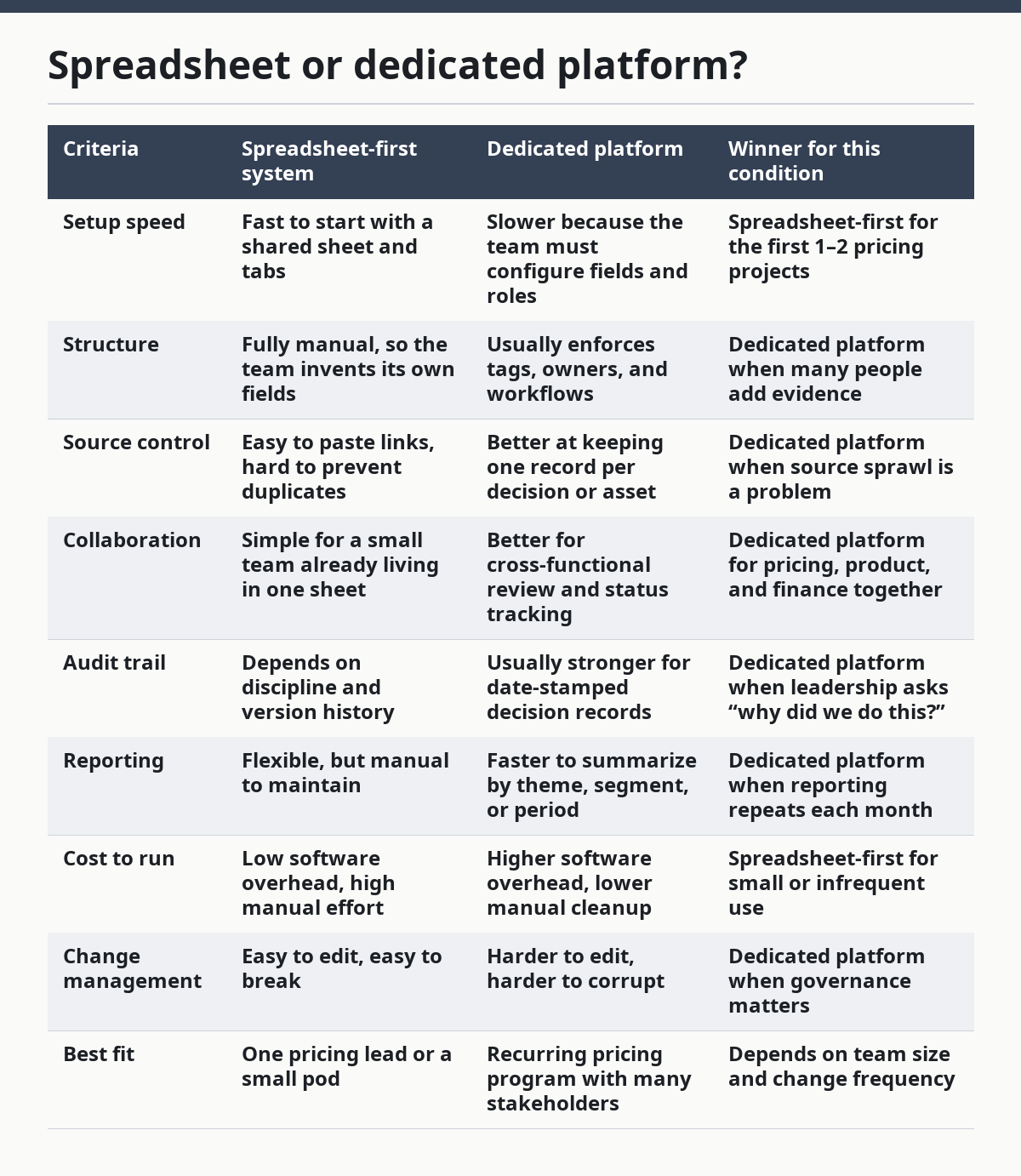
The spreadsheet route is right when pricing work is still episodic. If the team is planning one tier change, one discount policy update, or one packaging test, a clear sheet can be enough. The drawback is that discipline becomes the product. If one owner is not policing the fields, the sheet will drift into a file cabinet.
A dedicated platform wins when the company treats pricing as an ongoing system, not a one-time project. It is the better choice for teams with repeated experiments, many reviewers, or a need to show lineage from evidence to decision. The drawback is that the platform can become ceremony-heavy if the team has only a few pricing moves a year.
The honest trade-off against the spreadsheet is not just “manual versus automated.” It is “speed of start versus durability of record.” The honest trade-off against the platform is not just “more features versus less.” It is “shared control versus lighter process.” That is why a small SaaS team with one pricing owner often starts in a sheet and moves later, while a larger team with finance, product, and sales in the loop should skip the long manual phase.
How do I know the evidence is trustworthy?
Trustworthy evidence is traceable, current, and tied to a real decision. If any of those three is missing, the team should treat the item as a lead, not as proof.
Traceable means the record says where it came from. A customer quote should link to the call note or transcript. A usage claim should link to the dashboard or query. A competitor signal should link to the public page, release note, or job post that created the signal. Without source trail, the team cannot check whether the evidence was summarized fairly.
Current means the evidence still matches today’s product and market state. A pricing page from 18 months ago may be useful for history, but it should not drive a fresh decision without context. Pricing and packaging age quickly because features, customer expectations, and competitor moves keep changing.
Tied to a real decision means the evidence sits beside the question it was meant to answer. “Customers are confused” is too loose unless the system says confused about what, in which segment, and for which package choice. This is where evidence systems beat generic research repositories: they force the team to connect fact to action.
A good trust test is to ask whether someone outside the pricing group could follow the logic in five minutes. If the answer is no, the system is storing activity, not evidence. That matters especially when leadership wants to know why a feature moved into Enterprise or why a usage cap shifted in a mid-market plan.
Two public references are useful here. The National Institute of Standards and Technology discusses data quality and measurement discipline, and the ISO family’s documentation on information management standards is a reminder that records need consistent structure, not just storage. Those are not pricing manuals, but they show why provenance and repeatability matter in any decision system.
A team should also keep one practical rule: no claim should stand alone if it cannot be checked later. If the evidence is important enough to change price, it is important enough to record with source, date, and owner.
How does it change a pricing decision?
A pricing evidence system changes a pricing decision by shortening the path from signal to action. Instead of arguing from memory, the team starts from a documented set of facts and then checks whether those facts point to the same conclusion.
The first shift is in tier design. A system that captures feature adoption by segment can show which capabilities belong together and which ones cause confusion when bundled. If enterprise admins use a control that SMBs never touch, the record should make that gap visible before the tier map is redrawn.
The second shift is in packaging. Many teams want to add features to the “middle” plan because it feels safer. An evidence system can show whether the middle plan is already overloaded, whether it creates too much support burden, or whether a lighter bundle would improve clarity. That is the difference between a neat slide and a working package.
The third shift is in discount policy. Evidence often shows that some discounts are tied to real buying friction, while others are just habit. When the system tracks the reason for each discount request, the team can see whether annual terms, seat volume, or procurement pressure is the true driver.
The fourth shift is in post-launch review. If a price or package change lands, the evidence system should hold the outcome against the original hypothesis. That includes the date, the segment, and the expected effect. Without that loop, the team cannot tell whether the move worked or just survived the first month.
This is also where the system becomes a guardrail for bad instincts. A strong opinion from sales or a competitor headline can still matter, but it should enter the same record as the rest of the evidence. When that opinion conflicts with product usage or renewal behavior, the system makes the conflict visible instead of hiding it.
The best systems also improve speed. That sounds backwards, because more structure can feel slower at first. In practice, a clean evidence record reduces re-litigation. The next pricing meeting starts with the facts already sorted, so the team can spend time on the decision instead of reconstructing the past.
When should a team rebuild the system?
A team should rebuild the system when pricing decisions start taking longer to explain than to make. That usually means the record has outgrown the way it was built.
One trigger is a team expansion. If pricing input now comes from product, sales, finance, support, and customer success, a single sheet with loose tabs will start to fail. The more contributors there are, the more the system needs rules for ownership, tagging, and version history.
Another trigger is repeat work. If the team is revisiting the same question every quarter — for example, whether a feature should move upmarket or whether a usage limit should change — the current system is not preserving learning. The point of evidence is to reduce repeated debates, not to archive them.
A third trigger is risk. If a pricing mistake would affect billing, renewals, or enterprise contracts, the record needs stronger control. That does not mean the system must be complex. It does mean the team needs a reliable chain from signal to decision to rollout.
A fourth trigger is outside pressure. When the market shifts quickly, public-signal monitoring matters more. New competitor packaging, category consolidation, or a sudden change in customer expectations can make the old evidence stale. The system should be able to absorb new source types without turning into chaos.
The right move is not always a full rebuild. Sometimes the fix is a better taxonomy, a stricter review step, or a monthly decision log. If the current record still helps the team answer “why did we price it this way?” in under five minutes, it may only need cleanup. If it cannot do that, it needs a redesign.
What should a starter version include?
A starter version should include a decision log, a source index, a segment field, a date field, and an outcome field. That is enough to make the next pricing change traceable without building a huge system on day one.
The decision log is the core. Each row should answer one question: what change was considered, why, and what was decided. The source index should point to the evidence behind that choice, whether it came from calls, telemetry, support tickets, or public competitor pages.
The segment field matters because pricing proof is rarely universal. SMB and enterprise customers may react very differently to the same feature gate. Without segment labels, the team will mix signals that should stay separate.
The date field keeps chronology clear. Pricing work depends on timing, and timing is easy to lose in a shared document. A record with no date is often just a memory with a file attachment.
The outcome field closes the loop. If the team launches a change, the system should capture what happened next, even if the result is mixed. A bad outcome is still evidence. A good outcome that cannot be traced back is only half useful.
For many teams, that starter setup in one sheet is enough for the first 90 days of evidence work. The rule is not “build everything.” The rule is “make the next decision better than the last one.” If the process begins to produce the same arguments in new clothes, the system has not gone far enough.
The verdict: which setup should you choose?
Choose a spreadsheet-first system if the team is small, the pricing work is occasional, and one owner can keep the record clean. Choose a dedicated platform if pricing changes are recurring, many teams contribute evidence, and leadership needs a durable audit trail. Neither if the company cannot agree on the question the evidence is supposed to answer, because no tool fixes unclear decision rights.
That is the honest split. A spreadsheet is lighter, faster, and easier to start. A dedicated platform is better once the evidence becomes part of a broader pricing operating model and the cost of a broken record is higher than the cost of the software.
What are the exception scenarios?
The verdict flips in a few specific cases. If the company is under heavy regulatory or billing scrutiny, the safer choice is usually the more controlled system, even if the team is still small. Record integrity matters more when the consequences of a pricing error reach contracts or invoices.
If the team only touches pricing once or twice a year, a platform can be too much. In that case, the overhead of setup and governance may exceed the value of the extra structure. A disciplined sheet with a strong owner is enough for a low-change environment.
If the company sells across many segments with different price sensitivity, the evidence load grows fast. A single sheet can hide important differences between SMB, mid-market, and enterprise customer behavior. That is a point where the more structured path usually wins.
If leadership wants one source of truth for both pricing and packaging history, the system needs stronger controls than a casual doc can provide. History without control becomes folklore. A controlled record is better when the company expects to reuse the same logic across multiple launches.
FAQ
What is the main job of a SaaS pricing evidence system?
Its main job is to connect proof to a pricing decision. It stores the facts behind a plan, tier, limit, or discount change so the team can explain the choice later and review whether the outcome matched the expectation.
What kinds of evidence should I collect first?
Start with customer voice, product usage, revenue impact, and competitor signals. Those four cover the most common pricing questions without forcing the team to build an overcomplicated process on day one.
Is a spreadsheet enough?
A spreadsheet is enough for a small team with a few pricing decisions and one clear owner. It stops being enough when multiple teams need to add evidence, review the same record, and keep a clean history over time.
How do I keep the system from becoming cluttered?
Give every item a decision it supports, a date, a source, and an owner. If a note cannot answer those four things, it should not go into the core record.
When should the team move from a sheet to a platform?
Move when pricing work becomes recurring, cross-functional, and hard to explain from a single file. That is the point where the cost of manual cleanup starts to outweigh the simplicity of the spreadsheet.
Drafted with AI; not yet reviewed by a person.