





How to Build a SaaS Pricing Evidence Escalation Path for Conflicts Between Public Pages and Sales Quotes: A pricing evidence escalation path gives your…
Last updated: November 20, 2026
A pricing evidence escalation path gives your team one rule for what happens when a public pricing page and a sales quote disagree: who checks first, who approves next, and who has the final say. Build it when you need sales, revops, and legal to stop arguing from different copies of the truth.
Key takeaways
- Treat public pricing pages and sales quotes as two evidence sources, not two opinions.
- Give one team first review, one team final review, and one rule for legal handoff.
- Write source precedence down before the next conflict appears.
- Use the path only for mismatches, not for every pricing edit or exception.
- If the route is vague, the deal desk becomes the default referee and slowdowns follow.
What is a pricing evidence escalation path?

A pricing evidence escalation path is the 3-step route a pricing conflict follows from detection to decision. In plain terms, it says what happens when a quote says one thing and a public pricing page says another, so the team does not improvise under deal pressure.
The point is not to create a giant approval maze. The point is to turn a messy disagreement into a short, named path with 1 owner at each stage. That is what keeps revops from chasing screenshots, sales from making promises from memory, and legal from being pulled in too late.
The path should answer four questions in 1 page: which source wins first, who reviews the mismatch, who can approve a correction, and when the issue becomes a legal or policy matter. If those answers are not written down, the path is not real.
This is not the same as a pricing audit trail, a change log, or a review checklist. Those record what happened or what should be checked. This page is about the route a conflict takes once the team spots it.
How do you build the path?
You build the path by assigning source precedence, routing the mismatch through revops and the deal desk, and naming the legal handoff for edge cases. The fastest way is to map the route in 5 steps and keep each step tied to one owner and one decision.
-
Write the source order in a shared policy doc: public pricing pages first for self-serve motions, sales quotes first only when a named exception exists, and legal last for wording or term disputes. This removes the “which screen counts?” argument before it starts.
-
Route the first review to revops, because revops usually owns the pricing model, quote structure, and field rules. Give revops a 1-business-day response target so conflicts do not sit in inboxes over a weekend.
-
Escalate the commercial exception to the deal desk when the mismatch is about discounting, packaging, bundling, or customer-specific terms. The deal desk should decide whether the quote was wrong, the page was stale, or the exception was approved but not reflected.
-
Hand off to legal only when the conflict touches terms, renewal language, billing language, or any clause that changes risk. Legal should not be the first stop for routine price mismatches, because that turns a pricing dispute into a long document review.
-
Close the loop in the source of truth that owns the customer-facing number, then tell sales which source now prevails for the next 24 hours or until the next published update. A closed loop matters more than a fast answer that no one records.
Who should own each step?
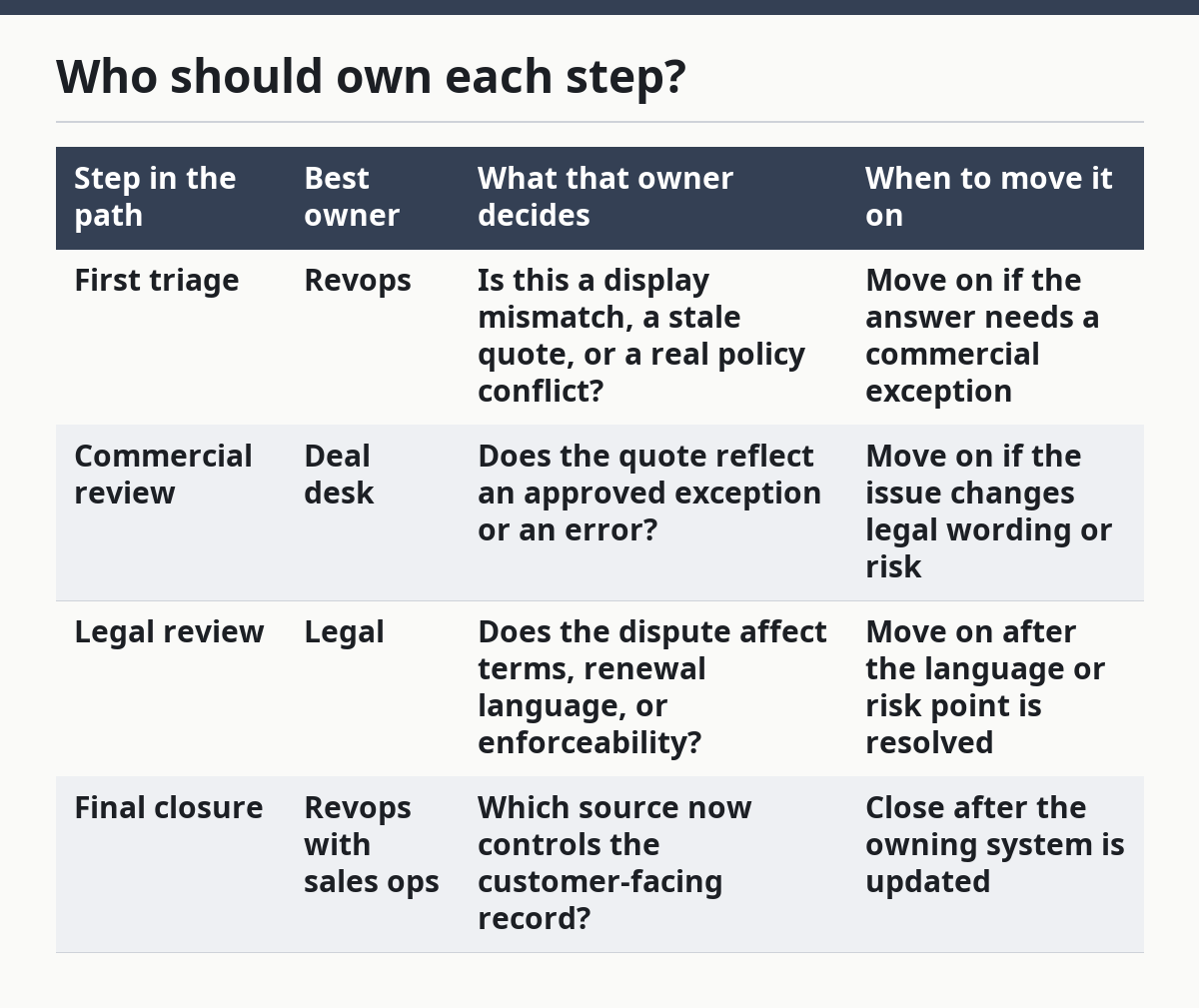
The owner should change by decision type, not by who shouts loudest. In most SaaS teams, revops owns the first triage, the deal desk owns commercial exceptions, and legal owns wording or term risk.
| Step in the path | Best owner | What that owner decides | When to move it on |
|---|---|---|---|
| First triage | Revops | Is this a display mismatch, a stale quote, or a real policy conflict? | Move on if the answer needs a commercial exception |
| Commercial review | Deal desk | Does the quote reflect an approved exception or an error? | Move on if the issue changes legal wording or risk |
| Legal review | Legal | Does the dispute affect terms, renewal language, or enforceability? | Move on after the language or risk point is resolved |
| Final closure | Revops with sales ops | Which source now controls the customer-facing record? | Close after the owning system is updated |
The trade-off is speed versus certainty. A short path gets you a decision in less time, but only if the owners are clear. A long path looks careful and often becomes a bottleneck, especially when every quote dispute gets sent to legal by default.
This is not for teams that still change pricing ad hoc and want the process to “figure itself out.” If the quote can change without revops seeing it, the path will break no matter how pretty the diagram looks.
What should the source precedence rule say?
The source precedence rule should say which artifact wins for each kind of conflict, in one sentence per case. A good rule names the source, the condition, and the fallback, so nobody has to interpret a vague phrase like “official pricing.”
For example, the rule can say that public pricing pages control standard list prices for self-serve offers, while sales quotes control only approved exceptions tied to a named deal. It can also say that if the quote and page conflict on the same SKU or package name, revops must verify which one was current when the quote went out.
The exact wording matters because different conflicts need different outcomes. A page can be wrong while the quote is right. A quote can also be outdated while the page is current. Your rule should not force the same answer for both.
Use 2 simple tests before you finalize the rule:
- Is this a standard offer or a special deal?
- Is the conflict about price, packaging, term language, or a renewal trigger?
If the answer is “special deal,” the quote may win. If the answer is “standard offer,” the public page usually wins unless the quote carries a documented approval. If the answer is about terms, legal gets pulled in.
The hard part is that “public” does not always mean “correct,” and “signed” does not always mean “current.” The rule should make that tension explicit instead of pretending one artifact always beats the other.
How should teams route a conflict?
Teams should route a conflict through a 24-hour triage path with one stop for revops, one stop for the deal desk, and one stop for legal only if needed. The point is to prevent duplicate reviews and keep the dispute moving.
Start with the question, “Is this a content mismatch or a pricing decision?” If it is only a stale page or a stale quote, revops can usually decide the next move. If the issue changes the commercial terms of the deal, the deal desk takes over.
A useful routing rule is to keep the first stop narrow. Revops checks the source order, the deal desk checks the commercial approval, and legal checks the language. That division saves time because each team sees only the part it is equipped to answer.
A common mistake is sending every conflict to the highest-status person in the room. That feels safe and often slows resolution by days. A better setup is a named escalation ladder with a clear “stop here unless” rule, so most issues die at the first or second step.
If the customer is waiting, set a same-day acknowledgment and a next-step owner. The path should not promise an answer in every case, but it should always promise a next move.
What belongs in the handoff note?
The handoff note should carry the conflicting sources, the deal context, and the exact question the next owner must answer. A clean handoff is usually 4 parts: what changed, where it appears, who approved it, and which system the team should trust next.
Keep the note short enough to read on a phone. A 6-line format is enough:
- Public page URL or quote reference
- Conflicting price, package, or term
- Date or status of the quote
- Known approval, if any
- Which team saw the mismatch
- The decision needed next
The goal is to avoid a half-hour of detective work. If the next owner has to ask for the same screenshot three times, the handoff failed even if the final decision was correct.
A strong handoff also names the consequence of delay. For example, if the mismatch could stall a deal desk review or create a wrong renewal promise, say so. That gives the next owner a reason to treat the issue as active, not as background noise.
Which mistakes break the process?
The most common mistake is letting the same team create and resolve the conflict without review. That creates self-approval, and self-approval is how wrong prices stay live long enough to become a habit.
Another mistake is making legal the first responder for every mismatch. Legal is essential when terms or risk change, but it is the wrong place to start for routine price disputes. The cost is delay, and the fix is a narrower trigger for handoff.
A third mistake is using vague labels like “pricing team” or “management” with no named owner. That sounds flexible and usually means nobody is waiting for the alert. One named owner per step is better than a 5-person group chat.
A fourth mistake is treating the public page as decorative while sales quotes carry the real rule. That works only until a prospect compares the two and asks which one counts. The cost is trust, and the fix is a written precedence rule that sales can quote back without hesitation.
The honest trade-off here is control versus speed. A stricter path takes more coordination, but it reduces the number of ad hoc exceptions. A looser path feels faster and tends to produce more conflicts later.
If you want this system to sit beside broader pricing governance, the hub on SaaS pricing and packaging evidence systems is the right place to frame it.
How do you keep the path from drifting?
You keep the path from drifting by reviewing it on a fixed schedule and by checking a small set of real conflicts, not hypothetical ones. A monthly 30-minute review is enough for many teams, as long as the review uses actual dispute examples.
Look for 3 drift signals: reviews that skip revops, legal cases that start too early, and quote decisions that never get reflected back into the source order. Any one of those means the path is no longer matching how the team works.
The review should also test whether the precedence rule still fits the current sales motion. A motion with more custom deals needs tighter deal desk routing than a motion built around standard public pricing. If the business changes and the path stays fixed, the path becomes theater.
Do not expand the path just because it was missed once. Add a step only when the same failure happens more than once or when the issue clearly belongs to a different owner. Otherwise, the process gets heavier without getting clearer.
What do you do when a quote conflicts with the website price?
You check which source the policy says controls that kind of offer, then send the conflict to the first owner named in the path. If the quote reflects an approved exception, the deal desk may confirm it; if not, revops should treat the website price as the current standard. The key is to decide from the rule, not from whichever screen the customer saw first.
Who resolves pricing evidence conflicts?
Revops should resolve the first pass, the deal desk should resolve commercial exceptions, and legal should resolve wording or risk issues. That split keeps each team in its lane and keeps simple mismatches out of legal review. If the conflict does not fit any lane, the escalation path is too vague and needs a rewrite.
How do you escalate pricing discrepancies?
You escalate pricing discrepancies by sending one handoff note to the next named owner, not by opening a new debate in every channel. Include the conflicting artifacts, the decision needed, and the business impact in a short note. If the issue crosses into terms or enforceability, add legal at that point instead of making them the first stop.
How long should the escalation path take?
The path should be short enough that someone can move it in the same business day for simple conflicts. A 24-hour first response target is practical for many teams, but the exact timing should match the motion and the owners you assign. If the route takes longer than the deal can tolerate, the path is too heavy or the owners are not real.
Drafted with AI; not yet reviewed by a person.