





A SaaS internal review queue usually works best with 5 fields, 3 review stages, and a 1-day-to-2-day turnaround rule. An internal review queue for SaaS…
Last updated: November 20, 2026
Quick answer: a SaaS internal review queue usually works best with 5 fields, 3 review stages, and a 1-day-to-2-day turnaround rule. An internal review queue for SaaS content is the right fit when content must pass through subject matter experts, legal reviewers, and a final approver before publication. This guide covers how to build a SaaS internal review queue for SME feedback, legal checks, and final approval without turning it into a heavy workflow system.
Key takeaways
- A review queue works best when each stage has one clear job: SME feedback, legal check, then final approval.
- The queue should use a fixed handoff order, a named owner for each step, and a visible turnaround rule.
- Legal review is not the same as editing; it checks claims, disclosures, and risk under the rules in the relevant jurisdiction.
- A simple queue can run in a spreadsheet or project tool, but it still needs strict stage ownership.
- If feedback comes back as a pile of vague comments, the queue is too loose and the final approval will stall.
Who should use this queue?
This queue is for SaaS teams that publish content with factual claims, product statements, or legal sensitivity, and it assumes the team already has a draft, a reviewer list, and a place to track work. It is not for teams that want to debate ownership policy, content governance, or SLA design, because those are different systems and belong on a separate page.
The basic use case is a content team that needs a repeatable path from draft to publish. That path usually includes a subject matter expert for accuracy, a legal reviewer for risk, and one final approver for release. In practical terms, the queue keeps those steps in order so a draft does not bounce between people for 3 rounds with no end point.
This is general information, not legal advice, and a qualified lawyer should be consulted on any real legal question. That matters because legal review is jurisdictional: a rule that is fine in one country may be wrong in another, especially for advertising, claims, privacy, and disclosures. The general pattern still helps, but the legal check must match the jurisdiction that applies to the content.
The queue also helps when content has a short shelf life, such as product updates or launch pages. If a draft needs a SME answer in 24 hours and legal review in 48 hours, the queue can make that visible before the piece misses its slot. It is less useful for a one-off blog post with no claims, no product mention, and no compliance risk.
What should the queue contain?
A good internal review queue contains 5 fields: the asset name, the current stage, the reviewer, the due time, and the decision state. Those fields are enough to show where a piece is stuck without turning the queue into a large workflow map.
The stage names should stay fixed. Use labels such as Draft, SME review, Legal review, Final approval, and Ready to publish. A label like “In progress” is too vague because it does not say who owns the next move or how long it has been sitting there.
The queue should also track turn length, even if the number is just a local rule rather than a formal SLA. For example, a team may use 1 business day for SME feedback and 2 business days for legal review. The point is not the exact number; the point is that each stage has a visible limit and a clear handoff time.
Use one system of record. A spreadsheet, task board, or ticket tool can all work, but the queue should live in one place so reviewers are not checking email, chat, and a doc at the same time. If the status lives in 3 places, the queue will drift.
Here is the simple structure that usually holds up:
| Option | Best for | What it handles well | What to skip |
|---|---|---|---|
| Spreadsheet queue | Small teams, low volume, 3 to 10 assets at a time | Fast setup, visible stage tracking, easy handoff notes | Complex approvals, heavy version control, duplicate comment threads |
| Task board | Teams that want stage movement and assigned owners | Clear status columns, due dates, review comments | Long legal notes, detailed clause tracking |
| Ticket-style queue | Teams with recurring approvals and named reviewers | Triage, routing, audit trail, decision history | Ad hoc edits with no fixed stage order |
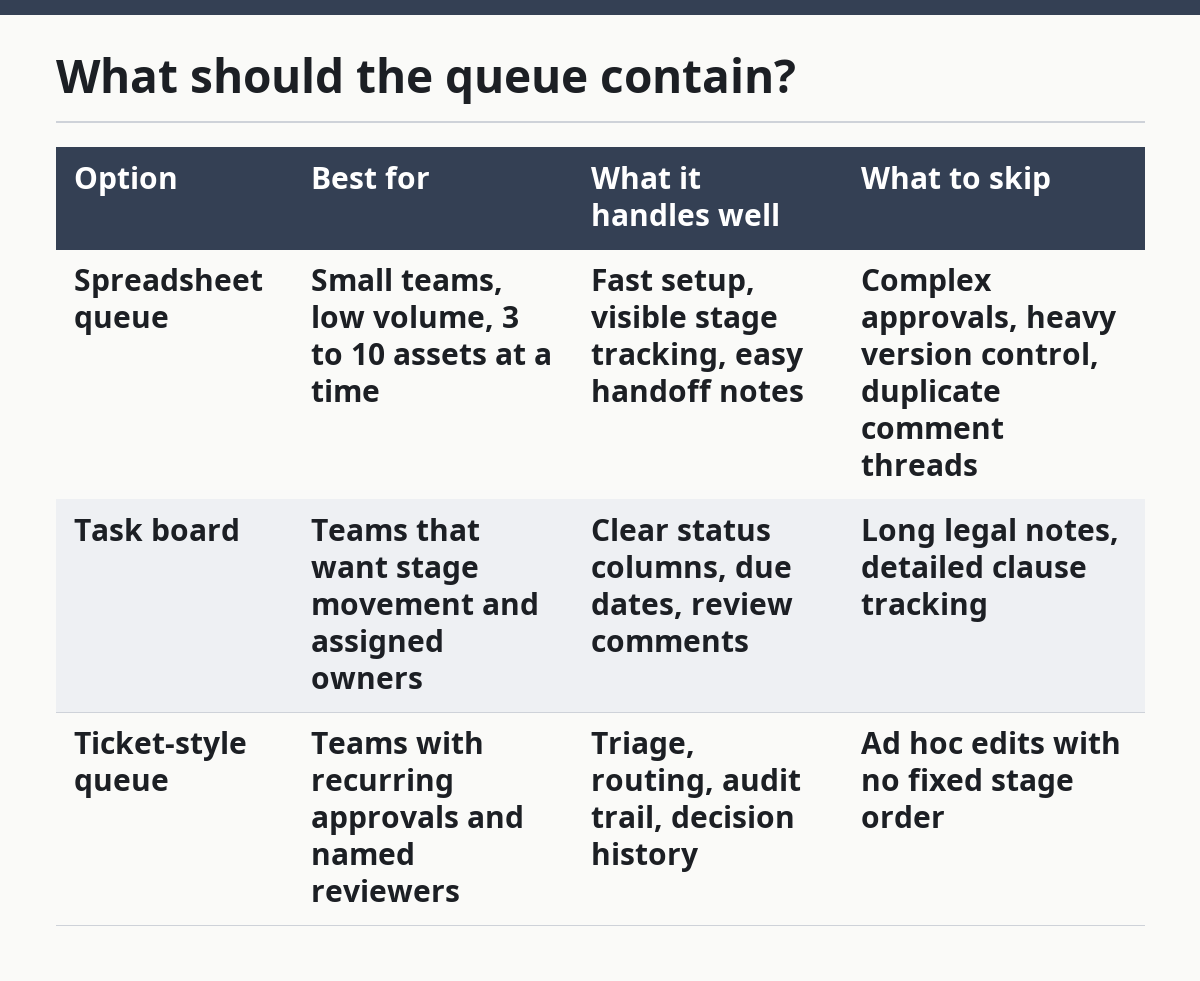
The wrong choice is the one that adds friction without adding control. A large workflow tool can be too much if the team only needs a 3-step queue, while a chat thread is too loose if legal needs traceable review notes. For related process design, see content workflow basics and editorial checklist examples.
How do you build the review stages?
You build the review stages by fixing the order, naming the reviewer for each stage, and writing the exit rule for every handoff. That is the heart of the queue, and it should be written down before the first draft enters it.
Start with SME review. The SME checks factual accuracy, product wording, terminology, and whether the draft says something the team cannot support. If the SME must mark up the same paragraph 4 times, the draft was sent too early or the brief was too thin.
Then move to legal review. Legal reviewers check the content against the relevant jurisdiction’s rules, which may include advertising claims, privacy language, endorsements, testimonials, competitive statements, or required disclosures. For general reference on privacy and advertising rules, the EU GDPR text and the FTC’s endorsement guide materials are useful examples of official sources, but the exact law depends on the market.
Then send the piece to final approval. Final approval should be a release decision, not another round of rewriting. If the final approver starts re-editing every paragraph, the queue is broken because the end stage has become a second editorial stage. For a tighter approval handoff, see final sign-off workflow.
How do you handle SME feedback and legal checks?
You handle SME feedback and legal checks by separating correction notes from approval notes and by forcing each reviewer to decide within the stage they own. That stops the common problem where one reviewer edits language, another rewrites it again, and no one knows which version is current.
Use a comment format that asks for 3 things: what is wrong, what needs to change, and whether the issue blocks approval. A blocked item is different from a suggested edit. If everything is marked urgent, then nothing is urgent, and the queue will not tell the editor what to fix first.
A clean handoff usually looks like this: the editor sends the draft, the reviewer answers in the same file or ticket, the editor resolves the note, and the asset moves forward only after the reviewer marks that stage complete. That sequence matters because handoff timing is part of the control system, not just a courtesy.
If the content includes product claims, legal should see the final wording after SME review, not before it. Otherwise legal may approve language that later changes in a way that creates new risk. If the content is still changing, it is too early for a final legal pass.
If the draft has 2 versions in circulation, stop the queue and reset to one source file. Version drift can make it hard to tell which claim was approved. In practice, the queue should never carry more than one current draft per asset. For version control patterns, see content versioning guide.
What goes wrong in a messy queue?
A messy queue usually fails because it mixes review, rewrite, and approval in the same stage. That creates churn, and churn adds delays without improving accuracy. The fix is to make each stage answer one question only: is this factually right, is it legally safe, or is it ready to publish?
A common mistake is sending content to legal before SME review is done. The consequence is wasted legal time, because the lawyer or reviewer may approve wording that changes later. The better path is SME first, then legal, then final approval.
Another mistake is giving every reviewer the same job. When SME, legal, and final approver all comment on style, the draft comes back with 3 competing sets of notes. The correct alternative is to define one review purpose per stage and to keep style edits with the editor.
A third mistake is vague turn rules. If the queue says “review soon,” nobody knows when a reminder should go out. The alternative is a concrete due window, even if it is simple, such as same day, 1 business day, or 2 business days.
A fourth mistake is letting final approval turn into a redesign meeting. That can add another 30 to 60 minutes of rework per asset, and it defeats the point of a queue. Final approval should either release the piece or send it back with one clear reason.
A fifth mistake is skipping the handoff note. Without a short note on what changed, reviewers reopen old issues and waste time retracing the same points. A 2-line handoff note is usually enough. For more on handoff hygiene, see review queue checklist.
When should this approach stop?
This approach should stop when the queue no longer matches the risk or the volume of the work. The signs are easy to see, and each one means the team needs a different process, not a larger queue.
If legal review keeps changing the same content after final approval: the queue is missing a stable legal standard — freeze the draft earlier and add a fixed legal checklist before approval.
If SME feedback arrives as long narrative comments on every draft: the review step is doing editorial work — narrow the SME brief to factual questions and move style changes back to the editor.
If every asset waits longer than the team can explain: the queue has no real turnaround rule — add due dates and escalation points, or the publish calendar will slip.
If the queue is used for policy disputes, not content review: the process is too small for the job — separate the policy discussion from the content approval path.
If the jurisdiction changes by campaign or market: the legal check is not one-size-fits-all — route those assets to the right jurisdiction-specific reviewer before they enter final approval.
If the team needs audit-grade traceability: a simple queue may not be enough — move to a system that preserves version history, reviewer identity, and approval timestamps.
A queue is a tool for moving content through a known path. It is not the right tool when the organization has not agreed on the path itself. If the team still argues about who may approve what, the queue will only record the conflict.
What does a good result look like?
A good result is a queue where every asset can be tracked in under 30 seconds and every reviewer knows what stage they own. That does not mean the process is fast in every case; it means the process is visible, predictable, and hard to skip.
A better sign is that SME feedback becomes shorter and more specific over time. Reviewers stop writing broad comments like “needs work” and start writing issue-level notes tied to a paragraph, claim, or disclosure. That usually means the queue is teaching the team what each stage is for.
A second good sign is that legal review is calmer. When the draft reaches legal only after factual cleanup, the legal stage can focus on risk rather than basic wording fixes. That saves back-and-forth and reduces the chance that the final approval stage becomes a rescue step.
A third good sign is that turnaround times become explainable. If a draft takes 2 business days in SME review and 1 business day in legal, the team can see whether the delay is in the content, the reviewers, or the handoff. That visibility is the real value of the queue.
For SaaS teams that publish often, this kind of queue is usually the right middle ground. It is stricter than a loose editorial board, but lighter than a full governance program. It works best when the team wants one path for SME feedback, legal checks, and final approval, and not a separate system for ownership or policy. For related team setup, see SaaS content operations.
How should the final approval step work?
The final approval step should confirm that the reviewed version is the version that will publish, and nothing else. That means it checks the final file, the final date, and the final reviewer sign-off before release.
Final approval should not reopen factual debate or legal interpretation unless a new change has been made since the last review. If new changes appear after approval, the asset goes back into the queue. That usually keeps the queue honest, but teams should still consult a qualified lawyer or other appropriate professional on sign-off rules and maintain a written approval log for regulated work.
The final approver also needs a simple release rule: approve, reject, or send back for one named fix. A 3-way decision keeps the last stage from becoming a vague holding area. If the approver has 6 comments and no clear decision, the queue is not finished.
That is the practical shape of an internal review queue for SME feedback, legal checks, and final approval. It is a controlled handoff system, not a content philosophy, and it works only when the stages stay narrow and the order stays fixed.
Drafted with AI; not yet reviewed by a person.