






How to Build a SaaS Content Gap Analysis for Competitors, SERPs, and Buyer Questions: A SaaS content gap analysis for competitors, SERPs, and buyer…
Last updated: November 20, 2026
A SaaS content gap analysis for competitors, SERPs, and buyer questions is a structured way to find what your site does not cover yet across competitors, search results, and buyer questions. Quick Answer: use 4 sources, 3 lenses, and 1 sheet to identify the missing pages, missing angles, and missing proof that keep your topic clusters from matching how buyers actually search. The goal is not more content for its own sake; it is to find the missing pages, missing angles, and missing proofs that keep your topic clusters from matching how buyers actually search.
Key takeaways
- Start with one content inventory so you can compare like for like, not page for page at random.
- Use 3 lenses: competitor content, SERPs, and buyer questions. Each reveals a different kind of gap.
- Mark gaps by intent, not by keyword alone. A page can rank and still miss the question a buyer needs answered.
- Prioritize coverage that supports a topic cluster you already own or want to own next.
- Skip gaps that only add noise, duplicate a current page, or sit too far from the buying path.
What is a SaaS content gap analysis?

A SaaS content gap analysis is a side-by-side check of your content inventory against competitor content, SERPs, and buyer questions to spot missing coverage. For SaaS, that usually means finding gaps in topic clusters around product use cases, integration questions, comparison pages, pain-point searches, and evaluation-stage questions.
Therefore, the phrase sounds broader than it is. In practice, the work is simple: list what you already publish, compare it with what shows up for the search terms that matter, then ask where real buyers still have unanswered questions. The result should be a short list of content opportunities, not a giant spreadsheet you never touch again.
This is not the same as a refresh audit. A refresh audit asks which existing pages should change. A gap analysis asks what is absent in the first place. It also is not a topic universe map, which aims to map the whole field. Here, the job is narrower: find the missing coverage that blocks progress in a few chosen topic clusters.
If you are building the page for a team that already publishes around one SaaS category, that narrow focus matters. A gap analysis works best when it feeds editorial decisions in the next 1 to 3 months, not a vague annual roadmap.
For the search side, a useful reference is Google Search Central’s guidance on how search works and how content is discovered. For buyer intent, the Content Marketing Institute and similar editorial sources are useful for framing audience questions, but the real work comes from your own SERP review and buyer language. See Google Search Central at https://developers.google.com/search/docs/fundamentals/how-search-works and the Content Marketing Institute at https://contentmarketinginstitute.com/.
How do you build a SaaS content gap analysis?
You build it by comparing 4 things in order: your content inventory, competitor content, SERP coverage, and buyer questions. The output should be a list of gaps with a reason for each one, not just a list of keywords.
A simple process keeps the work usable. Use one sheet, 4 tabs, and 1 owner for the first pass. That is enough structure to spot missing coverage without turning the project into a planning exercise that never ships.
-
Export your content inventory into one list.
Pull every indexable URL into a single sheet and sort by topic cluster, format, and intent. The point is to see whether one cluster has 12 pages while another has 2, or whether a key theme has no page at all. -
Pick 3 to 5 competitor sites that already rank for your target themes.
Do not choose rivals only by brand size. Choose them by overlap in search visibility, audience, and product category. This keeps the gap analysis tied to actual search pressure. -
Map the SERPs for 10 to 20 priority queries.
Look at the pages that rank, the format that wins, and the questions in the results page itself. If the SERP is full of comparison pages, a guide may be the wrong shape. If it is full of listicles and feature explainers, that says something different. -
Collect buyer questions from support, sales, demos, and community channels.
Group those questions into 5 to 8 themes. You are looking for repeated wording, not one-off curiosities. If 4 prospects ask the same setup question, that is likely a content gap. -
Compare the four views and mark the missing coverage.
A gap can be a missing topic, a missing subtopic, a missing format, or a missing stage in the buyer journey. A page can exist and still leave a gap if it never answers the specific question buyers ask before they convert. -
Tag each gap by effort and value.
Use a simple label such as high, medium, or low for both value and effort. That keeps the next step grounded in editorial trade-offs instead of endless debate. -
Turn the top gaps into briefs or assignments.
Each one should have a target intent, a primary question, the page type, and the cluster it supports. If you cannot explain why the page belongs in the cluster in one sentence, it is probably too vague.
One practical rule helps here: if a gap cannot be tied to a known cluster, it should wait. That keeps the project from bloating into random coverage. It also stops a team from writing “helpful” pages that do not help any one search journey.
Where do competitor content gaps show up?
Competitor content gaps show up where another site covers a topic cluster more completely, but not the exact question your buyers ask. The gap may be in depth, page type, or intent rather than in the keyword itself.
A competitor may have 8 comparison posts and still miss the setup, implementation, or switching question that matters most to your audience. Another may publish broad educational content but skip the decision-stage pages that help a buyer compare options. That is why a content gap analysis should not stop at “they rank, so copy the keyword.”
The cleanest way to compare competitor content is in a 3-column view: topic, format, and intent. A competitor might own “what is X” pages but have nothing for “X vs Y,” “how to use X for [use case],” or “X integration troubleshooting.” Those are different assets for different moments in the buyer path.
A few gap patterns come up often in SaaS:
- Missing adjacent use cases. A competitor covers the obvious use case but ignores related teams or workflows.
- Missing objections. They explain features but never answer the pricing, migration, or security question.
- Missing format variety. They rely on blogs while the SERP favors comparison pages, glossaries, or templates.
- Missing proof points. They say what the product does, but not how it fits a specific process.
The trade-off is obvious: chasing every gap competitor content shows can spread a team too thin. The better move is to look for gaps that connect to a cluster you already own or want to build next. A gap that sits outside your product’s actual use case is a distraction, even if a rival ranks for it.
If the competitor content is much larger than yours, do not copy the size of the library. Copy the shape of the coverage that matters. A smaller site can win with tighter intent matching and fewer dead-end pages. For related planning, see the SaaS topic planning and editorial strategy hub.
How do SERPs reveal missing coverage?
SERPs reveal missing coverage by showing what search engines reward for a query and what they leave out. If the page one mix is narrow, repetitive, or oddly shallow, that is often the clearest gap signal you will get.
Start with a small set of priority queries and inspect page one by hand. Look at the top 10 results, the types of pages that appear, and the questions surfaced in the results. If the same question keeps appearing in different wording, that is a clue that buyers want a specific answer and the current content does not satisfy it.
A useful SERP review checks 4 things:
- Format: guide, list, comparison, landing page, or product page
- Intent: learning, evaluation, or action
- Angle: feature-led, problem-led, use-case-led, or industry-led
- Coverage holes: subquestions no ranking page answers well
The gap may be in the result type itself. For example, if page one is full of high-level explainers but none of them address implementation steps, a practical how-to page may fit better than another conceptual post. If the SERP is packed with comparisons, a generic explainer may never satisfy the intent.
Do not confuse SERP gaps with easy keywords. A low-competition query can still be a poor fit if the current result set points to a different type of page than the one you can support. That is why the analysis should ask, “What does the SERP want?” before asking, “Can we rank?”
Google Search Central’s documentation on search appearance and quality is one of the few sources worth keeping open during this step. It will not tell you what content to write, but it does help frame why intent alignment matters more than keyword stuffing or page count. See https://developers.google.com/search/docs.
What buyer questions belong in the analysis?
Buyer questions belong in the analysis when they repeat across sales calls, support tickets, demos, community posts, or review pages. These questions often expose the gap between what a team publishes and what a buyer must know before moving forward.
This is the most ignored layer in many SaaS gap audits. Competitor pages and SERPs tell you what exists online; buyer questions tell you what people still do not understand. That difference matters when a page already ranks but still does not convert the right reader.
Therefore, the best method is usually to group questions into 5 to 8 themes, then compare them to your current content. Look for repeats like setup, integration, migration, pricing logic, security, reporting, or team workflows. If one theme shows up in 3 or more places, it deserves attention even if the keyword tools make it look small.
Buyer questions usually fall into 4 buckets:
- Can this work for my use case?
- How hard is it to set up or switch?
- How does it compare to the obvious alternative?
- What will break, cost time, or create risk?
Those are not keyword themes. They are decision themes. A page that answers them well can support a cluster better than a page built around a single keyword variation.
The mistake is to treat buyer questions as a separate research project. If you are unsure how to connect them to editorial planning, consult a content strategist or SEO professional, because the safest approach is to keep them in the same sheet and use them to change the priority order. A topic that looks minor in search data may become important once you see that 4 prospects ask it before the demo ends.
How do you compare your inventory to the gaps?
Once you have buyer questions in the sheet, you compare your inventory to the gaps by matching each page to one intent, one cluster, and one buyer question, then checking what is still missing. That comparison shows whether you need a new page, a new section, or no action at all.
A good inventory comparison does not ask, “Do we have content?” It asks, “Do we have the right content for this search journey?” That distinction saves time and stops teams from inflating the backlog with pages that duplicate something already published.
Here is a simple comparison table you can use:
| Checkpoint | What to look for | What it means |
|---|---|---|
| Topic cluster | Is the cluster covered from intro to decision? | A gap may sit in the middle, not the edge |
| Page format | Does the SERP want a guide, comparison, or use-case page? | The current page may have the wrong shape |
| Buyer question | Is the main question answered clearly in the first few paragraphs? | The page may rank but still miss intent |
| Competitor content | Do rivals cover a subtopic you ignore? | A missing page or section may be needed |
| Internal overlap | Does another page already answer the same thing? | The new idea may be redundant |
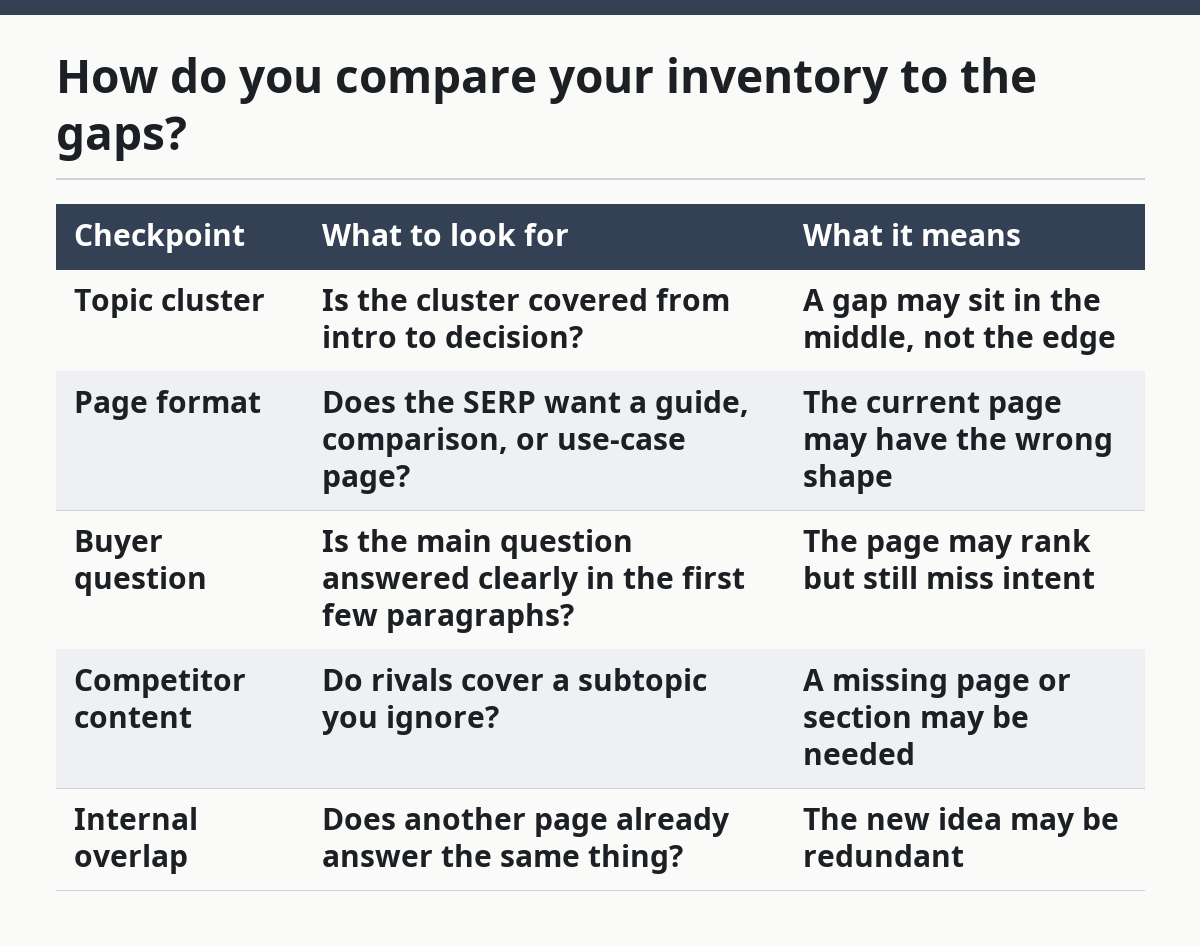
This is also where the phrase “content gap” needs discipline. Not every absence is worth fixing. If the missing page does not support a cluster, answer a recurring buyer question, or match a SERP pattern, leave it out.
One honest trade-off sits here: a full inventory comparison can take time up front, especially if the site has many URLs. But skipping it can cost more later because the team ends up arguing over ideas without a shared map. A 1-day spreadsheet pass can help prevent a 3-week content detour, depending on scope and team size.
For the broader planning layer, this page sits under the SaaS topic planning and editorial strategy hub, which is where the cluster-level decisions belong.
What should you prioritize first?
You should prioritize the gaps that sit closest to revenue-adjacent intent, support a topic cluster you already have, and solve a real buyer question the current content misses. That gives you a practical order instead of a giant wish list.
A simple priority filter works better than a complex matrix for this stage. Ask 3 questions about every gap: does it match a real SERP pattern, does it answer a repeated buyer question, and does it strengthen an existing cluster? If the answer is yes to at least 2 of those, it is probably worth moving up.
Do not start with the biggest keyword. Start with the clearest hole. A missing comparison page may matter more than a broad educational page if buyers are already weighing options. A missing implementation page may matter more than a top-of-funnel guide if prospects keep asking how long setup takes.
A gap is worth filling when it does at least one of these things:
- removes a point of doubt in a common buying path
- fills a missing page type inside a cluster
- matches the shape of a SERP you already have a shot at
- answers a repeated question your sales or support team hears often
A gap is not worth filling when it only adds noise, duplicates a current page, or requires a topic your product cannot credibly speak to. That is the honest limit of content strategy: not every search term deserves a page.
If you want the shortest rule, use this one. Fill the gaps that change how a buyer decides, not the gaps that merely make the spreadsheet look complete. For a related process, see the SaaS content brief template and the SaaS SEO topic cluster guide.
How do you find SaaS content gaps?
You find SaaS content gaps by comparing your content inventory with competitor content, SERPs, and buyer questions, then noting what is missing in each view. The fastest way is a 4-part sheet with one column for each source. The gaps that appear in more than one source are usually the strongest candidates.
Should gap analysis start with competitors or customers?
It should start with buyers if the goal is useful coverage, then use competitors to check what already exists online. Competitors show you the public shape of the topic, but buyer questions show you what people still need to know. If you reverse that order, the analysis can drift toward imitation.
What makes a content gap worth filling?
A content gap is worth filling when it helps a buyer move, supports a topic cluster, and matches a real search pattern. If it does none of those things, it is probably not a gap you should spend time on. A useful gap changes coverage, not just page count.
Drafted with AI; not yet reviewed by a person.