






SaaS topic planning and editorial strategy — The Complete Guide: SaaS topic planning and editorial strategy usually works best when a team starts with 3…
Last updated: November 20, 2026
Quick Answer: SaaS topic planning and editorial strategy usually works best when a team starts with 3 to 5 topic clusters, then builds support posts around them. In this guide to SaaS topic planning and editorial strategy, the goal is to connect buyer problems, product proof, and search demand so the calendar supports pipeline instead of becoming a list of random posts.
SaaS topic planning and editorial strategy is the system for deciding what to publish, in what order, and why those pages should help a software business grow. The right plan ties topics to buyer problems, product proof, and search demand, so the calendar supports pipeline instead of becoming a list of random posts. For practical search guidance, Google’s own documentation recommends people-first content and clear page structure: Creating helpful, reliable, people-first content.
Key takeaways
- Start with the buyer’s job, not with a list of keywords.
- Build around a few durable topic clusters, then support them with smaller posts.
- A good editorial strategy needs a clear rule for what gets published, what gets cut, and what gets updated.
- The strongest plan is usually the one that matches the product, sales cycle, and proof you can actually show.
- If a topic cannot connect to a real buyer problem or a product use case, it usually belongs in a backlog, not the calendar.
What does SaaS topic planning need to do?
SaaS topic planning needs to connect search demand, product value, and sales motion in one calendar. That means the plan should answer three questions at once: what people search for, what the product helps them do, and what the team can prove with facts, screenshots, docs, or buyer language.
For a SaaS company, a topic plan is not just an SEO list. It is a decision system. A topic that brings traffic but never reaches the right buyer can waste months of writing time, while a topic that matches a real use case can support both rankings and demos. That is why the plan needs a filter before anything gets assigned.
A useful plan usually starts with a small number of topic groups. Those groups often map to product jobs, pain points, or stages in the buying journey. The point is not to cover everything. The point is to cover the few areas where the software is actually different, where the market already asks questions, and where the team can answer those questions better than generic content can.
Specifically, Google’s own guidance on helpful content makes this practical: the content should be made for people first, not for search tricks. The strongest SaaS plans follow that rule by organizing around buyer intent, then supporting it with consistent updates, internal links, and clear page purpose. Google’s guidance is here: Creating helpful, reliable, people-first content.
This is where many generic posts go wrong. They treat editorial strategy like a publishing habit. In SaaS, it is closer to a product decision, and a professional SEO or content strategist should review the plan when the stakes are high. If a topic cannot support acquisition, activation, retention, or expansion in some way, it should be questioned before it gets a slot in the calendar.
Which topics deserve a place in the plan?
The strongest SaaS topics deserve a place in the plan when they match buyer language, product reality, and a realistic path to proof. That means the topic should be asked by someone the software can help, and the page should be able to answer it without hand-waving.
A strong topic usually fits at least one of these 4 patterns:
-
The buyer has a painful task.
Example pattern: “How do I shorten the approval process?” A SaaS product that solves approvals has a clear reason to publish here. -
The buyer is comparing tools or methods.
Example pattern: “X vs. Y” or “spreadsheet vs. software.” These pages can work when the product has a real difference, not when the only claim is “we are easier.” -
The buyer needs a setup or usage answer.
Example pattern: “How to set up automation for a 3-step workflow.” These are often high-intent pages because they meet the user closer to action. -
The buyer needs proof.
Example pattern: “How to measure team throughput” or “How to report churn.” These topics are useful when the product can show a concrete way to do the job.
A topic does not deserve a place just because keyword tools show volume. It also does not deserve a place just because a competitor published something similar. If the topic does not connect to your product, sales team, support docs, or buyer evidence, it usually becomes thin content.
The check below is a practical way to judge a topic:
- Can the page name a real buyer problem?
- Can the page show a specific solution?
- Can the page be updated later with product or market changes?
If the answer to any of those is no, the topic belongs in research, not in the schedule. That rule keeps the plan focused and saves the team from filling the blog with pages that look active but do nothing.
Pillar-first or campaign-first editorial strategy?
Pillar-first wins for most SaaS teams because it creates a stable structure that search, sales, and product teams can all use. Campaign-first wins only when the company has a short-term launch, event, or seasonal message that needs fast attention.
The difference is simple. A pillar-first strategy builds durable topic pages around core buyer problems, then supports them with related posts. A campaign-first strategy builds around a launch, theme, or offer, then tries to make the content useful later. One is built for compounding value; the other is built for speed.
| Criteria | Option A: Pillar-first | Option B: Campaign-first | Winner for [condition] |
|---|---|---|---|
| Primary goal | Long-term search and topic authority | Short-term attention around a launch or event | Pillar-first for steady organic growth |
| Calendar shape | Core pages first, then supporting posts | Date-driven bursts around a single theme | Pillar-first for teams with limited writing capacity |
| Search fit | Better for clustered intent and internal linking | Better when the topic ties to a timely demand spike | Pillar-first for SEO-led programs |
| Proof required | Needs clear product use cases and stable claims | Needs a timely hook and one clear message | Campaign-first for launches with a fixed date |
| Risk level | Lower risk of orphan pages if the cluster is planned well | Higher risk of one-off posts with no follow-up path | Pillar-first for evergreen content |
| Internal stakeholder fit | Works well with product, SEO, and sales input | Works well with demand gen and launch teams | Pillar-first for cross-functional editorial planning |
| Maintenance | Requires periodic updates and links between pages | Requires more rewriting after the campaign ends | Pillar-first for lower long-term rework |
| Best use case | Companies that need a content base they can keep building on | Companies with a major release, event, or promotion | Pillar-first for most B2B SaaS |
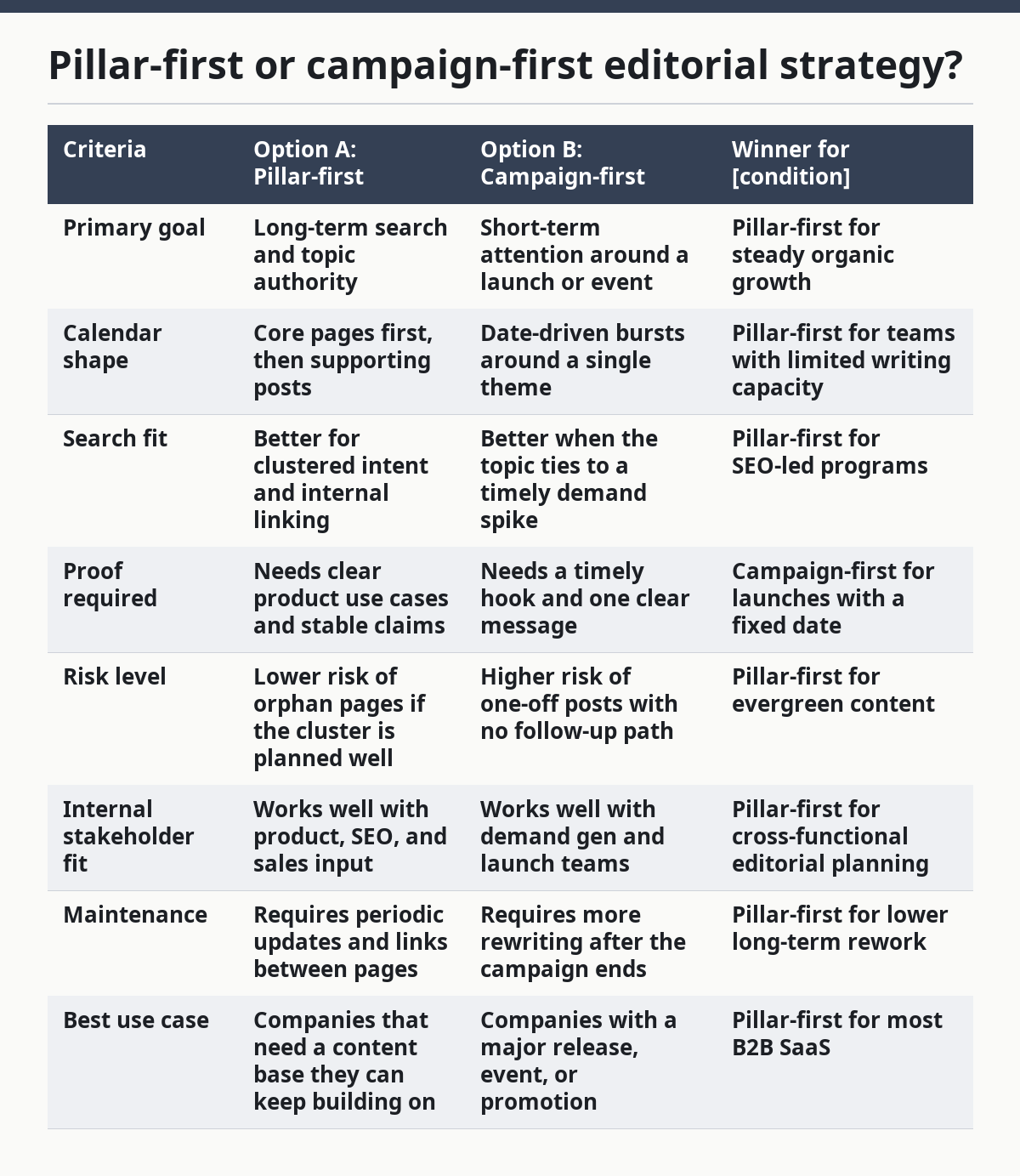
The honest drawback of pillar-first is that it can feel slow. It often takes more planning before the first batch goes live, and that can frustrate teams that want immediate activity. Campaign-first has a real advantage here: it can produce visible output quickly, which is useful during a launch window of a few weeks.
Therefore, a simple rule helps. Use pillar-first as the default editorial architecture, then use campaign-first as the overlay when a release, event, or market moment needs its own content sprint. That way the calendar keeps building value instead of resetting every month.
How should a SaaS content map be built?
A SaaS content map should be built from topic clusters, not from a loose list of headlines. The map needs to show which page is the main page, which pages support it, and which buyer questions each one answers.
Start with 3 layers:
- Core pages that define the main problem or category.
- Support pages that answer specific questions, objections, or comparisons.
- Evidence pages that show process, workflow, or product proof.
That structure keeps the editorial plan from scattering effort. It also makes internal linking easier, because every support post has a known parent page. If the plan has no parent-child logic, the blog usually turns into a pile of isolated posts.
In particular, the best maps also separate search intent from content format. A comparison page, a how-to page, and a glossary page may all sit in the same cluster, but they should not be treated as the same page type. The reader expects different depth from each one, and the editor should assign each page a job before writing starts.
A useful planning test is the “one page, one job” rule. If a page tries to rank for a definition, a comparison, a workflow, and a product pitch at once, it usually becomes muddy. Clear editorial strategy gives each page one main promise, one main audience, and one main action.
Google’s SEO starter guidance still supports this structure: pages should help users and be understandable to search engines through clear organization, descriptive titles, and useful content. The reference is here: SEO Starter Guide.
A content map also needs a backstop for updates. SaaS changes, pricing changes, workflows change, and competitors change. If the map has no update path, older pages go stale quickly. That is why a good map is not just a brainstorm document. It is a maintenance plan.
How do you prioritize topics without guessing?
You prioritize SaaS topics by combining intent, business value, and ease of proof, not by using keyword volume alone. A topic with lower demand can still be the right choice if it reaches the right buyer and can be supported with clear examples.
A practical prioritization model uses 4 checks:
- Relevance: Does the topic match a real buyer problem?
- Intent: Is the reader looking to learn, compare, or act?
- Proof: Can the page show something specific instead of vague claims?
- Effort: Can the team write, review, and update it without blocking other work?
This is where editorial strategy becomes more than planning. It becomes a ranking system for editorial time. A topic that scores high on relevance and proof often deserves priority over a generic topic with broader search demand but weak business fit.
A lot of teams get trapped by the same mistake: they optimize for “what gets clicks” and forget “what gets trust.” In SaaS, trust matters because the reader is often evaluating software that could affect a workflow, a budget, or a team process. A page that explains a real trade-off can do more for the business than a page that chases broad traffic.
Priority should also reflect the product stage. Early-stage SaaS usually needs definition and problem pages first, because the market may not know the category well. More mature products often need comparison pages, use-case pages, and migration pages, because the audience already knows the space and wants a decision.
Then, the smartest plans keep a 2-tier backlog. Tier 1 is the next 10 to 20 topics that fit the current quarter. Tier 2 is the longer list of ideas that are promising but not ready yet. That stops the calendar from being overloaded with “good ideas” that never get written.
What do most SaaS editorial plans get wrong?
Most SaaS editorial plans get wrong the relationship between volume and value. They publish too many pages with no shared structure, or they build one strong pillar page and then fail to support it with the 5 to 10 pages that make it useful.
The first common mistake is writing for a keyword instead of a decision. A topic like “project management software” may attract attention, but if the page does not help the reader choose, implement, or solve a real problem, it becomes generic fast.
The second mistake is skipping product truth. Editorial teams sometimes avoid specifics because they fear limiting the audience. In SaaS, vague content usually hurts more than it helps. A post that clearly states who the tool is for, what it does well, and where it is weak is usually more useful than a post that tries to sound universal.
The third mistake is publishing without a maintenance plan. A topic strategy that only works at launch time will decay as product screenshots, terminology, and market language change. Pages need a review cycle, even if it is simple. A 90-day or quarterly review rhythm is enough for many teams, but the key is consistency rather than frequency for its own sake.
The fourth mistake is failing to connect content to distribution. A good SaaS plan does not assume people will find every page on search alone. It also gives sales, product marketing, and support a reason to use the content. If a post cannot be linked in a demo follow-up, onboarding email, or support answer, it may be missing the practical layer that makes it valuable.
The honest trade-off here is focus. A tighter editorial strategy can leave some topics out. That is not a weakness if the plan is built for the right buyer and the right product stage. A broad plan may feel safer, but it often spreads effort too thin to matter.
When should the strategy change?
The strategy should change when the product, buyer, or market changes enough that the current topic map no longer matches reality. That usually happens after a new category push, a major feature release, a repositioning, or a shift in the sales motion.
There are 4 exception scenarios where the usual pillar-first recommendation should flip or bend:
-
A launch with a fixed deadline.
If the team has a release in 3 to 6 weeks, campaign-first work can take priority. The content needs to support the launch window, not wait for a full cluster to form. -
A brand-new category with low search clarity.
If buyers do not yet use stable language, the plan may need more problem education and fewer comparison pages. The map should start with definitions, pains, and workflow explanations. -
A narrow ICP with a clear workflow.
If the product serves one small user group, a tightly focused map can outperform a broad cluster plan. Specificity matters more than reach when the audience is precise. -
A mature market with strong competitor pages.
If the space is crowded, the strategy may need more proof-led content, migration guides, or point-of-view pages to stand out. “What is it?” pages may not be enough on their own.
A strategy should also change if the content library grows but leads do not. That is a signal that the topic mix may be wrong, the internal links are weak, or the page purpose is too fuzzy. The answer is not always “publish more.” Sometimes the answer is “cut the weak clusters and sharpen the strong ones.”
Because of that, the key is to treat editorial strategy as a living system. A plan built for an early-stage SaaS company often does not fit the same company 18 months later. The structure can stay, but the topics, proof points, and page types should shift with the business.
What should the final recommendation be?
Choose pillar-first if the SaaS company needs a durable content base, has a clear product value, and can support each cluster with proof and updates. Choose campaign-first if there is a launch, event, or timed message that needs fast attention inside a short window.
Neither works well if the product has no clear buyer problem, the team cannot show proof, or the calendar is only being filled to look active. In that case, the issue is not the editorial format. The issue is the absence of a content thesis.
SaaS topic planning works best when it behaves like product strategy: specific, selective, and tied to real use. A plan that can explain its choices will beat a plan that only looks busy.
FAQ
How many topics should a SaaS editorial plan start with?
A SaaS editorial plan should start with a small number of topic clusters, not a giant list of one-off posts. A useful first pass is often 3 to 5 clusters, each with a core page and several support pages. That gives the team enough structure to publish without locking the calendar into too many moving parts.
Should SaaS content focus on top-of-funnel only?
No, SaaS content should not focus on top-of-funnel only. Learning pages are useful, but comparison, implementation, and proof pages often do more to support pipeline because they meet readers closer to a buying decision. A strong plan usually mixes all 3 intent levels.
How do I know if a topic is too broad?
A topic is too broad if it cannot be tied to one buyer problem, one page purpose, or one clear action. If the draft outline keeps splitting into multiple unrelated answers, the topic is probably doing too much work. Broad subjects usually need to be broken into smaller posts before they can be useful.
How often should editorial strategy be reviewed?
Editorial strategy should be reviewed on a regular cycle, often quarterly, because SaaS products and market language change quickly. The review should check which pages still match the product, which clusters need updates, and which topics should move from backlog to active work. The exact rhythm matters less than keeping one.
What is the biggest mistake in SaaS topic planning?
The biggest mistake is choosing topics for traffic potential alone and ignoring whether the page can help a real buyer. That mistake creates content that may get clicks but does not support the product. The better question is whether the topic can earn trust, answer a real question, and connect back to the software.
Drafted with AI; not yet reviewed by a person.