SaaS blog structure and content governance — The Complete Guide: a SaaS blog structure and content governance system usually works best with 3 review…
Last updated: November 20, 2026
Quick answer: a SaaS blog structure and content governance system usually works best with 3 review tiers and one named owner per post. SaaS blog structure and content governance is the system that keeps a blog useful after the first draft ships. The structure decides what goes where; governance decides who approves it, how often it is reviewed, and when it gets updated or retired. For SaaS teams, that is the difference between a blog that grows traffic for 6 months and one that stays accurate after the product changes.
Key takeaways
- A SaaS blog needs two things at once: a clear page structure and a clear approval path.
- A strong structure for SaaS is usually built around search intent, product stage, and the jobs readers need to do.
- Governance is not just editing. It covers briefs, SME review, legal checks, update cadence, and post retirement.
- The biggest risk is stale content that keeps ranking after the product, pricing, or workflow has changed.
- A simple 3-step approval flow is usually better than a slow chain of sign-offs, unless the topic carries compliance risk.
What should a SaaS blog structure do?

A SaaS blog structure should help a reader find the right answer in under 30 seconds and help the team keep that answer current for 12 months or more. The structure is not decoration. It is the map that tells each post what job it has, where it sits in the funnel, and which other pages it supports.
Therefore, a strong SaaS blog usually does four things. It groups posts by problem type, by product stage, by audience, and by intent. That means a post for “how to set up SSO” does not sit beside a thought-leadership post about the future of identity management unless there is a clear reason. The two posts serve different readers and need different update rules.
The most common mistake is to organize posts by internal team structure. A sales team may want one cluster, product marketing another, and SEO another. Readers do not care about that. They care about solving a task, comparing tools, or learning a concept. A better structure follows those needs first.
A useful SaaS blog structure usually has 4 layers:
- Pillar pages for broad topics that can support many posts.
- Cluster posts for specific questions, workflows, or comparisons.
- Conversion pages for demos, trials, pricing, and product detail.
- Support pages for changelogs, help docs, and policy content.
That setup makes the blog more than a traffic machine. It becomes a content system that can answer search questions, support product adoption, and reduce repeated sales and support questions.
If the blog is very small, this structure can look like overkill. However, the cost of a bad structure shows up later, when 40 posts all talk about the same feature from different angles and nobody knows which one is right. That is harder to fix than building the spine first.
What does content governance mean in practice?
Content governance means the rules, owners, and checkpoints that control what gets published, who signs off, and when content gets reviewed or removed. In plain terms, it answers five questions: who writes, who approves, who updates, who owns the truth, and what happens when the truth changes.
For SaaS, governance matters because the product changes. A blog post written against version 1.4 can be wrong by the time version 2.0 ships. Pricing changes, feature names change, screenshots change, and integration details change. Without governance, the blog becomes a trail of old claims.
A practical governance model does not need 12 committees. It needs clear roles. The basic set is usually:
- Writer: drafts the post and matches it to a brief.
- Editor: checks clarity, structure, and search intent.
- Subject matter expert: confirms product accuracy.
- Legal or compliance reviewer: checks regulated claims, if needed.
- Publisher: posts the content and logs the version.
- Owner: tracks refresh dates and retirement decisions.
The most useful governance document is a one-page rule sheet. It should say what counts as a required review, what counts as a minor update, and what content can be published without product approval. That document saves time because it stops every post from becoming a special case.
A governance model should also define freshness rules. For example, product-led tutorials may need review every quarter, while evergreen concept posts may need review every 6 months. The exact schedule depends on how fast the product changes, not on how much traffic the post gets. A post can be popular and still be wrong.
Google’s guidance on helpful, reliable content is a useful reference point here: Google Search Central: creating helpful, reliable, people-first content. Google also publishes spam policies that matter when content starts to drift into thin, repetitive, or deceptive pages: Google Search Central: spam policies for Google web search. For broader editorial maintenance, Nielsen Norman Group’s guidance on content audits is also useful.
How should the blog be organized?

The blog should be organized around reader jobs, not around random topic ideas. A SaaS blog works best when every post fits one of a few clear buckets: learn, compare, solve, adopt, or decide. That makes the site easier to read and easier to govern.
A clean structure often starts with these 5 content groups:
- Educational posts that explain a concept in plain language.
- How-to posts that help a user complete one task.
- Comparison posts that help a buyer choose between options.
- Product-led posts that show how the software supports a workflow.
- Trust posts that answer risk, security, compliance, or implementation questions.
The real win is not the label. It is the rules attached to the label. A how-to post needs screenshots, steps, and error handling. A comparison post needs a fair matrix, defined criteria, and a clear recommendation. A trust post needs exact policy language, not marketing copy.
Here is a simple way to think about the structure.
| Content type | Primary job | Best stage | Governance risk | Example update trigger |
|---|---|---|---|---|
| Educational | Explain a concept | Early learning | Low to medium | New terminology or standard |
| How-to | Complete a task | Adoption | High | UI or workflow change |
| Comparison | Choose a tool | Consideration | Medium | Competitor or feature change |
| Product-led | Show the product in use | Consideration | High | Product release or rename |
| Trust | Reduce risk | Decision | Very high | Policy, security, or compliance change |
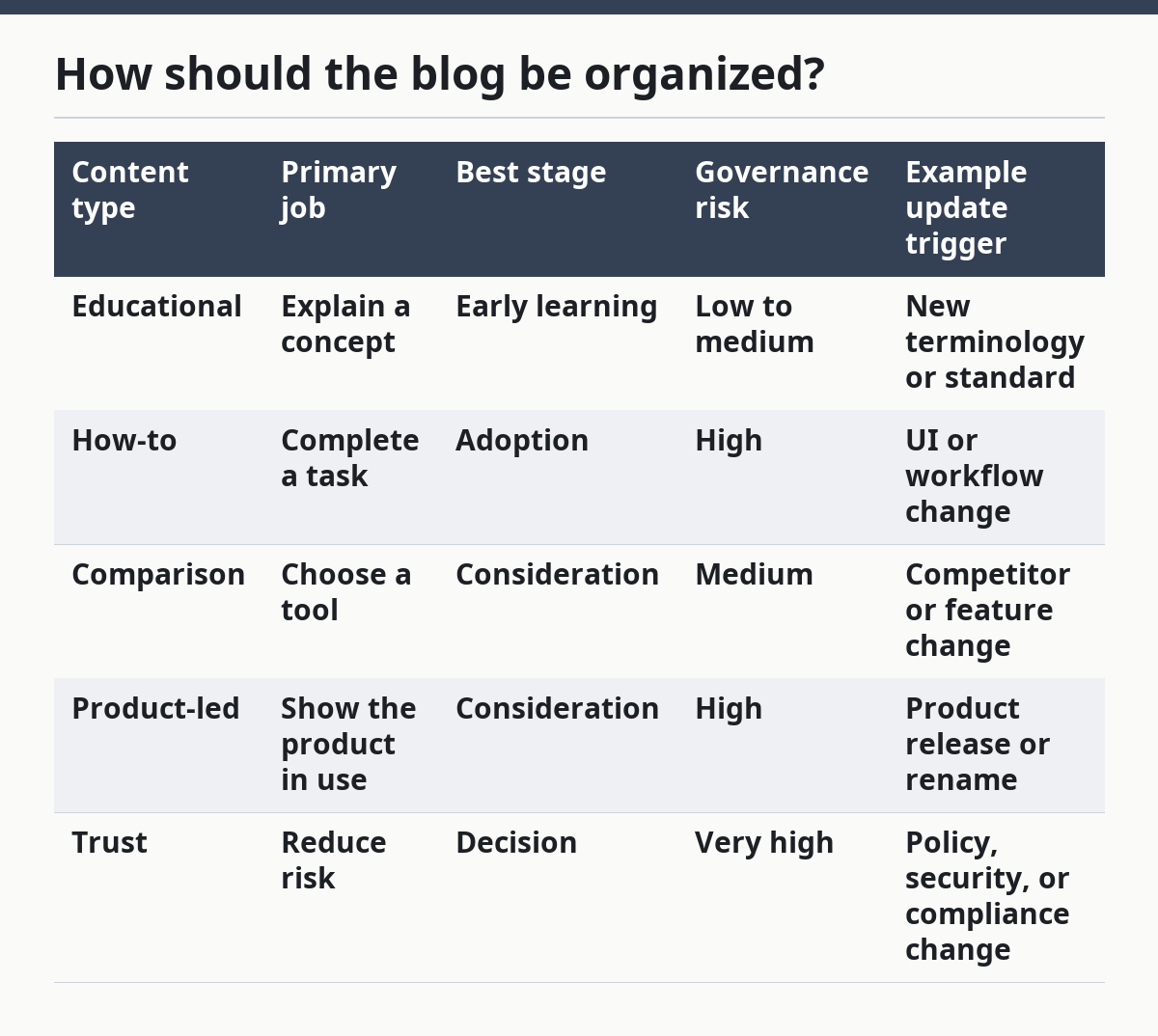
This structure matters because each group needs a different review path. A concept post may only need editorial review. A tutorial on permissions may need product sign-off and a timestamped refresh date. A post about security or data handling may need a compliance check before it goes live.
The obvious alternative is a flat blog with no grouping. That looks simpler, but it creates three problems fast. Readers cannot find related posts, editors cannot spot duplicates, and updates are easy to miss. Flat structures also make internal linking sloppy, because every post starts from zero.
A better structure is not just about SEO. It helps the team decide what each page is for. A page without a job tends to become a page with vague claims.
Which governance model works best?
A practical governance model for most SaaS blogs is a light, role-based workflow with a mandatory product review on posts that mention features, workflows, integrations, or pricing. That model is fast enough to publish often and strict enough to stop obvious errors.
The main choice is between a light process and a strict process. Light governance means fewer checkpoints and faster publishing. Strict governance means more review layers and stronger control. The right choice depends on how risky the content is and how often the product changes.
| Criteria | Light governance | Strict governance | Winner for this condition |
|---|---|---|---|
| Publishing speed | Faster, usually 2 or 3 steps | Slower, more sign-offs | Light, for low-risk educational content |
| Accuracy control | Good, if the product is stable | Stronger, especially with regulated claims | Strict, for feature-heavy posts |
| Team overhead | Lower | Higher | Light, for small teams |
| Fit for compliance | Weak unless paired with legal review | Better for review trails and approvals | Strict, for security or finance topics |
| Ease of updates | Easier to maintain | Can become bureaucratic | Light, when content changes often |
| Consistency across posts | Depends on editor discipline | More consistent across authors | Strict, for multi-author blogs |
| Risk of stale content | Higher if nobody owns refreshes | Lower if ownership is assigned | Strict, for fast-moving SaaS |
| Fit for thought leadership | Good enough | Can be too slow | Light, for opinion-led posts |
| Fit for tutorials | Risky if steps change often | Better when product accuracy matters | Strict, for workflow posts |
Light governance wins for teams that publish educational content, opinion posts, and broad SEO articles with limited product detail. Strict governance wins for content that mentions settings, integrations, permissions, pricing, or any claim that could be contradicted by the product team in a single release note.
The common mistake is to use strict governance for everything. That creates bottlenecks. Posts sit in review for days, then weeks, and the calendar gets clogged with work that should have been easy. The opposite mistake is to skip formal review entirely. That saves time today and creates rework later, when the post is outdated and still ranking.
A sane middle path is to use a 3-tier rule:
- Green content: concept posts and top-of-funnel explainers. Editor review only.
- Amber content: how-to posts, feature explainers, and comparisons. Editor plus SME review.
- Red content: security, compliance, pricing, integrations, and claims. Editor, SME, and legal or policy review if needed.
That 3-tier model is simple enough to run with a small team and strong enough to protect the pages that matter most.
What should a SaaS brief include?
A SaaS brief should include the search job, the reader, the angle, the product truth, and the review path. If any one of those is missing, the draft will usually drift. A vague brief can make content debt more likely.
A solid brief usually contains 8 parts:
- Primary question the page must answer.
- Reader stage such as learning, comparing, or adopting.
- Target audience such as founder, marketer, admin, or buyer.
- Core message in one sentence.
- Supporting points that must appear.
- Claims that need approval before publication.
- Links or references the writer must use.
- Refresh owner and date for the next review.
That last item matters more than many teams expect. If a post has no owner, it has no future. It may look finished on publish day, but the governance work has not started yet.
A brief should also say what the article must not do. For example, it should not compare the product to a competitor unless the comparison is approved. It should not mention roadmap items. It should not use screenshots from a build that is not public. These limits prevent the draft from filling in gaps with guesswork.
One useful rule is to separate “approved facts” from “writer notes.” The first are claims the post may print. The second are ideas to explore. Mixing them creates trouble because a draft can sound confident while still being unconfirmed.
This is where many generic content systems fail. They treat the brief like a topic note, so if the topic touches pricing, security, or product claims, the team should consult the relevant SME or a professional reviewer before publishing. For SaaS, the brief is closer to a control document. It sets the bounds of what can be said, not just the theme.
How do updates and ownership keep content accurate?
Updates and ownership keep content accurate by making one person responsible for each post after it publishes. Without a named owner, a SaaS blog becomes a pile of old versions, and the team notices the damage only when traffic falls or support tickets rise.
Ownership should be assigned at the post level, not only at the topic level. A single owner can manage several related posts, but every post needs one named person who knows when it was last checked. That owner does not have to write the update. The owner has to make sure the update happens.
A refresh system should define 4 things:
- Review cadence: for example, every quarter or every 6 months.
- Trigger events: a feature rename, pricing change, UI update, or policy shift.
- Update types: minor copy change, full rewrite, or retirement.
- Logging method: a simple record of what changed and when.
The most useful habit is to tie refreshes to product events. When the product ships a new workflow, the related blog post should go into review. When an integration changes, the tutorial should be checked. When a pricing page changes, any blog content that mentions pricing should be audited the same week, not later.
Retirement is part of governance too. Some posts should not be updated forever. If the topic is obsolete, or the page no longer fits the product, it may be better to remove it, redirect it, or archive it. Leaving dead pages in place is easy. It is also expensive, because stale pages can still attract the wrong search traffic.
The bad habit to avoid is “set and forget.” A blog post is not a brochure. It is a living page with a maintenance cost. A 20-minute review can save a reader from following the wrong steps and save the team from cleaning up the fallout.
When does governance get in the way?
Governance gets in the way when it slows down low-risk content more than it protects high-risk content. That happens when every post needs the same number of approvals, no matter whether it is a simple explainer or a sensitive product claim.
The first sign of over-governance is delay. If a 700-word educational post takes longer to approve than to write, the process is probably too heavy. The second sign is vague ownership. If nobody knows who can approve a page, the team may keep waiting for a sign-off that never comes.
There are 3 common failure modes:
- Too many reviewers: six people comment, but nobody owns the final call.
- Too much detail: the process tracks font choices before it tracks claim accuracy.
- Too little freedom: every line needs approval, so writers stop proposing better angles.
The fix is not to remove governance. The fix is to make it proportional. A general education post about a concept may need one editor and one final check. A page about data handling may need more. The process should reflect risk, not habit.
A good governance system is visible but not noisy. Writers know what is required before they draft. Editors know what to check. SMEs know when they are needed. And the review path should be short enough that the team can keep publishing on schedule.
The obvious alternative is an “anything goes” model. That may feel fast for a month or two. Then the blog fills with duplicates, mixed claims, and outdated screenshots. At that point, the cost of cleanup is higher than the cost of doing it right the first time.
What should the final operating model look like?
The final operating model should combine a simple blog structure with a tiered governance workflow and a named refresh owner for every post. That setup is usually the safest for most SaaS teams because it keeps publishing moving without turning accuracy into an afterthought.
A practical operating model often looks like this:
- Plan by page type. Decide whether the post is educational, how-to, comparison, product-led, or trust-based.
- Assign a review tier. Green, amber, or red.
- Write from a brief. Include the reader job, approved claims, and required sources.
- Review before publish. Use the smallest review path that fits the risk.
- Track the refresh date. Recheck the page after a defined period or product change.
- Retire when needed. Update, redirect, or archive stale pages.
That model is better than a “publish and hope” approach because it gives every post a life cycle. It is also better than a giant approval chain because the rules are clear before the draft starts.
The best SaaS blogs do not try to govern everything in the same way. They protect the risky posts, move fast on the safe ones, and keep a record of what changed. That is the real value of governance: not control for its own sake, but fewer errors and fewer surprises.
Choose light governance if the blog is mostly educational, the product changes slowly, and the team needs speed. Choose strict governance if the blog includes feature claims, integrations, security language, or compliance-sensitive content. Neither if the site cannot name an owner for each post, because without ownership, even the best structure will rot.
What are the exception scenarios?
The overall recommendation flips in a few cases, and those cases matter because they change the cost of being wrong. Here are 4 of them.
First, if the SaaS product changes every 2 or 3 weeks, strict governance becomes less optional. In that setting, the cost of stale tutorials is high, and a light process can fail quickly. The blog needs more review, not less.
Second, if the blog is almost entirely thought leadership, strict governance can be too heavy. Opinion posts and market commentary do not need the same review path as a permissions tutorial. A 2-step process may be enough.
Third, if the company is in a regulated or high-risk space, the bar rises. Security, finance, and compliance language can create real exposure if it is wrong. In those cases, a red-tier review path is not a luxury.
Fourth, if the team has only one content owner and no SME access, even a good structure can stall. The bottleneck is not the framework. It is the lack of people who can confirm the facts. In that case, the simpler path is to publish fewer posts and review them more carefully.
These exceptions do not cancel the main rule. They define the edges where the default model needs more control or more speed. A good governance system is not fixed. It adjusts to the risk in the content and the pace of product change.
FAQ
What is the difference between blog structure and content governance?
Blog structure is the way posts are grouped, linked, and labeled. Content governance is the process that controls who creates, approves, updates, and retires those posts. Structure helps readers find the right page; governance helps the team keep that page correct after publish day.
How often should SaaS blog content be reviewed?
The right cadence depends on how fast the product changes and how risky the page is. A feature tutorial may need review every quarter, while a broad educational post can often wait longer. Pages that mention pricing, integrations, or compliance should be checked whenever the underlying facts change.
Who should approve SaaS blog content?
The editor should approve clarity and structure, while the subject matter expert should approve product accuracy. Legal or compliance review is only needed when the topic carries that kind of risk. The goal is not to involve everyone; the goal is to involve the right people for the post type.
Which posts need the strictest governance?
Posts that mention features, workflows, integrations, pricing, security, or compliance need the strictest governance. Those posts can become wrong faster than general education posts because they depend on product details that change. A simple explanation of a concept is usually lower risk than a tutorial tied to the UI.
When should a SaaS blog post be retired instead of updated?
A post should be retired when the topic no longer matches the product, the page keeps attracting the wrong intent, or the rewrite would be more work than a new post. If the content is obsolete and cannot be made current without distorting the topic, retirement is cleaner than endless patching.
Drafted with AI; not yet reviewed by a person.