






How to Build a SaaS Blog Content Ownership Matrix for Authors, Editors, and Approvers: A SaaS blog content ownership matrix maps who writes, who edits…
Last updated: November 20, 2026
A SaaS blog content ownership matrix maps who writes, who edits, who approves, and who is answerable when a post stalls. It is the fastest way to stop “I thought you had it” handoffs, and it works best when one row covers one article and one person owns each role.
Key takeaways
- The matrix is a role map, not a workflow diagram.
- Each blog post should have one clear author, one editor, and one approver.
- Subject matter experts help with accuracy, but they should not become hidden owners.
- A simple 3-column setup is enough for many SaaS teams; more layers slow publishing.
- The best matrix is the one people can read in under 60 seconds.
What is a SaaS blog content ownership matrix?
A SaaS blog content ownership matrix is a table that shows who owns each part of a blog post, from draft to approval. In practice, it keeps authors, editors, approvers, subject matter experts, and workflow owners from overlapping in ways that create delays.
The simplest version is a 4-column sheet: content item, role, named person, and backup. One row might say the author drafts the post, the editor shapes it, the approver signs off on the final version, and the subject matter expert checks product accuracy. That is enough for a small team, and it is usually clearer than a long policy document.
The point is not hierarchy. The point is decision clarity. If a writer makes a product claim, the matrix should show who can approve it and who only reviews it for accuracy. If the editor and approver are the same person, that should be visible too, instead of hidden in Slack.
For SaaS teams, the matrix is most useful when a post crosses functions. A blog on pricing, security, integrations, or compliance can involve product, legal, and customer teams. Without a matrix, a 1,200-word article can sit for 5 days because nobody knows who has the last word.
This page sits under the larger SaaS blog structure and content governance hub, but it stays focused on ownership, not review rules or intake forms.
Who should be in the matrix?
The matrix should include the people who shape the post and the people who can stop it from shipping. For most SaaS blogs, that means authors, editors, approvers, subject matter experts, and the workflow owner.
An author writes the first draft and usually owns the angle, outline, and source gathering. An editor improves structure, clarity, tone, and SEO fit. An approver gives the final yes or no on the version that goes live. A subject matter expert checks factual accuracy on technical or product-specific claims. The workflow owner keeps the process moving and resolves dead ends.
If a team is small, one person can hold more than one role. A startup may have a writer who also edits, or a marketing lead who is both editor and approver. That is normal. The matrix should show the split clearly, even when the same name appears twice.
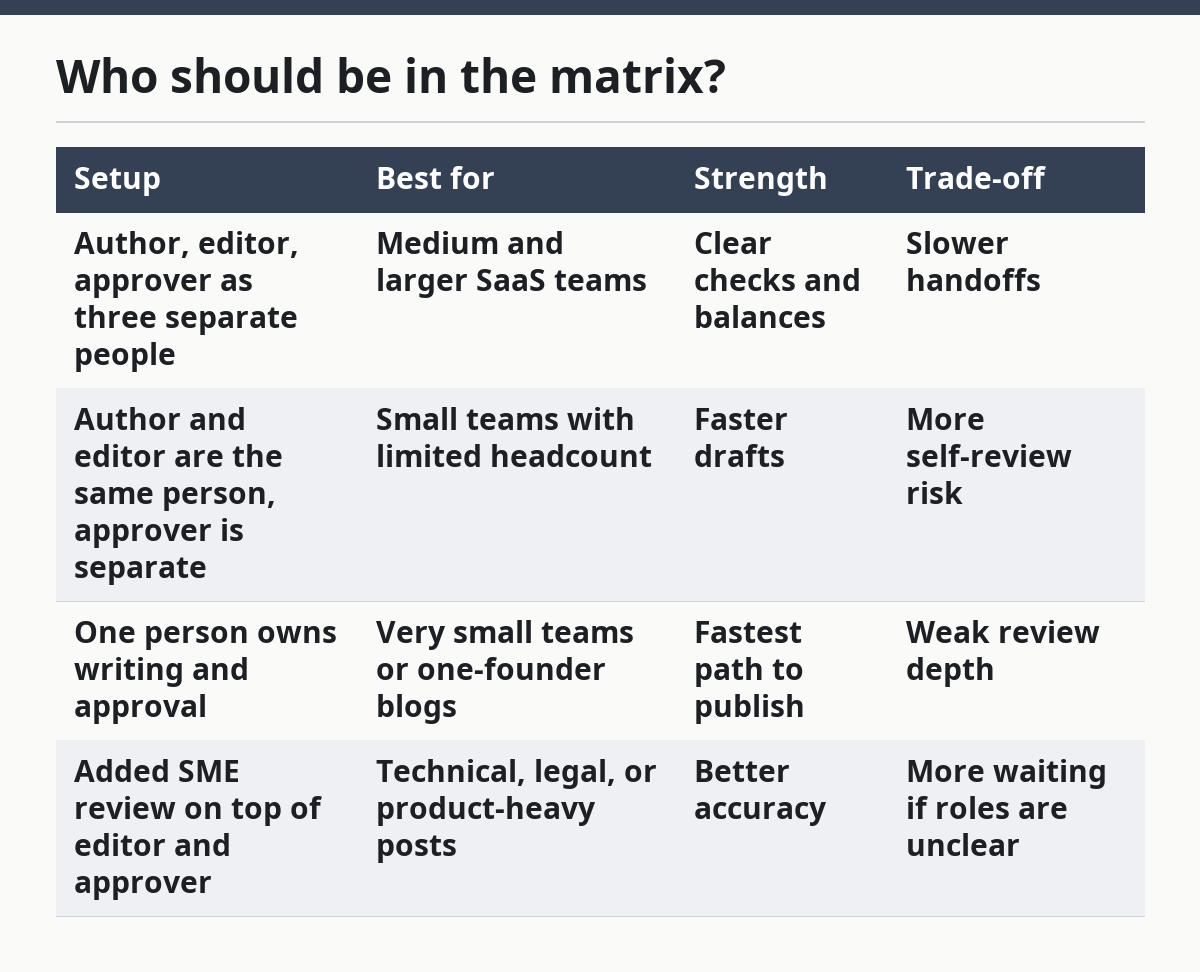
Here is a simple comparison of common ownership setups:
| Setup | Best for | Strength | Trade-off |
|---|---|---|---|
| Author, editor, approver as three separate people | Medium and larger SaaS teams | Clear checks and balances | Slower handoffs |
| Author and editor are the same person, approver is separate | Small teams with limited headcount | Faster drafts | More self-review risk |
| One person owns writing and approval | Very small teams or one-founder blogs | Fastest path to publish | Weak review depth |
| Added SME review on top of editor and approver | Technical, legal, or product-heavy posts | Better accuracy | More waiting if roles are unclear |
The wrong setup is any version where “everyone” reviews “sometimes.” That sounds flexible, but it usually means no one is accountable on a Tuesday at 4 p.m.
How do you build the matrix?
You build the matrix by listing content types, assigning one owner per decision point, and writing the handoff rules in one place. A usable draft can be made in 30 minutes in Google Sheets or Notion, then tightened after the first 10 posts.
-
List the blog content types you publish.
Group posts by what they need, such as thought leadership, product education, comparison posts, or technical explainers. A matrix for a 10-post editorial calendar is too vague unless the rows reflect real post types. -
Name the roles before naming people.
Write the roles first: author, editor, approver, SME, workflow owner. This prevents the matrix from turning into a staff list that breaks when one person leaves. -
Assign one primary person to each role.
One row should have one primary owner for each decision. If two people share the same box, the post can drift for 2 days while they compare notes. -
Add a backup only where the delay would hurt.
A backup is useful for approver or SME gaps, not for every cell. A 1-person backup lane keeps the sheet readable. -
Mark what each role can change.
The editor can change headings and structure; the approver can reject the whole piece; the SME can flag claims but should not rewrite tone unless that is their job. These limits stop role creep. -
Put the matrix where the team already works.
A spreadsheet can work for a five-person team, while a task tool may suit a larger one. The tool matters less than whether people open it before they comment in chat. -
Review the matrix after a few published posts.
After 3 to 5 posts, look for bottlenecks. If the same approver slows every article, the matrix is wrong, not the team.
A good matrix answers one question fast: “Who owns this at this step?” If it takes more than a minute to figure that out, it is too complex.
What should each role actually do?
Each role should have a narrow job so the matrix prevents overlap instead of encouraging debate. The safest pattern is to make the author responsible for creation, the editor responsible for shape, the approver responsible for release, and the SME responsible for factual checks.
The author owns the draft and the supporting notes. That includes the first outline, source notes, examples, and draft revisions from comments. The editor should not become the ghost writer unless the matrix says so.
The editor owns structure, readability, and the final editorial standard. That means removing weak sections, tightening the angle, and checking whether the post fits the blog’s format. In many SaaS teams, the editor also checks keyword use and internal link placement, but that should be part of the role only if it is written down.
The approver owns the decision to publish. That person should be able to say yes or no, not just “looks fine.” If the approver is a manager, product lead, or marketing lead, the matrix should also say what they are approving: accuracy, brand fit, legal sensitivity, or launch timing.
The SME owns accuracy on the parts they know best. The SME is not there to polish prose or rewrite the article from scratch. If the SME starts redrafting whole sections, the matrix has mixed review with authorship.
The workflow owner keeps the process from stalling. This role is easy to forget, but it matters when 8 people touch one article. The workflow owner does not need final approval power; the job is to move the item, name the next step, and remove ambiguity.
What mistakes break the matrix?
The biggest mistakes are too many approvers, unclear handoffs, and role labels that sound nice but mean nothing. Each one has a cost, and each one is easy to avoid once the matrix is plain enough to read.
Too many approvers slow the post and make nobody feel responsible. A post that needs 4 approvals can sit for a week because each person assumes someone else will catch the issue. The fix is to choose one final approver and make other reviewers advisory unless there is a real compliance reason.
Vague roles create duplicate edits. If the editor and approver both feel free to rewrite paragraphs, the final draft can bounce back and forth with no visible owner. The fix is to separate edit rights from sign-off rights, even if both people comment in the same document.
Hidden SME ownership is another common failure. A team may say a PM “just helps with accuracy,” then wait 48 hours for that PM to approve every product line. The fix is to state whether the SME is required or optional for that post type.
A fourth mistake is using the matrix as a job title chart. A content ownership matrix is about the work on a post, not about rank. The most senior person on the team does not need to approve a 700-word glossary post unless the matrix says so.
Simple language helps here. “Draft owner,” “edit owner,” and “final approver” are better than invented terms that sound strategic but confuse a new hire in 10 seconds.
Should you use RACI or a simpler model?
A simpler model is usually better for SaaS blog ownership unless the team is large or the stakes are high. RACI can help, but many blog teams only need a lighter version that names one owner for each step.
RACI stands for Responsible, Accountable, Consulted, and Informed. It is useful when a post needs several inputs, because it separates the person doing the work from the person answerable for the result. A 2024-style collaboration standard like that is helpful on complex pieces, but it can feel heavy for routine blog posts.
For a small SaaS blog, a 3-role matrix often works better: author, editor, approver. Add SME only when the topic touches product claims, security, data handling, or anything that could be misstated. That keeps the sheet small enough to use.
Use RACI when:
- a post needs cross-functional input from product, legal, and marketing
- several people need visibility but not decision power
- missed handoffs are already a problem
Use the simpler model when:
- the team is small
- the blog publishes standard educational posts
- speed matters more than layered review
If the matrix takes more than one screen on a laptop, it may be too detailed for the blog team. A one-page view is easier to maintain than a full governance map.
For reference on the RACI model itself, Atlassian’s RACI matrix guide and similar guides from project management organizations are useful starting points. The model matters less than using it consistently.
How do you keep the matrix usable over time?
You keep the matrix usable by treating it like a living reference, not a one-time policy file. A quarterly check is enough for many SaaS teams, and a quicker review makes sense after a role change or a new content type.
Start by checking whether the names still match the real work. If a new editor has been handling posts for 2 months, the matrix should say so. If the approver is always absent on Fridays, that is a process problem that should be visible in the sheet.
Next, watch for repeated bottlenecks. If every technical post pauses at SME review, give the SME a fixed window or reduce the number of posts that need that review. If a post type never needs legal eyes, do not keep routing it there out of habit.
Keep the matrix short enough to print on one page or view without side scrolling. A page that requires hunting through tabs will not be used when the team is under deadline. The goal is not perfection; the goal is fewer surprises on publishing day.
This is also where a boundary matters. A content ownership matrix is not the same thing as an editorial governance model, a review workflow, or a content intake workflow. Mixing those together creates a document no one can maintain.
If the matrix answers who owns each step, the rest of the system can stay simpler. That is the whole point.
Who should own SaaS blog content?
The matrix should name one clear owner for each role, not one person for everything. The author usually owns the draft, the editor owns the quality pass, and the approver owns the final yes. If one person owns all three, the blog can move fast, but it loses review depth.
What is the difference between an editor and an approver?
The editor improves the article; the approver authorizes publication. An editor can cut, rewrite, and tighten a post, while an approver decides whether the version is ready to go live. In a SaaS blog, those jobs should stay separate whenever the content involves product claims or cross-team input.
How do you assign content ownership?
Assign ownership by role first, then by name. Write down the post types, choose the author, editor, approver, and SME for each type, and add a backup only where delays would hurt. Keep the matrix in one place, such as a sheet or workspace page, so the team can find it in under a minute.
Drafted with AI; not yet reviewed by a person.