




SaaS content strategy and audience targeting — The Complete Guide: Most SaaS teams should start with 1 audience, 1 pain point, and 1 conversion path. This…
Last updated: November 17, 2026
SaaS Content Strategy and Audience Targeting — The Complete Guide
Quick answer: Most SaaS teams should start with 1 audience, 1 pain point, and 1 conversion path. This guide to SaaS content strategy and audience targeting works best when audience targeting is based on product fit, search intent, and sales friction rather than vague personas.
Key takeaways

- Start with the buyer’s job, not the blog calendar. A page should answer one problem a real SaaS buyer has at a specific stage.
- Narrow targeting usually wins first. A tighter audience is easier to serve, easier to convert, and easier to measure.
- Search intent matters more than topic volume. A lower-volume query from the right buyer can outperform a broad query that attracts the wrong reader.
- Product-led and sales-led content need different content shapes. One leans on trials and setup questions; the other leans on risk, process, and proof.
- A 90-day plan beats a giant content backlog. Build the first cluster around one ICP, one pain point, and one conversion step.
What is SaaS content strategy?
SaaS content strategy is the plan for which topics to publish, which audience to target, and how each page moves a buyer closer to signup or sales contact. It is not a blog schedule, and it is not a list of keywords. It is the link between the software’s value and the buyer’s problem.
The useful version starts with the product’s actual job. A payroll tool speaks to compliance and admin pain; a design tool speaks to collaboration and output quality; a security tool speaks to risk and control. Those differences change the words on the page, the proof points, and the call to action.
A generic content plan often fails because it aims at “everyone with the problem.” That sounds broad enough to grow, but it usually creates weak pages that please no one. A strong SaaS plan chooses the audience segment first, then builds topics that fit the segment’s buying stage.
Google’s own guidance on helpful, people-first content points in the same direction, and its Search Central documentation is worth reading alongside this plan: Google Search Central and people-first content. For broader content planning, audience definition and funnel design matter just as much as keywords.
The practical test is simple. If a page cannot answer who it is for, what pain it solves, and what the next step is, the strategy is too vague for SaaS.
Who is the audience, exactly?

The audience is the specific buyer, user, or evaluator whose problem the software can solve within the next buying cycle. In SaaS, that often means more than one person, but the message still needs a primary target.
The mistake most teams make is to treat “audience” as a single label like startup founders, marketers, or operations teams; if needed, consult a content strategist or SEO professional before narrowing the target. Those labels are too wide to guide content. A founder in a 10-person company and a director in a 200-person company may search the same broad term, but they need different proof, different risk answers, and different pricing context.
A better audience map has at least four layers: role, company shape, pain point, and buying stage. Role says who the reader is. Company shape covers company size, industry, and maturity. Pain point says what is broken. Buying stage says whether the reader is learning, comparing, or ready to act.
This is where SaaS content often gets it wrong: it writes for the title instead of the job. A head of marketing does not care only about “marketing software.” That person may care about approval flow, reporting speed, integrations, or whether the team can adopt the tool in 2 weeks.
The more precise the audience, the easier it is to decide what not to publish. A page for in-house finance teams should not also try to serve freelancers, agencies, and enterprise CFOs. That kind of blend usually flattens the message and weakens conversion. If the target mix is unclear, consult a messaging or SEO professional before expanding the page set.
Should the strategy target a broad market or a narrow ICP?
A narrow ICP usually wins first because it gives the content a clear promise, a clearer search profile, and a cleaner path to conversion. Broad targeting only works after the site already has strong category authority and multiple content paths.
Here is the honest trade-off. Broad targeting can bring more impressions and more top-of-funnel traffic, but it also attracts readers who will never buy. Narrow targeting brings less traffic at first, but the traffic is more likely to match the product, the demo, or the trial.
| Criteria | Broad market targeting | Narrow ICP targeting | Winner for this condition |
|---|---|---|---|
| Message clarity | Harder to keep one message | Easier to speak to one pain | Narrow ICP |
| Search intent match | More mixed queries | More specific queries | Narrow ICP |
| Traffic volume | Usually higher | Usually lower at first | Broad market |
| Conversion quality | Often weaker | Usually stronger | Narrow ICP |
| Sales alignment | Harder to support | Easier to support | Narrow ICP |
| Content reuse | More general, less precise | Easier to repurpose within one segment | Narrow ICP |
| Topic expansion | Wider, but noisy | Slower, but cleaner | Narrow ICP |
| Category authority | Can be useful later | Better for focused authority | Narrow ICP |
| Brand reach | Broader exposure | Stronger niche position | Broad market |
| Measurement | Hard to attribute | Easier to trace to pipeline | Narrow ICP |
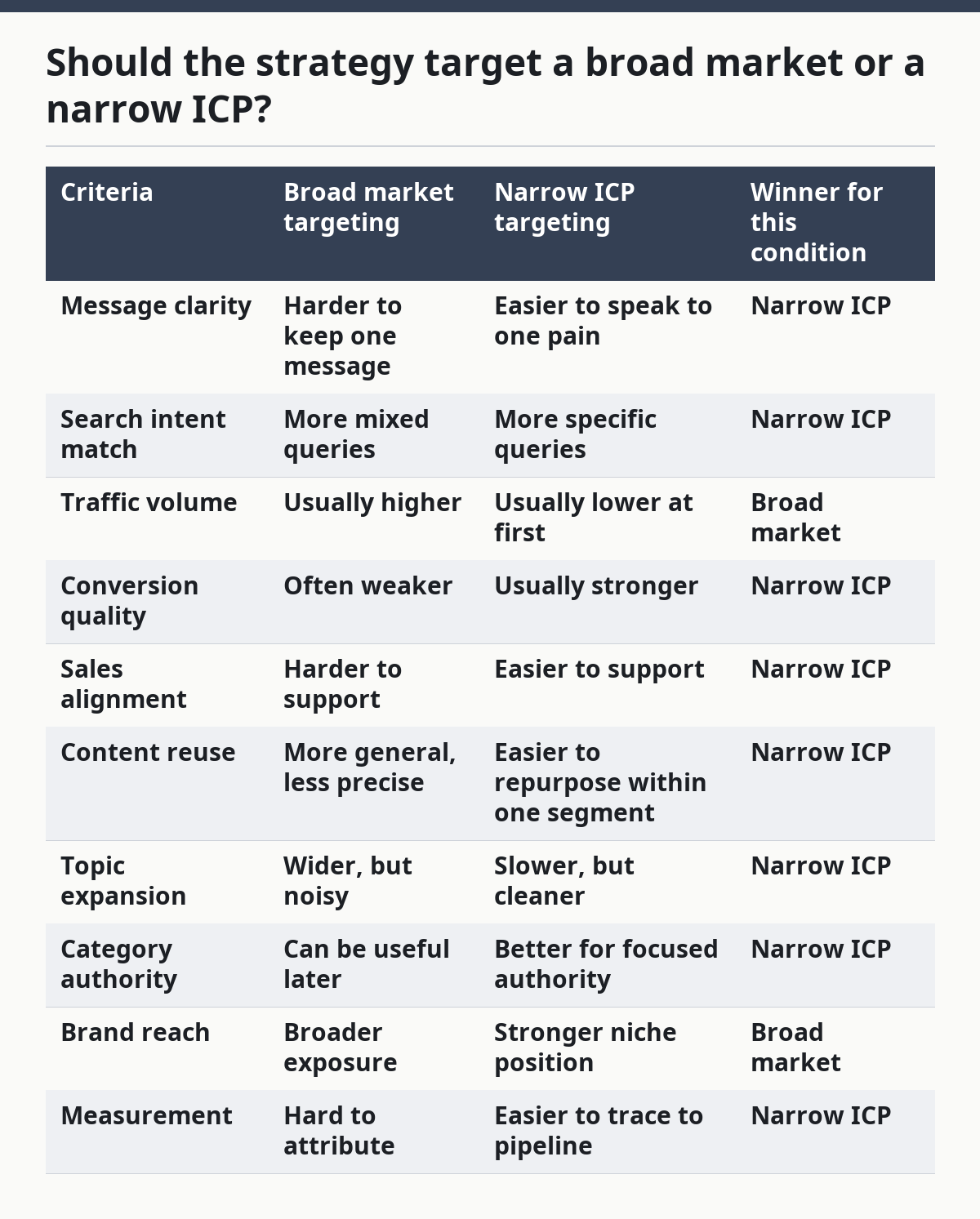
The winner for most SaaS teams is narrow ICP targeting, especially in the first 6 to 12 months of content work. That choice helps the site build a recognizable point of view. It also helps prevent the common trap of publishing pages that rank for loose terms but never help the sales team.
Broad targeting has one real advantage: it can support brand awareness if the product already has a clear category and a large market. That is useful for companies with strong distribution, a known category, or multiple product lines. It is a poor fit for a newer SaaS company that still needs a crisp position.
The simplest rule is this: target narrow until the site can prove it deserves to be broader. A page about “project management software” is usually too wide. A page about “project management software for agency client work” gives the reader a reason to stay.
How do you find the right audience signals?
The right audience signals come from public evidence, not guesswork. Search terms, competitor pages, support questions, job titles in review sites, community threads, and sales-call notes all point to what buyers care about.
Start with the product’s strongest use case. That use case should show up in search language, because real buyers tend to describe their problems in plain words. If the product saves time in onboarding, content should not only chase broad “HR software” phrases; it should also answer onboarding setup, compliance, and handoff questions.
Then look for friction. SaaS buyers often search because they are trying to reduce risk, not because they are chasing novelty. They want to know whether the product integrates with existing tools, whether the setup takes hours or weeks, and whether the workflow fits the team’s size.
A useful audience signal is the language people repeat when they describe the same pain. If several queries, comments, and sales objections keep circling back to one term, that term belongs in the strategy. If the team keeps guessing new phrases, the targeting is probably too loose.
This is also where many generic plans miss the real work. Audience research is not a one-time persona workshop. It is an ongoing pattern check. The content strategy should change when the product changes, the market changes, or the buyer’s language shifts.
What should a SaaS content funnel look like?
A SaaS content funnel should move from problem awareness to proof to action in 3 clear steps. If the funnel is longer than that, the pages often drift. If it is shorter, the content usually asks for conversion before trust exists.
At the top, the page should define the problem in the buyer’s own terms. At the middle, it should compare approaches, reduce risk, and show how the product fits. At the bottom, it should answer the final objections: setup effort, switching cost, integration, security, and team adoption.
The strongest SaaS funnels do not force every page to do every job. A comparison page should compare. A setup guide should teach setup. A use-case page should show fit. A pricing page should answer cost concerns without turning into a sales brochure.
A simple 3-step model often works better than a broad “awareness, consideration, decision” label because it gives the writer a clearer job.
For example, the funnel can be mapped to search behavior and content type instead of a generic lifecycle chart.
| Funnel step | Reader question | Best content type | Conversion goal |
|---|---|---|---|
| Problem awareness | What is wrong with my current process? | Pain-point explainer | Keep the reader on the page |
| Evaluation | Which approach or tool fits this case? | Comparison, use-case, category page | Build trust and shortlist the product |
| Action | Is this worth trying now? | Pricing, demo, trial, integration, onboarding page | Trial, demo, or contact |
The funnel should also reflect the buying motion of the product. A product that sells on free trial needs more setup and activation content. A product that sells through sales calls needs more proof content and objection handling. One funnel shape will not fit both.
Which content types work best for SaaS?
The most effective content types for SaaS are the ones that answer a buyer question at the exact stage where that question appears. In practice, that usually means use-case pages, comparison pages, integration pages, setup guides, and problem-led articles.
Use-case pages win when the product solves one clear job. They help the reader imagine the tool inside a real workflow. Comparison pages win when the buyer already knows the category and needs to narrow options. Integration pages win when switching cost is the main worry, because buyers want to know whether the new tool fits the stack they already have.
A setup guide is useful after sign-up, but it also helps pre-signup buyers judge complexity. If the setup looks like a 2-day project, some readers will leave. If the setup appears straightforward, the page can support conversion without saying so directly.
The weakest content type is the vague thought-leadership post that could belong to almost any software company. Those pieces often attract casual readers, not buyers. They may build a little authority, but they rarely answer the product-specific question that drives a SaaS decision.
Content type selection should follow buyer friction. If buyers worry about integration, write integration content. If they worry about migration, write migration content. If they worry about team adoption, write rollout content. A general blog post is not a substitute for those pages.
For related planning, see buying-stage messaging and targeting mistakes.
How should the message change by buying stage?
The message should get more specific and more concrete as the buyer moves closer to action. Early-stage content explains the problem. Mid-stage content explains fit. Late-stage content explains proof and risk.
At the early stage, the reader still needs language for the problem. That means plain descriptions, symptoms, and category framing. At this stage, a hard sales pitch usually backfires because the reader has not yet accepted the problem definition.
At the middle stage, the reader is comparing options or approaches. This is where the strategy should present trade-offs honestly. One product may be faster to adopt, while another may be better for complex workflows. Hiding that difference only helps in the short term.
At the late stage, the buyer wants fewer promises and more evidence. They care about process, security, support, implementation, and whether the product works inside their stack. This is where SaaS content often becomes too generic and too polished. Buyers do not need vague confidence; they need specific reasons to proceed.
A good way to test stage fit is to ask whether the page could still make sense if the buyer were 2 steps earlier in the journey. If yes, the page is probably too broad. The right page should feel slightly advanced for the reader who just arrived.
Which audience targeting mistakes hurt SaaS content most?
The worst targeting mistake is often writing for the company’s internal org chart instead of the buyer’s problem, though the severity depends on the product and market. That mistake creates pages about product features, team silos, and branded language that do little for search or conversion.
The second mistake is mixing too many personas into one page. A page that tries to satisfy a startup founder, a manager, and an admin usually ends up with a thin message for all three. It may feel inclusive, but it removes the sharp edge that makes the content persuasive.
The third mistake is targeting only by industry and ignoring use case. Industry matters, but use case often matters more. Two healthcare buyers can have very different needs if one is solving intake and the other is solving reporting.
The fourth mistake is treating awareness traffic as success by itself; if needed, a marketing or SEO professional can help tie top-of-funnel traffic to pipeline goals. A content team can build a lot of visits from broad educational posts and still fail to create pipeline. Traffic without audience fit is a vanity metric. It may look healthy on a dashboard and still leave sales with no qualified conversations.
The final mistake is copying competitor topics without checking audience fit. A competitor’s content may rank because their product, domain history, and distribution are different. If the topic does not match the product’s strongest buyer path, copying it only copies their noise.
When does the strategy need to change?
The strategy needs to change when the product changes, when the buyer changes, or when the current content stops matching the questions buyers ask. That shift can happen after a repositioning, a new feature line, a new vertical, or a new pricing model.
A major change in the sales motion is another trigger. A product that moves from self-serve signup to sales-assisted demo should not keep the same content mix. A trial-led motion needs setup and activation content; a demo-led motion needs proof and objection handling.
A new market can also force a reset. Expanding from small teams to mid-market buyers usually changes the language, the level of detail, and the proof points. A page written for a 5-person startup may not satisfy a buyer who manages a 50-person team and a procurement review.
The strategy should not change every month. That causes noise, not progress. But it should change when the evidence changes. If search queries, support tickets, or sales objections point in a new direction for 90 days or more, the content plan should catch up.
What is the honest recommendation?
Choose narrow ICP targeting if the goal is to win the right SaaS buyers first. Choose broader targeting only if the product already has strong category recognition, multiple proven use cases, and a content engine that can support wider reach.
Here is the clear call: narrow targeting is the better default for most SaaS teams because it gives the strategy a spine. It improves message clarity, makes the funnel easier to build, and gives sales a better match. Broad targeting is a later move, not a starting point.
Do not use either approach if the product cannot yet explain its main use case in one sentence. That is a positioning problem, not a content problem. A content plan cannot fix unclear product value, and a wide audience cannot hide that weakness for long.
The best SaaS content strategy is the one that accepts a limited audience on purpose. That sounds smaller, but it usually creates the stronger site.
When should you rethink the whole approach?
Rethink the whole approach when the content is pulling the wrong readers, not just the wrong numbers. A page that gets traffic from people who never match the product is a warning sign, even if the traffic looks good.
Rethink it when the sales team keeps hearing objections that the content never addresses. If buyers keep asking about setup time, integrations, or migration and the site never answers those questions, the content plan is out of sync.
Rethink it when the product roadmap changes enough to alter the buyer’s job. A new module, a new vertical, or a different workflow can shift which audience matters most. The content strategy should follow the actual product, not the old brochure.
Rethink it when the site tries to be both niche and broad at once. That split usually produces muddled pages and weak targeting. A sharper decision is usually better than a softer compromise.
FAQ
How do I choose the first SaaS audience to target?
Choose the audience that matches the product’s clearest and shortest path to value. Look for the group that already uses the language of the problem, has a visible pain point, and can plausibly convert without a long education cycle. For a practical next step, use a simple funnel map and review it against search intent.
Should SaaS content target users or buyers?
Target the primary buyer first, then support the user’s questions where they affect adoption. In many SaaS products, the user and the buyer are not the same person, so the content has to respect both roles without turning every page into a split message.
How many audience segments should a SaaS content strategy cover at once?
Start with one primary segment and one secondary segment at most. More than that usually weakens the message and makes the plan hard to measure, especially in the first 90 days.
What is the biggest mistake in SaaS content strategy?
The biggest mistake is writing topics before defining the audience’s real job to be done. If the content does not match the buyer’s language, search intent, and stage, it may attract readers but still fail to produce qualified interest.
Drafted with AI; not yet reviewed by a person.