




How to Build a SaaS Messaging Framework for Problem, Promise, and Proof: A SaaS messaging framework turns scattered claims into one clear system: problem…
Last updated: November 16, 2026
A SaaS messaging framework turns scattered claims into one clear system: problem, promise, and proof. Use it when your homepage, ads, sales deck, and blog posts keep saying different things, and you need a core message that stays stable across every page.
Key takeaways
- Build the framework around one real problem, one clear promise, and one proof point that can stand up in a sales call.
- Start with the customer’s pain, not your product’s feature list.
- Put the promise in plain language a buyer can repeat after a 30-second scan.
- Use proof to reduce doubt, not to flood the page with every claim you have.
- Keep one message hierarchy so landing pages, articles, and product copy do not fight each other.
What is a SaaS messaging framework?
A SaaS messaging framework is a simple structure that helps you say the same thing in different places without sounding repetitive. It gives you a core message, a value proposition, supporting proof, and a way to handle objections in a consistent order.
For SaaS teams, that matters because buyers rarely read one page in isolation. They may see a headline, a feature section, and a pricing page over 2 or 3 visits, then ask sales the same question again. A framework keeps those touchpoints pointed at the same job, which is usually a problem the buyer wants solved, not a product category they want to admire.
The point is not to write one perfect sentence and reuse it everywhere. The point is to build a message hierarchy: the top line says what problem you solve, the next line says what changes after the buyer adopts it, and the proof tells them why they should trust that claim. If one of those pieces is weak, the whole message feels thin.
A lot of generic advice gets this backward. It starts with a feature list, then tries to turn each feature into a benefit, then adds testimonials as decoration. That approach makes sense on paper, but it usually sounds like a catalog. A useful framework starts with the buyer’s trouble and works outward from there.
For an article, landing page, or product page, this is the fastest way to keep writing focused. It also helps teams avoid the common split where marketing says one thing, product says another, and sales has to translate both in a demo.
How do you build the framework?
You build the framework by writing the problem, promise, and proof in that order, then tightening each piece until a stranger can repeat it in one pass. Start with a 3-part draft, test it against objections, and cut anything that does not help a buyer decide faster.
-
Write the problem statement in one sentence. Name the pain, the cost of the pain, and the setting where it happens, such as “teams lose track of handoffs between trial signup and activation.”
This gives you the anchor. If the problem is too broad, the rest of the framework will drift into vague language. -
Write the promise in one sentence. State the change the buyer wants, not the feature that causes it, such as “help teams turn trial users into active users faster.”
A strong promise is concrete without overclaiming. It should sound like a result, not a slogan. -
Add one proof point that can survive a skeptical read. Use a standard, a visible product behavior, a measurable output, or a concrete artifact.
Proof is not a pile of claims. One sharp proof point usually does more work than three soft ones. -
List the top 3 objections a buyer is likely to raise. For SaaS, those are often “Will this fit our workflow?”, “Is this hard to adopt?”, and “Why is this better than what we do now?”
Write one short answer for each. If the answer turns into a paragraph, the objection is not handled yet. -
Put the pieces into a message hierarchy. Lead with the problem, follow with the promise, then place proof beside the claim that needs it most.
This is where most teams fail. They hide the problem in a subheading and lead with product language that only insiders understand. -
Trim the language to what a buyer can scan in about 30 seconds. Remove repeated words, internal jargon, and any phrase that sounds like a department wrote it.
The result should be usable in a headline, a section header, a sales opener, and a blog intro without changing the meaning.
This process works best when you treat the framework as a working draft, not a brand artifact carved in stone. It will change as you learn what customers repeat back, what sales hears in calls, and what pages get skipped. The mistake is not revision; the mistake is changing the message every week and calling that strategy.
What belongs in problem, promise, and proof?
Problem, promise, and proof each do a different job, and mixing them makes the message weaker. The problem earns attention, the promise creates interest, and the proof lowers doubt.
The problem statement should describe friction in the buyer’s world, not your company’s annoyance. A good problem statement names a task, a delay, a risk, or a cost. If you cannot point to a moment in the workflow where the pain shows up, the problem is probably too abstract.
The promise should be a plain-language outcome. It should answer the buyer’s silent question: “What gets better if I pay attention?” The promise is not a feature bundle, and it is not a list of modules. If the promise sounds like “all-in-one platform for modern teams,” it is too empty to move anyone.
The proof point has to match the promise. If you promise speed, proof should show reduced friction in the workflow or a faster path to the outcome. If you promise confidence, proof should show consistency, traceability, or a visible standard. Proof works best when it is specific enough to test in a demo or on a page.
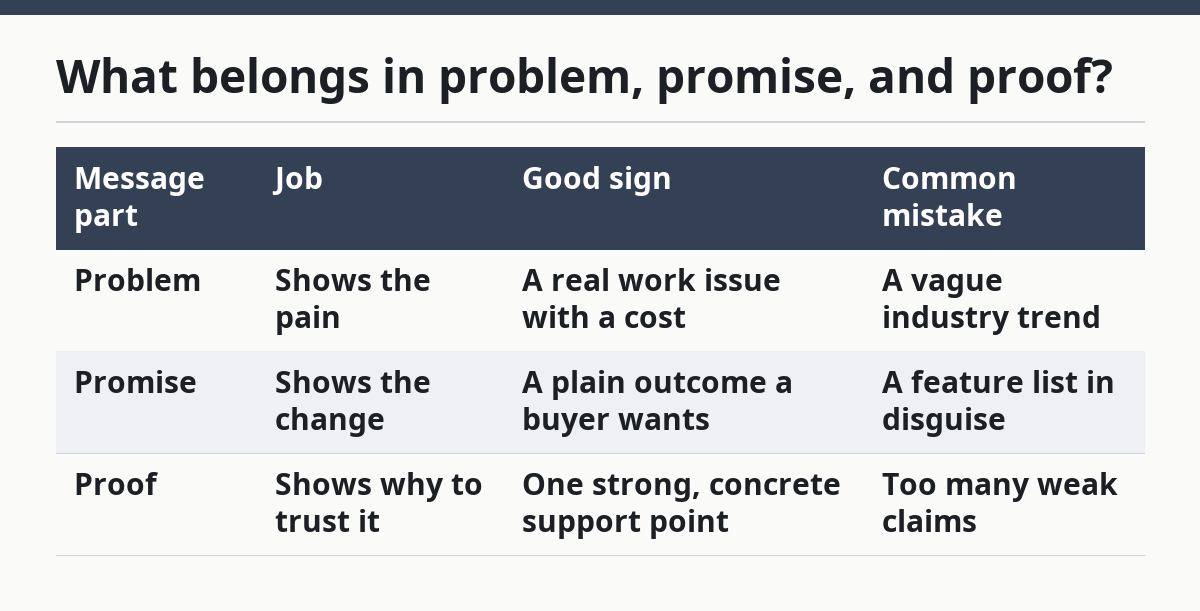
Here is the simplest way to separate them:
| Message part | Job | Good sign | Common mistake |
|---|---|---|---|
| Problem | Shows the pain | A real work issue with a cost | A vague industry trend |
| Promise | Shows the change | A plain outcome a buyer wants | A feature list in disguise |
| Proof | Shows why to trust it | One strong, concrete support point | Too many weak claims |
If one part pulls too hard, the others collapse. A strong proof point cannot rescue a weak promise, and a strong promise cannot rescue a problem no one feels. For SaaS content teams, that trade-off matters because pages often get written by different people on different dates, which creates message drift.
A useful rule is to keep each part short enough to fit on one screen. If a section needs four screens to explain itself, the framework is carrying too much weight. That is usually a sign that the message needs a narrower buyer, a clearer job, or a less crowded product story.
How do you handle objections without muddying the message?
You handle objections by naming the doubt plainly and answering it in the same language the buyer uses. Do not bury objections inside feature copy; put them where the buyer expects a reason to hesitate.
The most common mistake is trying to answer every objection at once. That produces long copy and weak copy. A better approach is to pick the 2 or 3 objections that would stop a real buyer from moving forward, then attach one proof point to each.
For example, if the buyer worries about adoption, answer with a proof point that shows a low-friction start, a familiar workflow, or a standard the team already trusts. If the buyer worries about fit, answer with a concrete use case instead of a broad claim about flexibility. If the buyer worries about switching cost, show what changes and what stays the same.
This is where a lot of generic articles go wrong: they say “objection handling” as if it means “add more reassurance.” Reassurance without evidence makes the page sound nervous. A better frame is to treat every objection as a question of fit, not belief. The buyer is asking, “Will this work for me?” not “Can you say the word trust one more time?”
A simple format helps: objection, answer, proof. Keep the answer to one or two sentences, then attach one proof point that can stand on its own. If the proof needs a long explanation, it is probably the wrong proof for that objection.
This also keeps the message honest. A framework that sounds perfect but avoids limits is usually not credible. It is better to say what the product is not for than to promise universal fit and lose trust later.
How do you keep messaging consistent across pages?
You keep messaging consistent across pages by using one source of truth for the core message and one rule for what each page is allowed to say. Without that, every page starts inventing its own angle, and the site reads like three different companies wrote it.
The core message should stay the same across articles, landing pages, and product copy. What changes is the emphasis. A blog post may explain the problem in more depth, while a landing page may move faster toward the promise and proof. The message stays aligned; the angle changes.
A useful control is a message hierarchy with three layers: core message, supporting message, and page-specific detail. The core message should be stable for at least one product line or audience segment. The supporting message can shift by use case. The page-specific detail can change based on the page job, such as education, conversion, or comparison.
Here is a practical test: if you removed the page title, could the reader still tell which product, audience, and problem the page belongs to within 10 seconds? If not, the message is too loose. If the page feels polished but cannot be pinned to one buyer job, it will not help the rest of the funnel.
The trade-off is real. Consistency slows down creative sprawl, and that can feel restrictive to writers who want each page to sound fresh. But the alternative is worse: you get fresh copy that does not connect. In SaaS, that usually means more rewriting, more sales explanation, and more confused readers.
This is also why a messaging framework is not the same as a slogan. A slogan can change with campaigns. A framework is the structure underneath the campaign work. If the framework is sound, new pages can be written in hours instead of being rebuilt from scratch every time.
For teams that publish often, that difference matters more than a clever line. It gives the writer a repeatable path and gives the buyer a cleaner reading experience.
What should you avoid when writing the framework?
You should avoid vague language, feature dumping, and proof that does not match the promise. Those mistakes make the framework look polished while doing nothing for the reader.
The first common mistake is starting with the product. That costs attention because buyers do not care about your internal structure. They care about the job they are trying to finish. If the first sentence sounds like a spec sheet, the page has already lost energy.
The second mistake is writing a promise that is too broad. “Help teams grow faster” sounds friendly, but it does not say what changes or for whom. The cost is weak recall. A buyer may remember that the page existed, but not what it was for.
The third mistake is using proof that is too generic. A proof point should answer the claim, not just sit beside it. If you say the product improves trust, but your proof is a vague statement about quality, the reader has no reason to believe the claim is real.
The fourth mistake is letting the framework answer every use case. That turns a message system into mush. A framework should make choices. It should tell you who the message is for, what problem it addresses, and what it will not try to cover. If it does not exclude anything, it probably does not say much.
A disciplined framework saves time later. It gives content teams a way to write faster, reduce rewrite rounds, and keep product marketing, sales, and web copy from pulling in different directions. That is the real value: fewer mixed messages and fewer pages that have to be rescued by a human in a demo.
How do you know if it is working?
You know it is working when the message can be repeated without help and still sounds like the same product. If different people describe the product with the same problem, promise, and proof after a 1-page scan, the framework is doing its job.
The simplest check is internal consistency. Ask whether the homepage, a blog article, and a sales script use the same core language for the same buyer problem. If they do not, the framework is either too loose or not being used.
The second check is resistance to objection. A good framework makes the hardest question easier to answer. If a buyer asks why they should care, the problem statement handles that. If they ask what changes, the promise handles that. If they ask why they should trust it, the proof handles that.
The final check is whether the message helps you choose what to leave out. That may sound small, but it matters. A framework is useful only when it cuts copy, not when it adds more of it. If every section of the site tries to say everything, the reader gets none of it.
For SaaS content strategy, that is the point of the whole exercise. The framework is not decoration. It is the decision rule that keeps your content from becoming a stack of isolated claims.
What is a SaaS messaging framework?
A SaaS messaging framework is a repeatable way to organize your product message around a problem, a promise, and proof. It keeps articles, landing pages, and product copy aligned so the reader sees one clear story instead of a mix of claims.
The framework is most useful when different teams write for the same product. It gives them a shared structure, so the message stays stable even when the wording changes. If you need one line to guide the whole system, it is this: the framework should help buyers understand the problem, see the outcome, and trust the claim.
How do i turn benefits into messages?
Turn benefits into messages by tying each benefit to a real problem and a proof point. A benefit on its own is too loose; it needs a buyer pain to make it matter and evidence to make it believable.
A good test is whether the sentence can survive in a headline, a subhead, or a sales opener without sounding inflated. If it cannot, the benefit is probably still too generic. Strip away the extra language until only the outcome and the reason to believe it remain.
How do i keep messaging consistent across pages?
You keep messaging consistent across pages by using the same core problem, promise, and proof while changing only the angle for each page’s job. That means the homepage, an article, and a product page can all sound different in length and tone but still say the same thing.
The easiest way to do that is to keep one message hierarchy and one source of truth for the core message. If each page invents its own version, the site will feel fragmented. If the core stays fixed, the reader can move from page to page without relearning the product story.
Drafted with AI; not yet reviewed by a person.