


How to Build a SaaS Buyer Journey Map for Awareness, Consideration, and Decision Content: a SaaS buyer journey map has 3 stages — awareness…
Last updated: November 16, 2026
Quick Answer: a SaaS buyer journey map has 3 stages — awareness, consideration, and decision — and it helps you match one content job to one buyer need. A SaaS buyer journey map for awareness, consideration, and decision content shows which content a buyer needs at each stage, so the content funnel follows the buyer need instead of random publishing. It works best for SaaS teams that already have some content and want a clearer path from problem discovery to product shortlist. It is not for teams that want one article to do every job at once.
Key takeaways
- A buyer journey map turns stage labels into a content plan with a clear job for each page.
- The map should connect one buyer need to one stage, not one keyword to one article.
- Awareness content explains the problem, consideration content compares approaches, and decision content supports a final choice.
- The biggest mistake is putting product pages too early, before the buyer knows the problem.
- A useful map needs a stage, a question, a content type, and a next step for each entry.
What does a SaaS buyer journey map do?
A SaaS buyer journey map shows how a buyer moves from first problem awareness to final product choice, and it tells you what content to publish at each step. In practice, it stops the common mistake of mixing awareness content with decision content in the same article.
The map should answer four simple questions in one view: what the buyer knows, what they need next, what content helps, and what action should follow. For SaaS, that usually means a content funnel with three stages: awareness stage, consideration stage, and decision stage. A buyer who is still naming the problem does not need a feature checklist yet.
This matters because SaaS buyers rarely buy after one page view. They often compare categories, features, use cases, and trust signals over several visits, and each visit asks for a different kind of proof. A clean map keeps that sequence visible so the content team does not publish ten awareness articles and no decision support.
A useful map is also narrow. It should focus on one buyer need at a time, such as “reduce manual reporting,” “replace a spreadsheet workflow,” or “choose a better CRM.” If the map tries to cover every persona, every product line, and every use case, it becomes too vague to guide content. A one-page map is enough to start; a 3-page deck is usually too much for the first draft.
How do I build a SaaS buyer journey map?
You build a SaaS buyer journey map by tracing one buyer need through the three stages and assigning content that matches each stage’s job. The cleanest way is a 5-step process that starts with the problem, not the keyword list.
-
Write the buyer need in one sentence.
Use a plain line such as “I need to cut the time spent on weekly reporting.” That sentence gives the map a fixed point, and it keeps the rest of the work tied to a real pain instead of a vague theme. -
Split the journey into awareness, consideration, and decision.
Put the buyer at the point where they first name the problem, the point where they compare approaches, and the point where they compare vendors. Three stages are enough for a first pass, and they keep the map readable. -
List the question the buyer asks in each stage.
Awareness might ask “What is causing this?” Consideration might ask “What type of solution should I use?” Decision might ask “Which product fits best?” These questions are the bridge between buyer need and content type. -
Match each question to one content job.
Awareness content should explain or diagnose, and in health, legal, or financial contexts it should be paired with a qualified source or a prompt to consult a professional. Consideration content should compare options, methods, or categories. Decision content should support evaluation with proof, product detail, or buying guidance. If a page tries to do all three, it usually fails at the first one. SaaS content strategy -
Add the next step for the reader.
Each item on the map should point to a next action, such as a deeper explainer, a comparison page, a product page, or a demo request. The next step is what turns the map from a list into a funnel. For more structure, see customer journey mapping and content funnel planning.
A practical format is a simple table with 4 columns: stage, buyer question, content type, and next step. That structure is usually enough for a content team to spot gaps in under 30 minutes. It also makes it obvious when the site has five awareness articles and no decision content at all.
The hard part is not filling the columns. It is deciding what not to publish. If a topic is still in awareness, do not force a product pitch into it. If the stage is decision, do not waste the page on broad educational copy that never names the product choice.
What belongs in awareness content?
Awareness content belongs at the moment the buyer knows there is a problem but not yet the best solution. This stage should help the reader name the issue, understand its cost in time or effort, and define the shape of the fix.
Use awareness content for problem guides, symptom checklists, and “why this keeps happening” articles. For SaaS, that usually means the buyer is not asking about vendors yet; they are asking why a workflow breaks, why a team spends 2 hours on a task that should take 20 minutes, or why current tools do not fit. The content should feel useful even if the reader never buys software.
The strongest awareness content answers a question without forcing a product comparison. It gives the reader enough clarity to say, “Yes, that is my problem.” A clean awareness page often includes one short framework, one simple example, and one next step to a deeper article. It should not read like a landing page with education sprinkled on top. For a broader framing of content intent, see information architecture.
Here is the simplest way to think about stage fit:
| Stage | Buyer mindset | Best content type | What to avoid |
|---|---|---|---|
| Awareness | “What is wrong?” | Problem explainer, symptom guide, checklist | Product pitch, feature list |
| Consideration | “What kind of solution works?” | Comparison, category guide, method article | Hard sell, generic fluff |
| Decision | “Which vendor should I choose?” | Product page, proof page, buying guide | Broad education with no specifics |
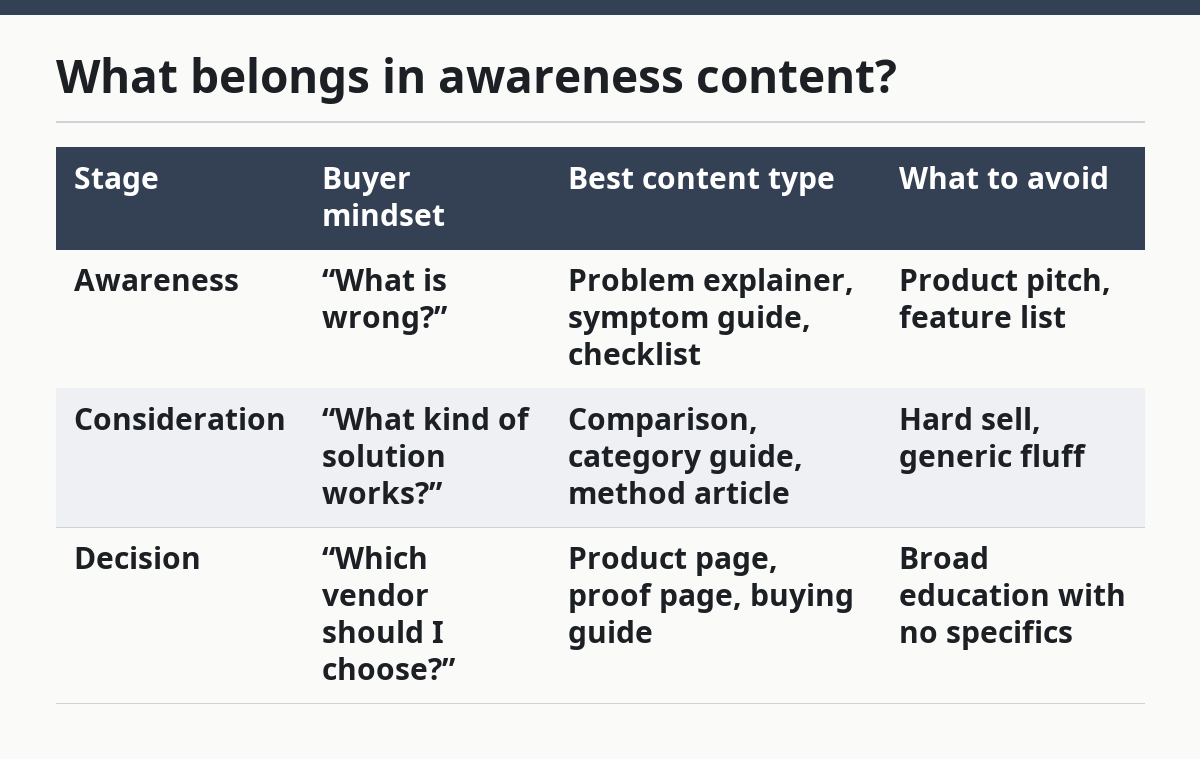
That table shows why awareness content and decision content should not be blended too early. A buyer who is still diagnosing the issue does not need a trial CTA shoved into the middle of the page. The cost of that mistake is simple: the page feels premature, and the reader leaves.
Awareness content is right for the top of the funnel. It is wrong for a page whose main job is conversion support. If the content keeps saying “our tool” before the buyer has even framed the problem, the map is off.
What belongs in consideration content?
Consideration content belongs when the buyer knows the problem and is comparing approaches, categories, or workflows. At this stage, the reader is not asking “Do I have a problem?” anymore; they are asking “Which path solves it best?”
This stage is where comparison pages earn their keep. A buyer may be choosing between a spreadsheet workaround, a point tool, a platform, or a team process change. Consideration content should explain those options in plain terms, then show the trade-off between speed, control, setup time, and team fit. The job is not to declare a winner in every case. The job is to help the buyer see the decision shape. A practical example is comparing manual workflow tracking with a SaaS dashboard approach.
A strong consideration page usually covers 3 things: what the options are, who each option suits, and what the trade-off costs. That third part matters most. A generic article says one method is better. A useful article says one method is faster but harder to manage, or easier to start but weaker at scale. That kind of honesty builds trust because it matches how SaaS buyers compare tools.
The wrong move at this stage is to jump into product detail too soon. If the buyer is still deciding between categories, a feature list can feel like noise. The page should stay centered on the method or category, not drift into a hidden sales pitch. Consideration content also works well when it links to a clearer decision page later in the journey.
Because the middle stage often carries the most comparisons, it needs a clean handoff. If the page helps the buyer choose a category, the next step should lead to decision support: a product comparison, a use-case page, or a feature page that proves fit. Without that handoff, the content funnel breaks after the middle stage.
What belongs in decision content?
Decision content belongs when the buyer is comparing specific products and needs proof that one choice fits better than the others. This is the stage where product detail, trust signals, and buying guidance matter most.
Decision content should answer questions like: What does the product do? What does setup look like? What do I need to connect it to? What trade-offs should I expect? For SaaS, this is where integration notes, feature limits, implementation effort, and team fit matter more than broad education. The buyer is no longer asking for category theory. They want decision support.
A decision page should feel specific enough to help a shortlist. That usually means a clear description of the use case, a plain summary of capabilities, and a next step that fits the buyer’s level of readiness. A demo request is one valid next step, but it is not the only one. Sometimes the better next step is a product tour, a pricing page, a comparison page, or a security page, depending on what the buyer still needs to confirm. For product trust details, many teams also point readers to a security page checklist or a pricing page guide.
This stage is also where the honest trade-off against the obvious alternative matters most. If a product is faster to deploy than a heavier platform, say so. If it has less flexibility than a more complex system, say that too. Buyers who are close to purchase notice when the page hides trade-offs.
Decision content is wrong for early education pages. Putting a hard CTA in front of an awareness reader usually lowers trust, not increases it. It can also make the content funnel look shorter than it is, which leads the team to underinvest in the middle stages that actually warm the buyer up.
What mistakes break the map?
The most common mistakes are stage mismatch, duplicate topics, and missing handoffs, and each one costs you clarity. A bad map makes the funnel look full while leaving the buyer without the right next step.
Stage mismatch is the biggest problem. It happens when awareness content reads like a product page or when decision content reads like a beginner guide. The cost is simple: the reader cannot tell whether the page is meant to teach, compare, or convert. The fix is to assign one job per page and strip out the rest.
Duplicate topics are the next problem. Two pages that answer the same question in slightly different words compete with each other and blur the map. A safer move is to separate the intent cleanly: one page for “what is the problem,” one for “what are the options,” and one for “which product should I choose.”
Missing handoffs are easy to miss. A page can be useful on its own and still fail as part of the content funnel if it never points to the next stage. A good map shows where the reader should go after finishing the page, even if that next step is another informational article.
Because the map is only as strong as the buyer need behind it, a less obvious mistake is trying to map content before the buyer need is clear. That often produces a calendar full of topics but no real journey. If the map starts from the keyword list, it usually serves search volume before it serves the buyer. Start with the problem, then place the content around it.
A final mistake is treating the map as a one-time doc. SaaS buyers change behavior as products change, competitors change, and use cases change. A map that gets reviewed once a year will go stale fast. Review it after you notice repeated content gaps, missed conversions, or new buyer questions, and if the stakes are high, consult a professional strategist before changing the funnel.
What is a buyer journey map?
A buyer journey map is a simple plan that shows what a buyer needs at each stage before they buy. In SaaS, it connects the awareness stage, consideration stage, and decision stage to the right content so the buyer gets the right help at the right time.
It is not the same as a topic list. A topic list tells you what to write. A journey map tells you why each piece exists and how one piece should lead to the next. That difference is why a map is useful for content strategy and audience targeting, not just for editorial planning. It also helps teams keep the article focused on one stage per page.
What content belongs in each stage of the buyer journey?
Awareness content belongs where the buyer is defining the problem, consideration content belongs where the buyer is comparing approaches, and decision content belongs where the buyer is choosing a product. That simple split keeps the content funnel from blurring into one long sales page.
The best test is to ask what question the page answers first. If it explains a symptom, it belongs in awareness. If it compares categories or methods, it belongs in consideration. If it helps a buyer choose a specific product, it belongs in decision.
How do I map SaaS topics to the funnel?
I map SaaS topics to the funnel by starting with one buyer need, then assigning one stage, one question, and one content job to each topic. That method keeps the page tied to intent instead of forcing every topic into a generic funnel shape.
A good check is to ask whether the topic helps the buyer name the problem, compare solutions, or choose a vendor. If it does none of those clearly, it is probably too broad, too narrow, or aimed at the wrong stage. That is why the same SaaS buyer journey map can stay useful across multiple article clusters without becoming vague.
What should I avoid when mapping SaaS content?
I avoid mixing stages on the same page, because it confuses the reader and weakens the funnel. I also avoid mapping content from the keyword list alone, because search demand does not tell you the buyer’s stage.
The best maps are honest about trade-offs. If a topic sounds useful but has no clear next step, it does not belong on the journey map yet.
Drafted with AI; not yet reviewed by a person.