


How to Build a SaaS Launch Claim Extraction Guide for Features, Dates, and Availability Notes: A SaaS launch claim extraction guide turns launch copy into…
Last updated: November 17, 2026
A SaaS launch claim extraction guide turns launch copy into trackable statements about features, dates, and availability. Build it so a reviewer can read one sentence and mark what was claimed, when it applies, and whether it is a feature claim or an availability note.
Key takeaways
- Split launch text into small claims before you score anything.
- Treat feature statements, date mentions, and availability notes as different tags.
- Pull claims from homepage copy, pricing copy, release notes, help docs, and social captions with the same rules.
- Keep the guide strict enough that two people would label the same sentence the same way.
- Use date standards like ISO 8601 and W3C date-time formats when you normalize launch timing.
What should this guide do?
This guide should make launch text easy to label in less than 1 minute per sentence. The point is not to judge the launch, but to separate sentence fragments into claim types you can track later in a source coverage map.
A good guide tells the reviewer what counts as a claim in homepage copy, pricing copy, release notes, help docs, and social captions. It also tells the reviewer what to do with a mixed sentence such as “New team permissions are live today for Pro customers in the U.S.” That one line holds a feature claim, a date mention, and an availability note.
The guide should also prevent category drift. If one person labels “available now” as a feature claim and another labels it as a timing note, your later comparisons will fail. That is why the guide needs short definitions, examples, and a few hard rules. It should support later scoring, but it should not try to do the scoring itself.
This is for people working with public SaaS launch signals, not for teams trying to rewrite marketing copy. It is not the right tool if the only goal is to compare homepage promises to a product page or to build a narrative map of problem and promise changes. Those are different jobs.
What claim types belong in the guide?
The guide should include three core claim types: feature statements, date mentions, and availability notes. Those three buckets cover the most common launch language without forcing every sentence into a vague “signal” label.
Feature statements describe what the product does or what changed. Date mentions name a time anchor, such as “today,” “on March 12,” or “rolling out this week.” Availability notes say who can access it, where it works, or under what plan it appears. A sentence can carry more than one type, and the guide should say that upfront.
A simple rule helps: if the phrase names capability, tag it as a feature statement; if it names time, tag it as a date mention; if it names access, region, account tier, or rollout state, tag it as an availability note. A launch sentence often contains all three. “Available now” is not a feature by itself. It is a rollout note.
The guide should also define scope qualifiers. These are words that narrow the claim, such as “for admins,” “in beta,” “for new workspaces,” or “on mobile.” Scope qualifiers are not the main claim, but they change what the claim means. If a sentence says a feature exists only for one plan, the plan is part of the extraction.
Use the same labels every time. If the guide grows beyond 10 or 12 labels, it becomes harder to use than the raw copy. Most teams do better with a small set of tags and clear examples than with a large taxonomy that looks precise but slows the reviewer down.
How do you extract feature claims from marketing copy?
You extract feature claims by breaking each sentence into one unit of meaning, then tagging the parts that say what the product does. The best way to do that is a short, repeatable process that starts with source type and ends with a clean label.
-
Open the source in your review tool and mark the source type first: homepage copy, pricing copy, release notes, help docs, or social captions. This matters because a claim in release notes often has a different level of certainty than a claim in social captions.
-
Split the text into single claims before labeling, even if the sentence is long. One sentence can carry a feature, a date, and a rollout note, and each part should be extractable on its own.
-
Tag the capability phrase as a feature statement when it names a product action, function, or newly added behavior. If the phrase only says “new,” “improved,” or “faster” without a clear function, keep it as a weak claim and do not promote it to a feature.
-
Mark any time phrase as a date mention, including relative time like “today,” “this week,” or “now live.” If the claim uses an exact date, record the date in the format your guide uses, ideally ISO 8601 style such as 2026-03-12.
-
Separate access language from the feature itself. A phrase like “for Enterprise customers” should sit beside the feature claim, not inside it, so later analysis can compare the feature across plans or regions.
-
Record the source sentence with its original wording. Do not paraphrase inside the extraction step, because paraphrase turns a public claim into your own summary and muddies later review.
This works best when the reviewer can finish a claim in under 30 seconds. If the sentence needs a long explanation, the guide is probably too loose or the source is too messy. In that case, the right move is not more interpretation. It is a tighter rule for what counts as a feature claim.
How do you separate availability notes from feature claims?
You separate availability notes from feature claims by asking whether the sentence says what exists or who can get it. A feature claim says the product can do something; an availability note says whether, where, or when someone can use it.
“Now available” is a timing signal, not a feature. “Available to Pro users in the EU” is an access signal, not a new capability. “Adds team-level approval routing” is a feature claim. If a sentence has both, split it into two extracted parts and keep each one in its own field.
This split matters because availability changes faster than features. A launch note may say the same feature is in beta on mobile, rolling out by region, or limited to a specific plan. If your guide folds that into the feature label, you lose the ability to compare launch windows or rollout patterns later.
A useful test is the “remove the access clause” check. If the sentence still describes a function after you remove “for admins,” “in the U.S.,” or “starting March 12,” then the remainder is likely the feature claim. If what remains is only a timing phrase, then you are dealing with an availability note, not a feature.
Keep the wording of the availability note close to the source. If a release note says “gradual rollout,” that phrase matters. If a help doc says “limited beta,” that matters too. These notes can be plain words, not formal labels, but the guide should standardize how you tag them.
Where should the guide pull claims from?
The guide should pull claims from homepage copy, pricing copy, release notes, help docs, and social captions because each source carries a different kind of launch language. That mix gives you a fuller claim set than any one page alone.
Homepage copy usually carries broad promises and feature headlines. Pricing copy often narrows access by plan or tier. Release notes tend to include the clearest change language, especially when a version or rollout date appears. Help docs can show how the company wants the feature explained after launch. Social captions often compress the launch into one short claim, which makes them useful but also easier to overread.
The guide should say what to do when the same claim appears in more than one source. The safest rule is to treat each appearance as a separate source instance, not as a new claim, unless the wording changes in a meaningful way. That keeps the extraction clean and helps later comparison work.
Use one plain rule for source priority only if you truly need it. Otherwise, let the guide capture what each page says in its own voice. The goal here is not to decide which page is “right.” The goal is to extract claim fragments in a way that is repeatable across source types.
What makes the guide usable for a reviewer?
The guide is usable when two people can apply it the same way without a long debate. That usually means you need short definitions, 2 or 3 examples per label, and one simple decision rule for mixed sentences.
Keep the examples close to real launch language. Use forms like “now available,” “for new customers,” “rolls out on March 12,” and “adds workspace-level permissions.” Those are the phrases a reviewer will see most often. Avoid abstract examples that sound tidy but never appear in live copy.
A good guide also says what not to extract. Do not tag slogans, benefits, or vague praise as feature claims unless they name a concrete function. “Faster teamwork” is not the same as “adds shared task assignment.” The first is copy; the second is a claim. That distinction saves time later.
Your guide should be strict about dates as well. If a sentence says “today,” note it as a relative date mention. If it gives a calendar date, normalize it. If it says “soon,” keep it as an imprecise timing note rather than forcing a date where none exists. The same principle applies to availability: if the source does not state region, plan, or rollout state, do not invent one.
The best version of this guide is short enough to use while reading, not after the fact. If it takes more than one screen on a phone, it is probably too wide. Tight rules and a few clean examples beat a long manual every time.
What are the common mistakes?
The most common mistake is turning one launch sentence into one label. That hides the difference between what the product does, when it is mentioned, and who can access it. The cost is weak later analysis, because every claim looks broader than it really is.
Another mistake is over-tagging marketing words as features. A sentence with “new,” “better,” or “improved” can still be vague. If you tag those words as features without a concrete action, your extraction gets noisy fast. The fix is to require a function, action, or capability in the feature phrase.
A third mistake is ignoring scope qualifiers. “For enterprise teams,” “in beta,” and “on iOS” are not decoration. They limit the claim. Leave them out, and the guide will make a limited rollout look like a full launch.
The last mistake is mixing extraction with judgment. A guide for extraction is not the same as a scorecard or audit. It should not decide whether a claim is true, strong, or consistent. It should only decide what the claim says and how to classify it. That narrow job is what makes the rest of the workflow possible.
How should you format the guide?
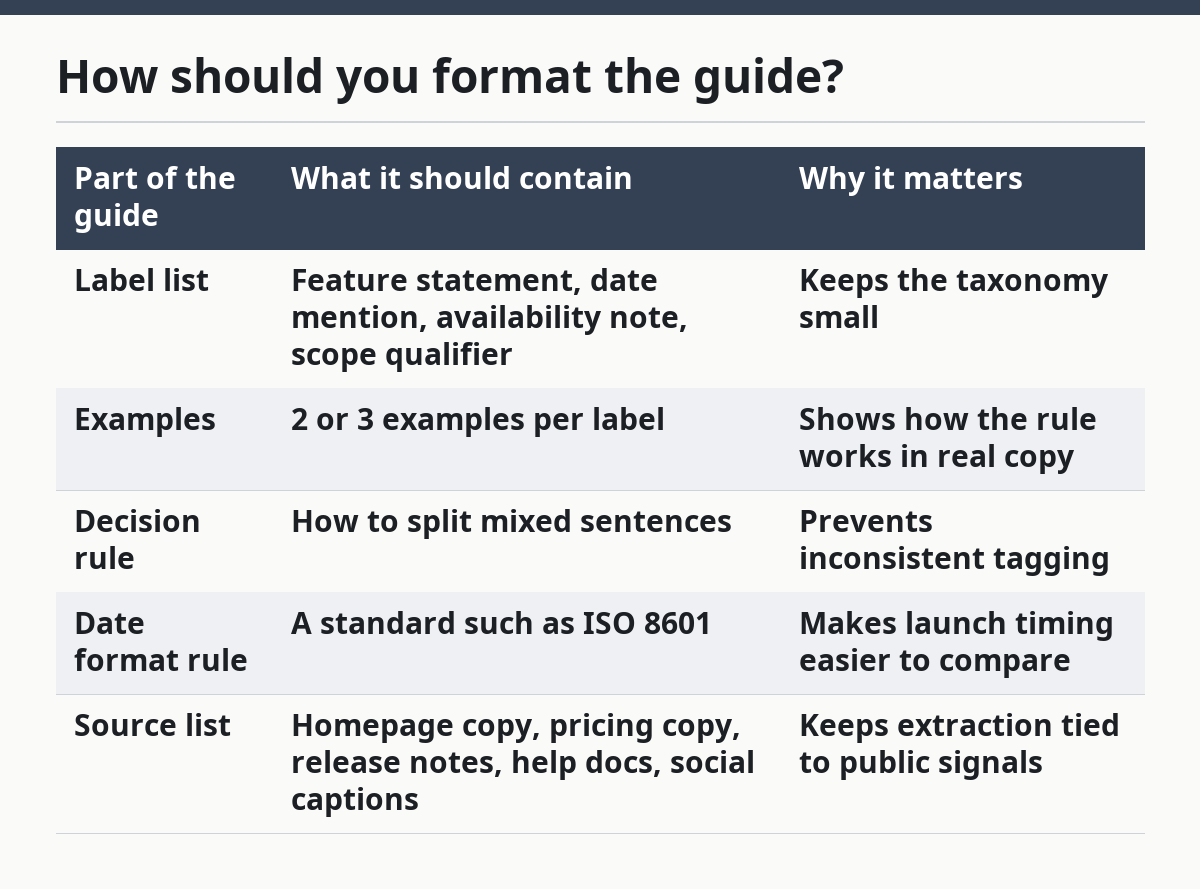
You should format the guide as a short rule set with examples, a label list, and a decision path for mixed sentences. A clean format helps more than a long prose memo.
A simple structure works well:
| Part of the guide | What it should contain | Why it matters |
|---|---|---|
| Label list | Feature statement, date mention, availability note, scope qualifier | Keeps the taxonomy small |
| Examples | 2 or 3 examples per label | Shows how the rule works in real copy |
| Decision rule | How to split mixed sentences | Prevents inconsistent tagging |
| Date format rule | A standard such as ISO 8601 | Makes launch timing easier to compare |
| Source list | Homepage copy, pricing copy, release notes, help docs, social captions | Keeps extraction tied to public signals |
If date handling is part of the guide, include one normalization rule and one exception rule. For example, “March 12” and “2026-03-12” can map to the same date field, while “this quarter” stays a relative timing note. W3C date and time formats and ISO 8601 are useful references for that part of the guide.
The guide should end with a short checklist the reviewer can use before saving a claim: Did I split the sentence? Did I tag the feature separately from the timing? Did I keep access language out of the feature field? That checklist is small, but it stops most errors before they spread.
What counts as a launch claim?
A launch claim is any sentence fragment that says a product can do something, when something changes, or who can access it. That includes feature statements, date mentions, and availability notes. If a sentence only sounds promotional and names no capability, timing, or access condition, it is probably not a claim.
How do you extract feature claims from marketing copy?
You extract feature claims by finding the action or capability in the sentence and separating it from praise, timing, and access language. “Adds invoice approval workflows” is a feature claim. “Now live for Pro users” is not the feature; it is the availability note attached to it.
How do you separate availability notes from feature claims?
You separate them by asking whether the phrase describes what exists or who can use it. “Available now” and “limited beta” are availability notes. “Adds shared dashboards” is the feature claim. If one sentence contains both, split them and tag each part on its own.
Drafted with AI; not yet reviewed by a person.