




How to Build a SaaS SEO Content Review Checklist for Intent, Structure, and On-Page Signals: use a 5-point SaaS SEO content review checklist for most…
Last updated: November 20, 2026
Quick Answer: use a 5-point SaaS SEO content review checklist for most articles, with 3 to 6 H2 sections, a 40- to 60-word opening, and one clear pass/fail check for each item. A SaaS SEO content review checklist for intent, structure, and on-page signals is for any team that wants a pre-publish gate, not a broad editing rubric. Skip it if you want a general content quality checklist, a content brief template, or a full workflow; those solve different problems and will make this page feel too narrow. Use it when one article needs to earn search visibility before it goes live.
Key takeaways
- Build the checklist around 3 things first: search intent, heading structure, and on-page signals.
- Keep the review focused on the page that will rank, not the whole writing process.
- Use one pass for intent, one for structure, and one for signals such as titles, links, and snippet readiness.
- Choose a lighter or stricter checklist based on how many people touch the draft and how much risk a bad publish creates.
- If a page misses intent fit, no amount of polish on the sentence level will save it.
What belongs in a SaaS SEO content review checklist?
A SaaS SEO content review checklist should cover 5 checks: intent fit, heading structure, on-page SEO, internal links, and snippet readiness. That is the set that matters before publish when the job is to make a page match a search query and support the SaaS content production and optimization hub.
The checklist should not try to do everything at once. A general content quality checklist may care about voice, brand tone, and explanation depth, but this page needs to answer a narrower question: does the draft look like the result searchers expect for a SaaS SEO query?
A useful checklist also needs a clear pass or fail for each item. “Looks good” wastes time. “H1 matches the topic,” “three to five H2s support the search task,” and “title tag stays focused on the query” are easier to use in a 10-minute review than vague editorial notes. If a review step cannot be checked in under 1 minute, it is too broad for a pre-publish gate.
The checklist belongs closest to the point where a draft is ready to ship. It is not the place to rewrite the brief or rebuild the article outline. Put another way, if the draft still needs a new angle, the checklist is too early. If it only needs verification against the search intent and the page elements, it is in the right place.
The honest downside is that this kind of checklist can make weak drafts look tidy. A page with clean headings and strong internal links can still miss the real search need. That is why intent comes first, not last.
How do you review a blog post for search intent?
You review a blog post for search intent by comparing the draft’s promise, depth, and format against the query the page is meant to win. For a SaaS SEO content review checklist, that means checking whether the draft answers a commercial searcher’s question fast enough to keep attention.
Start with the opening paragraph. In the first 40 to 60 words, the page should say what the checklist is for and who it suits. If the opening sounds like a definition of SEO, it has already drifted. The reader asked for a checklist, not a lesson on search theory.
Then look at the angle. A commercial searcher usually wants to decide whether the checklist is worth using, not to learn every detail of on-page SEO. That means the article should show the structure, the trade-off, and the limits early. It should tell the reader what it covers, what it skips, and why.
Use this 3-part intent check:
- Ask what the searcher is trying to do. If the query includes “checklist,” the reader wants something they can apply to a draft.
- Match the format to the task. A checklist should feel operational, with steps and review points, not like a whitepaper.
- Check the promise against the body. If the body spends 2,000 words on content governance, it is off target for this page.
The mistake here is over-answering. A page that explains every kind of SEO content workflow can lose the reader who only wants a pre-publish filter. The fix is to keep the scope on the review moment, not the whole production chain.
How do you check structure without overbuilding it?
You check structure by making sure the draft has enough headings to guide the reader, but not so many that it breaks the flow. For this page, 3 to 6 H2 sections is usually enough to cover the review task without turning the article into a wall of subheads.
A good structure for this topic usually includes one opening verdict, one section on intent, one on headings, one on on-page signals, and one on choosing the right checklist depth. That gives the reader a clear path through the page and makes the article easier to scan on mobile.
Use this order when you review structure:
- Check the H1. It should name the page topic clearly and point at the task, not the theory.
- Check the H2s. Each one should answer a real sub-question a searcher would ask, such as what belongs in the checklist or how to review structure.
- Check the first sentence under each H2. It should answer the heading directly, in one sentence, so the reader knows they are in the right place.
- Check the flow. The sections should move from intent to structure to signals, not bounce back and forth between ideas.
- Check the ending. It should help the reader choose a checklist style or decide what to skip, not just repeat the opening.
A generic article often makes the structure too broad. It adds separate sections for content quality, governance, and editorial process, then buries the actual SEO review points. That costs the page focus and can dilute internal linking value because the article no longer feels about one job.
What on-page signals matter for SaaS content?
The main on-page signals for SaaS content are the title tag, the H1, headings, internal links, and snippet readiness. Those are the parts a review checklist should inspect before publish because they shape how the page reads to both searchers and search systems.
The title tag should stay close to the query and not drift into brand language. If the page is about a checklist for SaaS SEO content review, the title should signal the task quickly. The H1 should do the same thing in plain language. If the title and H1 pull in different directions, the page feels split before it even leaves the draft stage.
Headings matter because they show whether the article covers the right subtopics in the right order. A page about intent, structure, and on-page signals should make those ideas visible in the heading set. If the headings are generic, the article may still read fine to a human, but it will be harder to scan and harder to judge for completeness.
Internal links matter because they place the page inside the site’s topic map. For this topic, the link to the hub is part of the article’s job, but the rest of the links should support the reader without pulling them away from the review task. Too many links make the page feel scattered; too few make it look disconnected from the rest of the site. For example, a linked content brief template or internal linking guide can support the review without changing the page’s purpose.
Snippet readiness is the last signal worth checking. The opening should answer the searcher’s question in plain English, and at least one section should package the checklist in a form that can be quoted. That usually means short, direct sentences and a clear list. The downside is that snippet-friendly writing can feel blunt, so the review needs to balance clarity with enough detail to be useful.
Google Search Central says title links should describe the page’s content clearly, and Nielsen Norman Group has repeatedly shown that clear headings improve scanability for readers. Those two sources are enough to justify a tight review of titles and headings before publish: Google Search Central and Nielsen Norman Group.
Which checklist style fits your team?
The right checklist style depends on how many people touch the draft and how much risk a bad publish creates. A solo writer does not need the same gate as a multi-step SaaS team with editors, strategists, and SEO sign-off.
| Checklist style | Best for | What it covers | What to skip |
|---|---|---|---|
| Lightweight 5-point check | Small teams and fast publish cycles | Intent fit, H1, H2s, title tag, one or two internal links | Deep editorial passes, long note chains, extra governance layers |
| Standard pre-publish check | Most SaaS content teams | Intent, structure, on-page signals, internal links, snippet readiness | Full workflow review, content brief rebuild, post-publish update planning |
| Strict multi-review gate | High-stakes pages and larger teams | Everything in the standard check plus closer sign-off on every page element | Fast-track publishing and casual “good enough” approvals |
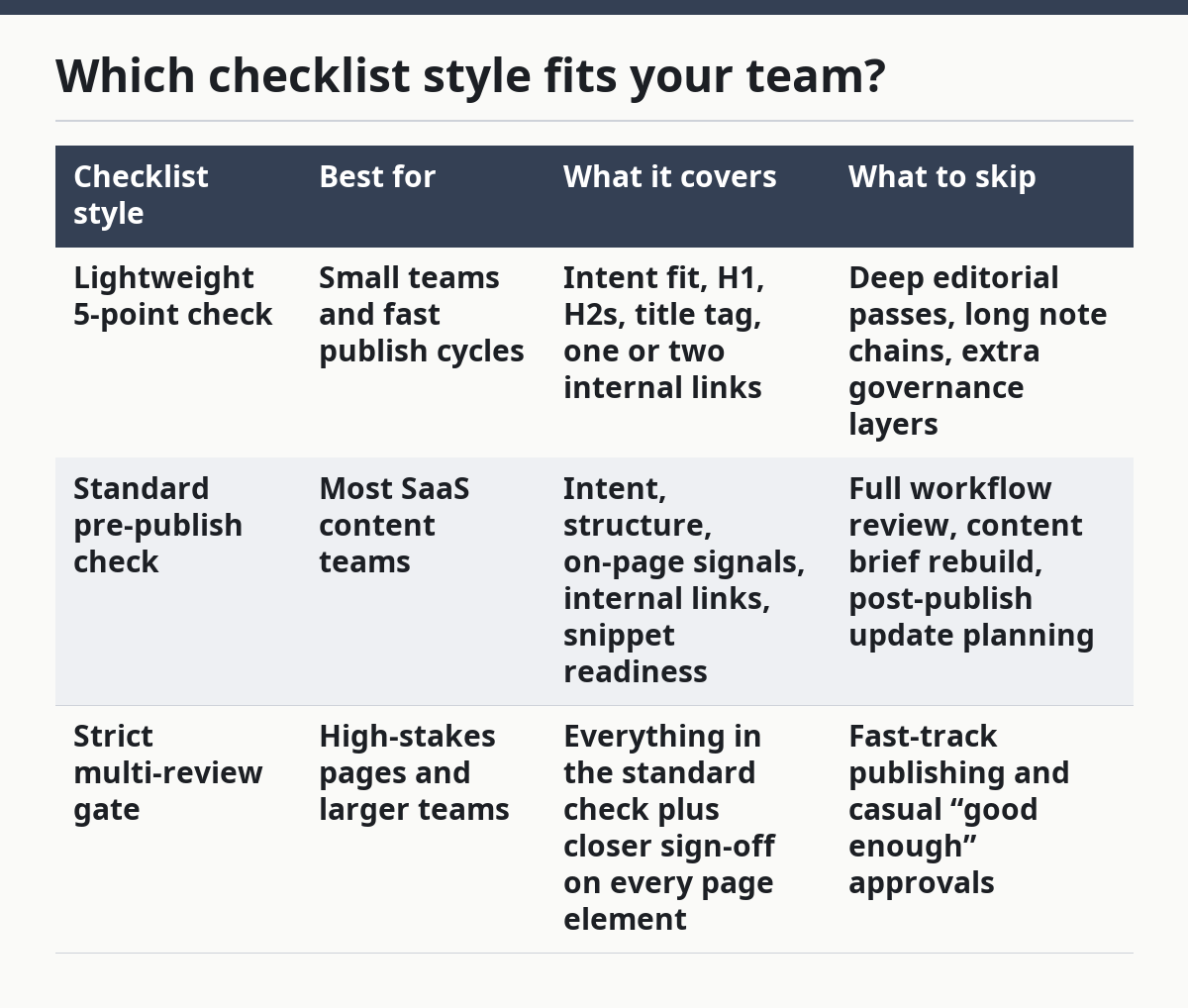
The lightweight version is right when speed matters more than process weight. The standard version is often the best fit for most teams because it keeps the checklist focused on the page itself without trying to solve every editorial problem. The strict version is for teams that need more control, but it can slow publishing if every draft passes through too many hands.
What to skip is just as important as what to include. If the page is only meant to check intent, structure, and on-page signals, do not load it with content quality scoring, metadata policy, or workflow steps. Those belong on other pages in the site architecture. A title tag checklist or editorial checklist can handle those narrower jobs.
What mistakes cost you the most?
The biggest mistakes are checking the wrong thing, checking too late, and turning the checklist into a rewrite tool. Those three errors cost time and blur the purpose of the page.
The first mistake is treating the checklist like a general editing pass. If you are unsure whether a draft belongs in this gate or in a broader editorial review, consult a qualified SEO professional or editorial lead and use Google Search Central’s guidance as a reference point. That adds noise and distracts from the actual search task. A page can be grammatically clean and still fail the intent check, which means the review missed the problem that matters most.
The second mistake is reviewing after the draft has already been approved in spirit. At that point, the checklist turns into a debate instead of a filter. It is faster to catch mismatched headings and weak internal links before the publish decision hardens.
The third mistake is asking the checklist to fix a bad outline. A checklist can catch the problem, but it should not be the place where the article is rebuilt from scratch. If the structure is wrong, send the draft back to outline stage and keep the review focused on the final publish gate.
Another common miss is writing headings that sound polished but say nothing specific. “Why This Matters” and “Best Practices” do not help a SaaS SEO content review checklist page earn search relevance. Specific labels like “How do you review a blog post for search intent?” do more work and make the page easier to scan.
A good checklist saves time by narrowing judgment, not by expanding it. If the review is taking 30 minutes for a 1,500-word page, the process may be doing too much. The goal is a quick, reliable decision on whether the page is ready to go live. For a SaaS SEO checklist used across multiple articles, that time cap helps the team keep the process consistent.
Drafted with AI; not yet reviewed by a person.