





How to Build a SaaS Contract Terms Summary for Renewal Clauses, Commitments, and Usage Minimums: a SaaS contract terms summary usually fits on one page…
Last updated: November 18, 2026
Quick Answer: a SaaS contract terms summary usually fits on one page and tracks 8 core fields so pricing, renewal, and minimum-spend risk are visible fast. A SaaS contract terms summary turns an MSA, order form, and SOW into one readable record of what renews, what commits, and what the minimum bill is. It is for pricing research and renewal review, not for legal interpretation or sales notes.
What goes in a SaaS contract terms summary?
A SaaS contract terms summary should capture the few clauses that change the real price: term length, auto-renewal, renewal notice, minimum commit, and any usage minimums. It should also note which document controls each point, because the MSA, order form, and SOW often say different things.
However, the goal is not to copy the whole contract. The goal is to make the parts that affect future spend visible in 30 seconds instead of 30 minutes. A useful summary names the clause, quotes the key line, and records the business effect in plain words.
A weak summary repeats the contract heading and leaves the reader guessing which number matters. A useful one answers three questions: what starts the term, what ends it, and what happens if usage falls short. That is why a renewal clause and a usage minimum belong in the same record even though they live in different sections of the paper.
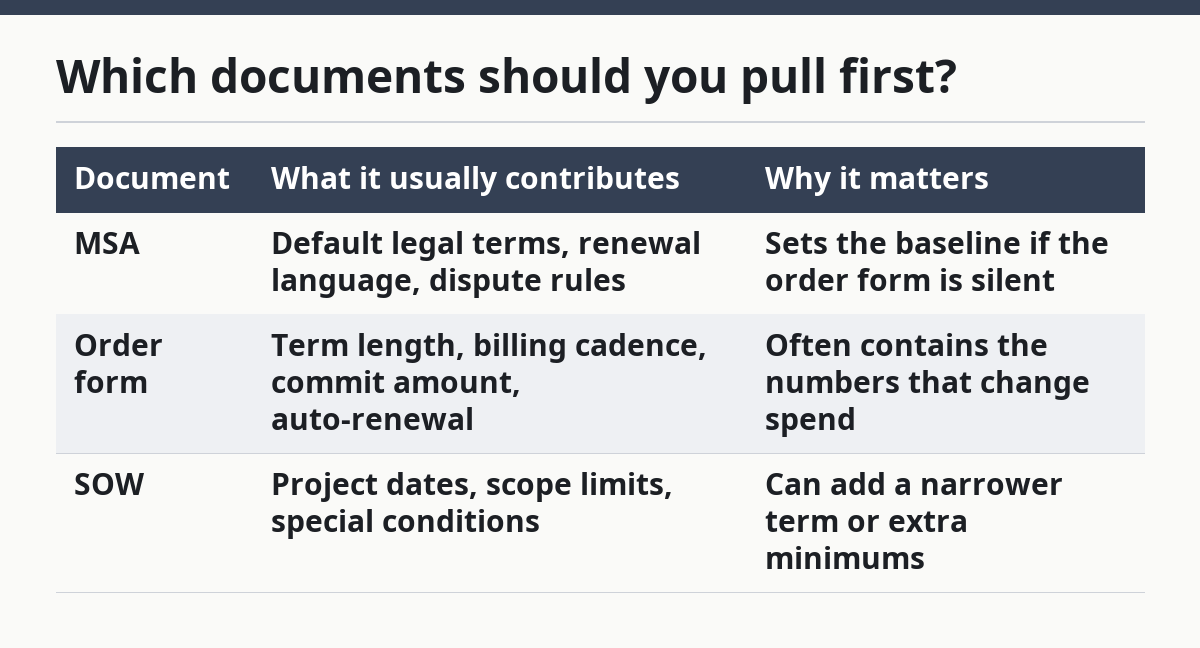
Which documents should you pull first?

Start with the MSA, order form, and SOW, then read them in that order. The MSA usually holds the legal framework, the order form often holds term and commercial terms, and the SOW may add service dates, scoped work, or a special commitment.
Therefore, this order matters because an order form can override the MSA on a single point, and an SOW can add a term without changing the master agreement. If the summary starts with the wrong document, the first note can be wrong even when every later note looks neat.
Use a simple document stack when the contract set is small enough to keep the source order clear:
| Document | What it usually contributes | Why it matters |
|---|---|---|
| MSA | Default legal terms, renewal language, dispute rules | Sets the baseline if the order form is silent |
| Order form | Term length, billing cadence, commit amount, auto-renewal | Often contains the numbers that change spend |
| SOW | Project dates, scope limits, special conditions | Can add a narrower term or extra minimums |
The best habit is to record the source next to every extracted term. If a renewal notice window appears in the MSA and a different one appears in the order form, the summary should show both and mark which one controls. That is more useful than smoothing the conflict away. For contract-interpretation basics, see Cornell Law School’s Legal Information Institute on contracts and interpretation.
How do you capture renewal clauses?
You capture renewal clauses by extracting the trigger, the notice window, and the new term length from the exact clause that governs renewal. The summary should say whether renewal is automatic, whether notice is required, and how long the next term runs.
Next, use this sequence:
- Open the MSA and find the renewal or term section so the base rule is clear.
- Open the order form and check whether it changes the renewal date, notice period, or next term length.
- Copy the notice window exactly, such as 30 days, 60 days, or another stated period.
- Write the renewal type as auto-renewal, manual renewal, or silent expiry.
- Add the business effect in one short line, such as “customer must cancel before the notice deadline to avoid another term.”
The summary should also show whether renewal is tied to the initial subscription term or to a later anniversary date. That sounds small, but it changes when a buyer has to act.
A common mistake is treating “renewal” as a single yes/no field; if you are unsure how a clause should be read, consult a lawyer or procurement professional, and use a source such as Cornell LII’s contract interpretation overview. It is usually three fields: notice, timing, and term length. If a contract says the subscription renews for 12 months unless notice is given 30 days before the end date, the summary should not reduce that to “auto-renews.” It should keep all three parts visible.
That detail helps when a buyer compares contracts with different term lengths, such as 12 months versus 36 months. It also shows when a contract keeps rolling after the first term, which changes both timing and leverage at renewal.
How do you record commitments and usage minimums?
You record commitments and usage minimums by separating what the buyer promises to spend from what the seller bills if the buyer underuses the service. A minimum commit is a spend floor; a usage minimum is a required level of consumption or spend attached to the deal.
The cleanest summary has one line for each of these items:
- Commitment amount: the dollar floor, seat count, or unit volume
- Measurement basis: monthly, annual, quarterly, or per term
- Usage minimum: the minimum activity, volume, or spend the buyer must meet
- Shortfall rule: what happens if the floor is not met
This matters because a contract can look low-cost on the face of it and still carry a heavy minimum. A 12-month term with a low list rate can still force a buyer to pay for unused seats or unused credits if the minimum is set higher than real consumption.
The summary should also note whether the minimum is prepaid, true-up based, or billed in arrears. That one detail tells the reader when the cash leaves and whether the contract creates a surprise bill at the end of the term.
Do not hide usage minimums inside a generic “commercial terms” note. Put them on their own line. If the contract says the buyer must consume a set number of units each month or pay the difference, that is not a side note. It is part of the price. For a broader pricing-reference structure, see the related pages on pricing research and renewal review.
What should the summary look like?
A good summary fits on one page and uses the same fields every time. The format should make scanning easier than reading the source contract, which means no long prose blocks and no mixed wording for the same term.
A practical layout is:
- Contract name
- Vendor
- Source documents reviewed
- Term start and end date
- Renewal type
- Renewal notice window
- Minimum commit
- Usage minimum
- Billing period
- Special override language
- Open questions
The summary should keep the quote from the contract short and place the plain-English meaning next to it. That side-by-side format helps a reader compare deals without rereading the whole clause.
Use one table for the core fields:
| Field | Source text | Plain meaning |
|---|---|---|
| Term length | 12 months | The deal lasts one year before renewal |
| Auto-renewal clause | Renews unless notice is given 30 days before the end date | The buyer must act before the notice deadline |
| Minimum commit | Annual minimum applies | The buyer owes at least that floor even if usage is lower |
| Usage minimum | Minimum monthly usage required | Low use can still trigger payment |
| SOW override | Special pilot term applies | The SOW may change the base contract |
This format is better than a narrative memo when the reader cares about renewal risk, not legal style. It is not the right format for a redline or a contract opinion. It is right for pricing research, deal review, and evidence collection.
What gets missed most often?
The most missed items are the notice deadline, the controlling document, and the shortfall rule. Each one can change the effective price without changing the headline rate.
A summary that leaves out the notice deadline makes auto-renewal look harmless. If the contract requires notice 30 days before term end, the buyer needs that date, not just the renewal month. A summary that leaves out the controlling document can also mislead the reader when the MSA and order form disagree.
The shortfall rule is the next trap. Some contracts tie minimum spend to a yearly figure, some to a monthly floor, and some to a unit consumption target. If the summary does not say which one applies, it hides the penalty path.
Overall, the trade-off is simple: shorter summaries are faster to scan, but they lose deal risk. Longer summaries catch more detail, but they are slower to maintain. This guide is not for a team that only wants a one-line note in a CRM field. It is for a team that needs to know what a renewal clause, a commitment, and a usage minimum actually do to the bill.
If a team is building a larger evidence system, this summary should feed into the broader pricing surface map, not replace it. The map can hold the structure; the summary holds the contract terms that bend the price. Related workflows on contract redlines and deal desk review can use the same fields.
When should you not compress the clause?
You should not compress the clause when the contract has a special override, a split term, or a mixed billing rule. A one-line summary breaks down if the order form says one term and the SOW says another, or if the minimum commit changes after a pilot period.
However, a special override needs the source language kept close to the summary, even if that makes the record longer. That is true when a clause changes the renewal date, extends the first term, or adds a usage minimum only for part of the contract. The same warning applies when the deal has different minimums by region, product, or user tier.
The safe rule is to summarize the contract, not to simplify it past the point of meaning. If a clause would change the amount owed after 12 months, it deserves a visible field.
Key takeaways
- A good summary tracks the terms that change spend, not every clause in the contract.
- The MSA, order form, and SOW can disagree, so the source for each term must be named.
- Renewal language should be split into notice, timing, and next term length.
- Minimum commits and usage minimums need their own fields because they affect the real bill.
- A strong summary is short enough to scan and detailed enough to survive a renewal dispute.
What terms should be summarized from a SaaS contract?
The summary should cover the terms that affect renewal and spend: term length, auto-renewal, notice period, minimum commit, usage minimums, and any override language in the order form or SOW. It should also note which document controls each term so the reader can tell what actually governs the deal.
How do you capture renewal language in pricing research?
Capture the exact renewal clause, the notice window, and the next term length, then label the controlling document. A sentence like “renews unless notice is given 30 days before the end date” is more useful than “auto-renews,” because it shows when action is required and how much time is left.
What is a usage minimum in a SaaS contract?
A usage minimum is the least amount of usage, spend, or activity the buyer must meet under the contract. If the minimum is missed, the contract may require payment anyway or trigger a true-up. That makes it a pricing term, not just an operations detail.
Drafted with AI; not yet reviewed by a person.