






How to Build a SaaS Contract Terms Matrix for Auto-Renewal, Usage Minimums, and Price Escalators Build a 5-part SaaS contract terms matrix that tracks the…
Last updated: November 18, 2026
How to Build a SaaS Contract Terms Matrix for Auto-Renewal, Usage Minimums, and Price Escalators
Quick Answer: Build a 5-part SaaS contract terms matrix that tracks the clause, trigger, date, cost impact, and action needed before renewal. This article on How to Build a SaaS Contract Terms Matrix for Auto-Renewal, Usage Minimums, and Price Escalators shows how to capture the terms that change cost and renewal risk without turning the sheet into a contract summary.
A SaaS contract terms matrix is a spreadsheet or table that captures the contract terms that change cost and renewal risk: the auto-renewal clause, usage minimums, price escalators, termination notice, and billing terms.
Build it so a sales, finance, or legal reader can scan one row and see when the contract renews, what must be consumed or paid, and what notice is needed to stop the next term.
Key takeaways
- A good matrix tracks the clause, the trigger, the date, the cost impact, and the action needed before renewal.
- Put auto-renewal, usage minimums, price escalators, termination notice, and billing terms in separate columns so they do not blur together.
- The matrix is for risk control, not contract summarizing; it should show what can change spend or lock the buyer in.
- The hardest part is not collecting clauses. It is keeping the dates and thresholds consistent across every contract row.
- This approach is not for a one-line summary or a pricing sheet; those answer different questions.
What should a SaaS contract terms matrix capture?

Therefore, a SaaS contract terms matrix should capture the clause text, the commercial trigger, the timing, and the action required for each contract. That means one row per contract and columns for the auto-renewal clause, usage minimum, price escalator, termination notice, billing cycle, and any renewal cap or notice date.
The point is to make contract risk visible before a renewal window closes. A contract that renews in 30 days with a 90-day termination notice is a very different item from a contract that renews monthly and can be cancelled with 10 days’ notice. The matrix should show that difference in plain language, not hide it in long legal prose.
For example, a useful matrix is narrow enough to scan on a phone but detailed enough to support action. If a column does not change behavior, cost, or timing, cut it. If it affects spend in the next 12 months, keep it.
Specifically, a simple way to think about the matrix is: clause, date, threshold, consequence, owner. That five-part frame keeps the row useful without turning it into a contract summary. The SaaS contract terms and renewal hub can sit above this work if the team needs the bigger renewal process around it.
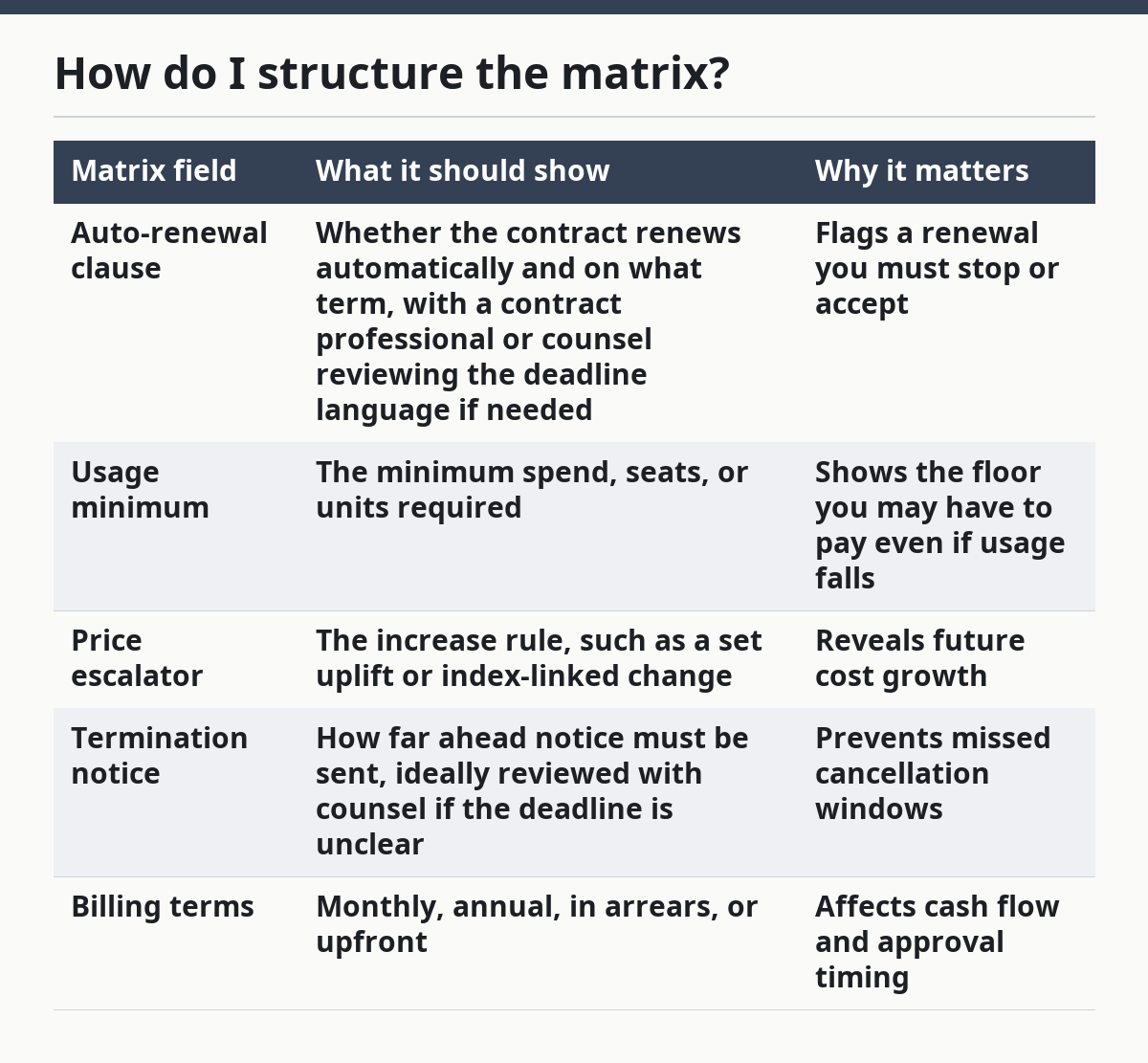
How do I structure the matrix?
You should structure the matrix so each row holds one contract and each column answers one operational question. Start with a fixed set of fields: vendor, product, contract start date, current term end date, auto-renewal yes/no, renewal length, notice deadline, usage minimum, escalator language, billing terms, and internal owner.
Use one date format across the sheet, such as YYYY-MM-DD, so sorting works. Use one currency format too, since a hidden symbol change can make a renewal look smaller than it is. If the agreement uses percentages for an escalator, capture both the clause and the exact trigger, such as annual uplift or CPI-linked increase, in separate columns.
| Matrix field | What it should show | Why it matters |
|---|---|---|
| Auto-renewal clause | Whether the contract renews automatically and on what term, with a contract professional or counsel reviewing the deadline language if needed | Flags a renewal you must stop or accept |
| Usage minimum | The minimum spend, seats, or units required | Shows the floor you may have to pay even if usage falls |
| Price escalator | The increase rule, such as a set uplift or index-linked change | Reveals future cost growth |
| Termination notice | How far ahead notice must be sent, ideally reviewed with counsel if the deadline is unclear | Prevents missed cancellation windows |
| Billing terms | Monthly, annual, in arrears, or upfront | Affects cash flow and approval timing |
Keep a notes field for odd terms that do not fit the columns. That is where you record clauses like mid-term true-up language, minimum true-up dates, or a special renewal cap. Without that notes field, the matrix turns brittle the first time a contract breaks the pattern.
How do auto-renewal terms work?

Therefore, auto-renewal terms work by extending the contract for another term unless notice is given before a deadline. The matrix should record the renewal term length, the exact notice deadline, and whether the deadline is tied to the end date, a fixed number of days before the end, or a calendar date.
The most common mistake is to record only “auto-renewal: yes.” That tells you almost nothing. A 12-month renewal with a 60-day notice deadline is far riskier than a 1-month renewal with a 10-day notice deadline, because the first one can trap spend for another year if the team misses the window.
This is where the matrix earns its keep. Put the deadline in a dedicated column, then add a status column for “notice needed by” or “safe to renew.” If the contract says notice must be sent 90 days before renewal, the row should make that deadline impossible to miss.
For clause checking, the Federal Trade Commission’s guidance on negative-option and subscription-style billing is useful background: https://www.ftc.gov/business-guidance/advertising-marketing/negative-option-marketing. It is not a SaaS playbook, but it does help explain why renewal timing and clear consent language matter in recurring billing. For broader subscription law context, see the FTC’s consumer guidance on recurring charges and the California automatic renewal law overview: https://consumer.ftc.gov/articles/automatic-renewal-offers and https://oag.ca.gov/consumers/general/automatic-renewal-offers.
The honest trade-off is that a hard deadline makes the matrix more work to maintain. The benefit is fewer surprise renewals. This format is not for teams that only want a high-level list of vendors; they will still miss the deadline unless someone owns the follow-up.
How should I record usage minimums and escalators?
Therefore, you should record usage minimums and escalators as separate commercial risks, because they behave differently. A usage minimum is the floor the buyer must consume or pay for, while a price escalator changes the unit price or total fee over time.
For usage minimums, capture the metric first. It may be seats, API calls, storage, spend, or another unit. Then capture the threshold, the review period, and what happens if usage stays below the floor. If the contract says the buyer must commit to 500 seats but actually uses 320, that gap should be shown in the matrix as a usage shortfall, with the precise commercial consequence confirmed against the contract.
For escalators, capture the trigger and the size of the increase. Some contracts raise price on each renewal; others tie the increase to an index or another formula. The matrix should not just say “price increase.” It should say what increases, when it increases, and whether the uplift applies to the base fee, usage overage, or both.
A helpful column is “impact type.” Mark whether the clause creates a fixed dollar exposure, a percentage increase, or a consumption risk. That makes it easier to compare contracts that look similar on paper but behave very differently in spend planning.
This is also where a matrix is not the same as a pricing comparison sheet. A pricing sheet asks which plan is cheaper or richer in features. This matrix asks what the contract can force the buyer to pay later. Those are different jobs, and mixing them makes both less useful.
How do I handle termination rights and billing terms?
So, you should handle termination rights and billing terms as the safety valves around renewal risk and cash timing. Termination rights tell you when you can exit; billing terms tell you when money leaves the account and whether the cost is paid monthly, annually, in arrears, or upfront.
Record the termination trigger, the notice period, and any cure or non-cure language in the termination column, and confirm unclear drafting with a contract professional or counsel where needed. If the contract allows termination only for cause, that is very different from a contract with a clean convenience exit. The matrix should make that difference visible without reading three pages of legal text, and the drafting should be checked against the governing contract language or a reliable legal source if there is any ambiguity.
Billing terms deserve their own field because they change how painful a renewal is. Annual billing concentrates cost at the start of the term. Monthly billing reduces the cash hit but can hide a long commitment if the auto-renewal keeps rolling. If the contract allows prepayment credits or true-ups, note that in the same row.
One practical check is to line up the renewal date, the notice date, and the billing date. If the renewal date and the billing date are close together, a missed notice can turn into a new invoice before anyone notices the renewal happened. That is the kind of timing problem a matrix should surface at a glance.
What is the workflow for building it?
Then, you should build the matrix by extracting the same fields from every contract, then reviewing the outliers last. Start with the documents, then normalize the clauses, then assign the deadlines, then validate the commercial terms.
- Gather the executed contract, order form, amendment, and any renewal notice language. The result should be one source set per vendor, not a scattered folder.
- Pull the renewal term, notice deadline, usage minimum, escalator language, termination right, and billing term into the same template. The result is a first-pass row that covers the main risk points.
- Standardize dates, currency, and units across all rows. That makes the sheet sortable and helps prevent one contract from being misread because it uses a different format.
- Flag any clause that does not fit the template, such as a one-time uplift, a special true-up, or a notice date tied to a calendar quarter. The result is a notes list for exceptions.
- Review the rows against the invoice history or current usage records. If usage is below the minimum or the notice deadline is near, the row should show it plainly.
- Sort by next notice deadline, then by contract value or exposure. That turns the matrix into a worklist instead of a static archive.
The job is not finished when the sheet is filled out. It is finished when a person can use it to decide what needs notice, what needs renegotiation, and what can renew without action. If the matrix cannot support that decision, it is too vague.
What mistakes make the matrix fail?
However, the matrix fails when it stores clauses but not consequences. A row that says “auto-renewal: yes” or “escalator: present” looks complete, but it does not tell anyone what to do next. That mistake costs time, missed notices, and unwanted spend.
The second common mistake is mixing contract terms with product features. A feature list tells you what the software does; a contract terms matrix tells you what the paper obligates you to pay or renew. If those two are merged, the renewal risk gets buried under product detail.
The third mistake is leaving out termination notice because it feels repetitive. It is not repetitive. It is the deadline that decides whether the buyer stays locked in for another term, and it belongs beside the auto-renewal clause every time.
The fourth mistake is failing to track the exact unit behind a usage minimum. “Minimum commit” sounds clear until you have to ask whether it means seats, dollars, or consumption. If the unit is missing, the matrix is half-built.
This approach is not for readers who only need a one-page summary of renewal dates. It is for teams that need to see commercial risk across a portfolio of SaaS contracts and act before the deadline closes.
FAQ
What clauses belong in a SaaS contract terms matrix?
Therefore, a SaaS contract terms matrix should include the clauses that can change cost, lock-in, or renewal timing. The core fields are auto-renewal, usage minimums, price escalators, termination notice, and billing terms, plus any unusual renewal or true-up language. If a clause does not affect one of those outcomes, it usually belongs in a note, not a main column.
How do auto-renewal terms work?
Auto-renewal terms extend the contract for another term unless notice is sent before the deadline. The matrix should show the renewal length, the notice window, and the exact date by which action is due. If that date is tied to 30, 60, or 90 days before term end, capture the number plainly so it can be tracked.
What is a usage minimum in a SaaS contract?
A usage minimum is the lowest level of spend, seats, or usage the buyer must pay for under the contract. It creates a floor even if actual use falls below that level. In the matrix, record the unit, the threshold, and what happens if the minimum is not met, because those three details drive the commercial risk.
Drafted with AI; not yet reviewed by a person.