


How to Compare SaaS Testimonials for Specificity, Outcome, and Objection Coverage: compare SaaS testimonials on 3 points—specificity, outcome, and…
Last updated: November 16, 2026
Quick Answer: compare SaaS testimonials on 3 points—specificity, outcome, and objection coverage. The topic, How to Compare SaaS Testimonials for Specificity, Outcome, and Objection Coverage, is simple: the strongest quote names the role, the workflow, and the result, so a buyer can judge fit fast.
Key takeaways
- Specificity beats praise. A named role plus a concrete change is harder to fake than a warm sentence.
- Outcome language matters most when the reader wants proof of business value, not just goodwill.
- Objection coverage is what keeps a testimonial useful when the buyer is worried about setup, switching, or team adoption.
- A short quote can work well if it names the problem and the result.
- A SaaS testimonial that sounds polished but vague is often less helpful than a plain buyer quote with one useful detail.
What should a SaaS testimonial compare first?

A SaaS testimonial should be compared first on specificity, then on outcome, then on objection coverage. That order tells a buyer whether the quote is believable, whether it matters, and whether it answers the doubt that could block the sale.
The simplest way to judge this is to read the quote as if it were evidence in a buying decision. A line like “we saved time” is soft. A line like “our support team stopped chasing the same issue twice” is more useful because it points to a real workflow, not just a happy mood.
A useful comparison also checks role attribution. A quote from a manager, admin, or end user means something different. If the testimonial does not say who is speaking, the reader has less reason to trust the outcome.
For a broader method on buyer evidence, the hub page on SaaS customer evidence and outcome proof should sit above this one. This page stays narrower: it helps a reader compare testimonials as evidence, not map the larger buying story. See also the related page on testimonial trust signals and the page on buyer proof by role.
Specificity, outcome, or objection coverage?
Specificity wins when the reader is screening for credibility, outcome wins when the reader wants business value, and objection coverage wins when the reader is close to buying but still unsure. The right choice depends on where the buyer is in the decision.
| Criteria | Specificity-first testimonial | Outcome-first testimonial | Winner for [condition] |
|---|---|---|---|
| Named role | Usually includes the speaker’s job title or team | May skip the role and go straight to the result | Specificity-first, when credibility is the main question |
| Concrete detail | Often includes one process detail, tool name, or workflow | Often stays at the result level | Specificity-first, when the buyer needs proof the quote is real |
| Business value | Can be light on business impact | Usually names time saved, revenue protected, or effort reduced | Outcome-first, when the buyer cares about ROI language |
| Ease of comparison | Good for side-by-side vetting | Good for deciding if the software matters | Outcome-first, when options already feel close |
| Objection handling | May not answer the main worry | Often answers the payoff, not the concern | Objection-focused, when the reader fears complexity or adoption issues |
| Believability | Higher when the detail is plain and ordinary | Higher when the result is tied to a real workflow | Specificity-first, when the market is crowded and trust is thin |
| Use in marketing pages | Works well near feature claims and product proof | Works well near pricing or conversion sections | Outcome-first, when the page must push action |
| Risk of sounding canned | Lower if the quote includes a plain operational detail | Higher if it only repeats a promise | Specificity-first, when the copy feels over-edited |
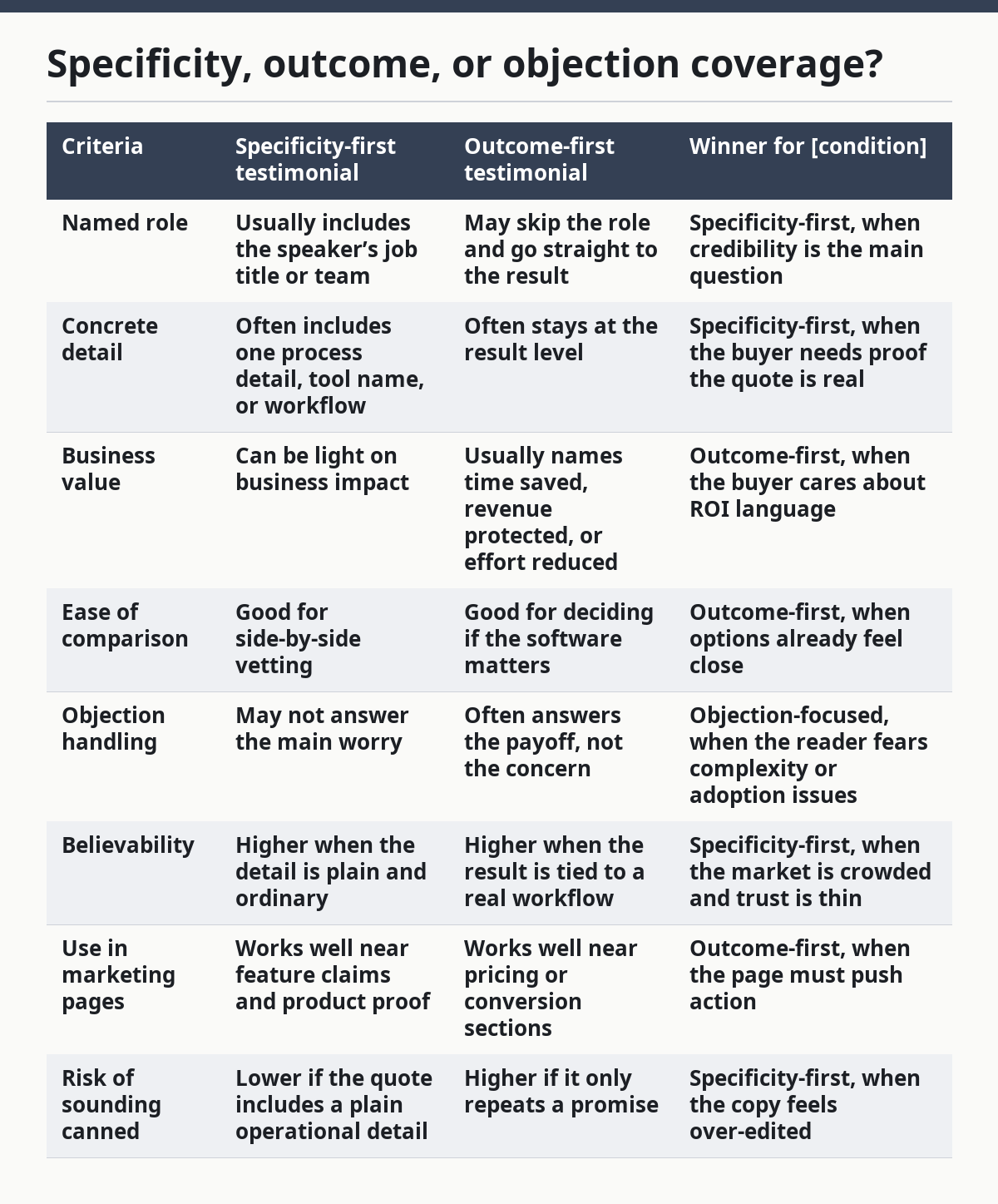
The short version is this: specificity makes the quote believable, outcome makes it valuable, and objection coverage makes it persuasive. If a testimonial has only one of those, it is incomplete. If it has all three, it is worth keeping.
Which testimonial is more believable?

The more believable testimonial is the one that names a person, a role, and one concrete change without sounding scripted. A quote that mentions a support queue, a workflow, or a handoff is usually stronger than one that only praises service.
This is where many generic testimonials fail. They use big feelings and no evidence. The reader is left with a nice sentence and no reason to trust it.
A believable SaaS testimonial also avoids absolute claims it cannot support. If the quote says “everything is faster now” or “it solved every issue,” the reader should consult a qualified professional if the claim affects procurement, compliance, or implementation decisions, and they should verify it against product documentation and review guidance from the FTC: https://www.ftc.gov/business-guidance/advertising-marketing/endorsements-influencers-reviews. Stronger evidence sounds narrower: one team, one use case, one result.
The Federal Trade Commission’s endorsement guidance is a useful guardrail here: endorsements should not mislead, and material connections must be clear. That rule matters in SaaS because a quote that looks polished can still be weak or deceptive if the context is missing. See the FTC’s Endorsement Guides and related guidance on endorsements: https://www.ftc.gov/business-guidance/advertising-marketing/endorsements-influencers-reviews. For credibility cues in web content, see Nielsen Norman Group’s guidance on trust and credibility: https://www.nngroup.com/articles/website-credibility/.
Pros and cons of specificity-first testimonials
Pros
- Easier to trust because the quote sounds grounded in a real role.
- Better for skeptical buyers who want proof before they read deeper.
- Helps distinguish one buyer from another, even in a crowded category.
Cons
- Can be too narrow if the detail does not connect to the buyer’s own problem.
- May describe a workflow without showing the business result.
- Can feel dry if the quote has detail but no emotion or payoff.
Who this is for
- Buyers comparing similar SaaS tools.
- Pages that need credibility near the top.
- Teams that face trust problems because the category is crowded.
Who should skip it
- Teams that need conversion copy more than proof.
- Pages where the main blocker is ROI, not believability.
Which testimonial answers objections best?
The testimonial that answers objections best is the one that names the worry and shows how it was handled. That can mean setup time, team adoption, switching pain, or whether the tool fit an existing workflow.
Objection coverage is not the same as praise. A line like “it was easy to use” is vague. A line like “the team adopted it without a long handoff” gives the reader a reason to relax. The quote does not need to answer every concern; it needs to answer the most likely one.
This matters most when the buyer is already interested. At that stage, the question is rarely “Is this a good company?” It is more often “Will this be painful to roll out?” or “Will my team actually use it?” A testimonial that handles those doubts is stronger than one that only says the product is excellent.
A second source worth checking for this kind of evidence is the Nielsen Norman Group’s work on trust and credibility in web content, which is useful when judging whether a page feels reliable or merely polished. The point is simple: details reduce doubt better than empty praise. See also the FTC’s guidance on endorsements and disclosures: https://www.ftc.gov/business-guidance/advertising-marketing/endorsements-influencers-reviews
Pros and cons of objection-focused testimonials
Pros
- Directly addresses the doubts that slow a purchase.
- Works well for demos, pricing pages, and trial prompts.
- Helps the buyer imagine adoption, not just ownership.
Cons
- Can sound defensive if the objection is forced into the quote.
- May not show a strong final result.
- Can miss the buyer’s bigger concern if the wrong objection is chosen.
Who this is for
- SaaS pages aimed at cautious evaluators.
- Buyers worried about implementation or switching.
- Products that need to prove adoption, not just features.
Who should skip it
- Brands that need top-level credibility first.
- Cases where the main proof problem is lack of outcome language.
The honest side-by-side
The better testimonial is the one that matches the buyer’s stage, and the wrong one can slow the decision. If the reader is early, specificity matters most. If the reader is near purchase, objection coverage usually matters more.
| Criteria | Specificity-first testimonial | Outcome-first testimonial | Winner for [condition] |
|---|---|---|---|
| Believability | Strong because it names real details | Moderate if the result is broad | Specificity-first, for skeptical readers |
| Business value | Sometimes thin | Usually clear | Outcome-first, for ROI questions |
| Objection handling | Often weak | Sometimes indirect | Objection-focused, for close-to-buying readers |
| Role clarity | Usually strong | Mixed | Specificity-first, for trust-building |
| Conversion use | Good near product proof | Good near pricing or CTA | Outcome-first, for decision pages |
| Risk of sounding generic | Lower | Higher if the result is too broad | Specificity-first, for crowded markets |
| Best use case | Validation and credibility | Outcome and sales support | Depends on the page goal |
The main trade-off is plain: the more a testimonial tries to prove one thing, the less it may prove the others. A quote can be believable without being persuasive. It can also be persuasive without being fully believable. The strongest pages use both kinds, but they should not pretend one quote does all the work.
What should you choose?
Choose outcome-first testimonials if the page needs to show clear value fast. Choose specificity-first testimonials if the buyer is comparing vendors and needs credibility before they believe the promise. Neither if the quote is vague, uncredited, or so polished that it reads like ad copy.
That is the cleanest rule. If the reader’s doubt is “does this work for someone like me?”, use specificity. If the doubt is “does this matter enough to buy?”, use outcome. If the doubt is “will this be hard to adopt?”, use objection coverage.
There is one more useful split. A support-heavy SaaS product often needs objection coverage first because implementation fear is high. A revenue or workflow product often needs outcome language first because the buyer wants to see value quickly. The right testimonial is the one that fits the buying friction, not the one that sounds nicest.
When does the verdict flip?
The verdict flips when the page is not trying to close a warm reader. If the audience is early-stage and does not yet trust the category, specificity wins over outcome language because it feels more real.
It also flips when the product is technically complex. In that case, a testimonial that explains the setup or handoff can beat a quote that only says the team loved it. For complex SaaS, simple praise is weak evidence.
A third flip happens when the category is highly similar across vendors. If every tool claims the same outcome, the quote that names a real process or role becomes the separator. The detail does more work than the claim.
A fourth flip happens when the page has too many testimonials already. Then the best move is not another glossy quote, but a quote that addresses the one objection the other testimonials skip. In a set of three, one outcome quote, one specificity quote, and one objection quote is stronger than three near-duplicates.
What makes one testimonial better than another?
One testimonial is better when it gives the reader a concrete reason to believe it and a concrete reason to care. A quote that names a role, a workflow, and a result is stronger than a generic compliment, even if the compliment sounds warmer.
The stronger SaaS testimonial also fits the page it sits on. A product page needs evidence of value. A pricing page needs evidence that the buyer will not regret the switch. A homepage needs enough clarity to make the next click feel safe. See the related page on product-page proof and the page on pricing-page testimonials.
How do you tell if a testimonial answers objections?
A testimonial answers objections when it mentions the exact fear the buyer is likely to have and shows that fear was reduced. That fear might be setup time, team adoption, switching effort, or whether the tool fits an existing stack.
If the quote only says the product is good, it does not answer an objection. If it says the team adopted it quickly, or the setup was simpler than expected, it is doing real objection work. The stronger version names the concern in plain language, not marketing language.
What details make a testimonial more believable?
A testimonial is more believable when it includes a role, a specific workflow, and a result that sounds tied to real work. Short phrases like “our support queue,” “monthly reporting,” or “handoff between teams” make the quote feel grounded.
Believability also improves when the quote avoids sweeping claims. A narrow result is usually more credible than a perfect one. The FTC’s endorsement guidance is a reminder that clarity matters: the reader should be able to tell who is speaking and why the statement matters.
Drafted with AI; not yet reviewed by a person.