How to Build a SaaS Launch Evidence Scorecard for Claims, Screens, and References: A SaaS launch evidence scorecard for claims, screens, and references is…
Last updated: November 16, 2026
A SaaS launch evidence scorecard for claims, screens, and references is a simple way to judge how much trust to place in launch claims, screenshots, and references before you use them in a brief, alert, or report. Quick answer: a 3-level scorecard is usually enough, using high, medium, and low. It is for people who need a clear confidence call from mixed public signals, not a pile of notes.
Key takeaways
- Score the evidence, not the marketing line. A claim can sound strong and still rest on weak proof.
- Separate claims, screens, and references into different rows. They fail in different ways.
- Use a short confidence label for the final call: high, medium, or low is usually enough.
- Keep source notes close to the score so anyone can see why a field earned its mark.
- This method is not a homepage consistency audit or a quote-tracing workflow; it is for launch evidence strength.
- For related process guidance, see the launch intelligence systems hub and the source attribution guide.
What does a SaaS launch evidence scorecard do?
A SaaS launch evidence scorecard turns messy launch material into a repeatable confidence judgment. It helps you decide whether a feature claim, screenshot, or reference trail is strong enough to reuse, flag, or hold.
That matters because launch pages often mix three different things: what the product says it does, what the screen seems to show, and what outside sources confirm. Those do not carry the same weight. A claim on a page is not equal to a release note, and a social post is not equal to a help doc.
The scorecard is also useful because it forces a choice between “supported,” “partly supported,” and “thinly supported.” That is better than a vague yes/no check. A claim that is backed by a help doc and release notes deserves a different label from a claim that only appears in a post with no date, no product screen, and no follow-up source.
This page is about launch evidence strength, not public-page consistency, quote extraction, or source attribution. If the job is to compare homepage, pricing, and product page wording line by line, that is a different workflow. If the job is to build a trail from one quote to one source, that is different too. A scorecard sits one step earlier: it tells you how much confidence the evidence deserves.
For a broader system view, this page fits under the launch intelligence systems hub. The hub can hold the wider process; this scorecard handles the proof.
How do you score launch evidence?
A launch evidence scorecard works best when each item gets the same 5-step treatment, but if the stakes are high, consult a research, legal, or product-ops professional before using the result. NIST’s guidance on auditability and traceability is a useful reference point for keeping records consistent (NIST SP 800-53 Rev. 5). The point is not precision theater; the point is a repeatable judgement that another reader can follow in under 2 minutes.
- List the claim exactly as written. Copy the launch claim, screen caption, or reference line into one row. One row should hold one claim, not a bundle of three.
- Name the evidence type. Mark whether the support is a screenshot, quote, release note, help doc, or social post. That keeps you from treating a polished image like a verified spec sheet; if the use is sensitive, consult a professional and check the source trail against a published record.
- Check the match. Ask whether the evidence directly supports the claim, only hints at it, or contradicts it. A screenshot that shows a partial interface is not the same as a help doc that states the feature in plain text.
- Look at source trail strength. A release note with a date and product name is stronger than an unlabeled social post. A help doc is stronger when it names the feature and matches the screen.
- Assign a confidence label. Use a short label such as high, medium, or low, then add one sentence saying why. Keep the note short enough that a teammate can scan it in 10 seconds.
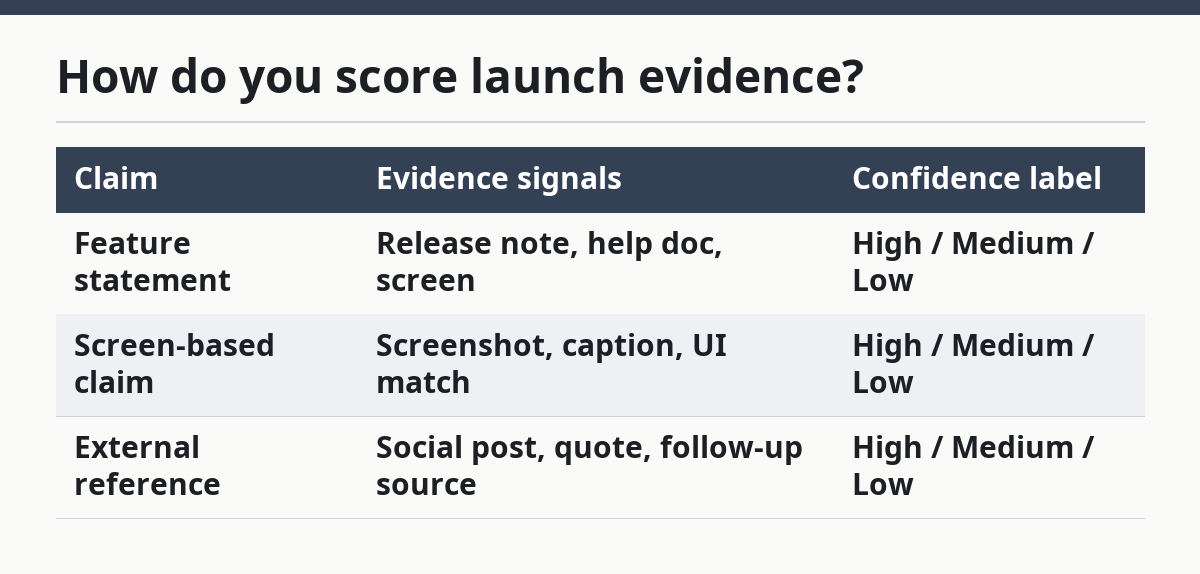
A simple 3-column layout is enough for most teams:
| Claim | Evidence signals | Confidence label |
|---|---|---|
| Feature statement | Release note, help doc, screen | High / Medium / Low |
| Screen-based claim | Screenshot, caption, UI match | High / Medium / Low |
| External reference | Social post, quote, follow-up source | High / Medium / Low |
The hard part is not the column count. It is deciding what the evidence actually proves. A scorecard should not reward speed over strength. A claim supported by a dated release note and a help doc usually deserves more weight than the same claim repeated in three social posts.
What counts as strong evidence in a SaaS launch?
Strong evidence in a SaaS launch is direct, dated, and specific to the claim. It should show the same feature, name, or screen state without making the reader guess.
Release notes are often strong because they usually tie a feature to a product update. Help docs can also be strong when they describe the same action the claim describes. Screenshots help when the visible UI matches the claim closely and the context is clear. Social posts are weaker on their own, but they can add value when they point back to a release note or help doc.
Here is the usual pattern, from stronger to weaker, for this kind of work:
| Evidence type | Typical strength | Main risk |
|---|---|---|
| Release notes | Strong | Vague wording or missing context |
| Help docs | Strong to medium | Out-of-date instructions |
| Screenshots | Medium | Cropped UI, old build, missing labels |
| Social posts | Medium to weak | Hype, shorthand, no stable record |
| Quotes without trail | Weak | Hard to verify or date |
The trade-off is simple. The stronger the evidence, the less likely it is to be misleading, but the fewer claims it may cover. A screenshot can show the interface, yet it may not prove how the feature works. A help doc can describe the feature, yet it may not show that the UI still matches.
A generic article would stop here and call it a day. That leaves out the real risk: mixed evidence. A launch often has one strong release note, two fuzzy screens, and a social post that sounds confident but proves little. The scorecard should let you mark that mix without forcing false certainty.
A useful rule is to treat one strong source plus one matching source as better than three weak sources that say the same thing in different words, but if a decision has legal, financial, or customer-impact risk, consult a professional before treating that as enough. Repetition is not proof. If the sources all trace back to the same launch post, the score should stay cautious. For related launch workflow context, see release notes audit and screenshot verification.
How do you score screenshots without fooling yourself?
A screenshot scores well only when it shows the exact UI state the claim depends on. If the image is cropped, unlabeled, or too generic, it should not earn a high confidence label.
Start with three checks. First, ask whether the visible screen names the feature or action. Second, check whether the surrounding UI proves the screen is part of the product and not a mockup. Third, look for signs that the image came from the same launch window as the claim. A screen from an old build can make a weak claim look stronger than it is.
Screenshots are useful because they show layout, labels, and visible controls. They are also easy to over-read. A small button, a partial dashboard, or a chart with no axis labels can suggest more than it proves. If the screen needs a long explanation, the score should drop.
That is why the scorecard should include a source note field beside every image. A source note can record where the screen came from, what it shows, and what it does not show. If the image supports only part of the claim, write that plainly. “Shows export menu, not export success flow” is better than a vague “supported.”
This is also where partial confidence matters. A screenshot can support a subclaim even when it does not support the full claim. For example, it may confirm that a menu exists, but not that the workflow is complete or public. The scorecard should preserve that difference instead of flattening it into one yes/no box.
How do you build the reference trail?
A reference trail is the chain that shows where each launch signal came from and how it connects to the claim. It is the piece that keeps the scorecard from becoming a pile of screenshots with no context.
Use one row per claim and attach the source path in order: release note, help doc, social post, quote, and screen. Then add a short note about what each source adds. If a source only repeats the same wording, say so. If a source adds a date, a product name, or a visible UI match, say that too.
A clean trail often looks like this:
- Release note: names the feature and gives a date.
- Help doc: explains the feature in plain terms.
- Screenshot: shows the UI state tied to the claim.
- Social post: confirms public launch timing or announcement language.
- Quote: restates the claim, but only counts if the trail reaches back to a source.
The main mistake is to treat the last mention as the source. A social post may be the easiest thing to find, but it is not always the source of truth. The trail should point backward, not just sideways.
If you need a tighter standard, use a simple rule: no claim should get a high confidence label unless it has at least one direct product source and one supporting signal that matches it. That rule is not perfect, but it blocks the most common error, which is giving too much weight to public hype. For deeper documentation practice, see source attribution and release notes audit.
For a methodical approach to evidence handling across a launch program, this scorecard sits alongside other launch intelligence systems. It is the piece that tells you whether the proof is solid enough to trust.
What should source notes and confidence labels say?
Source notes and confidence labels should say what the evidence proves, not what you hope it proves. A good label is short, honest, and easy to reuse.
Use three labels if you want the cleanest system: high, medium, and low. High means the claim is directly supported by strong, matching evidence. Medium means the evidence is relevant but incomplete or partly indirect. Low means the evidence is thin, mismatched, or hard to trace.
The source note should answer four questions in one line: what the source is, what it shows, what it leaves out, and why the label landed where it did. Keep it plain. “Help doc names the feature; screenshot matches the menu; no dated release note found” is better than a polished but empty summary.
The danger here is confidence drift. If a team uses “medium” for almost everything, the scorecard stops helping. If every partial signal gets marked high, the labels become decoration. A scorecard only works when low and medium are used often enough to matter.
This is also where the scorecard is not for everybody. If the task is fast social listening, a full scorecard may be too slow. If the task is a high-stakes claim review, the light version is not enough. The right level depends on how much proof the decision needs and how much time the team has.
Common mistakes with launch evidence scorecards
The most common mistakes are mixing evidence types, over-crediting screenshots, and hiding uncertainty behind a neat label. Each one costs trust.
Mixing evidence types means a claim, a screen, and a reference all sit in the same bucket. That makes it hard to see what actually supports the statement. The fix is simple: separate the row fields and score each source type on its own before you write the final label.
Over-crediting screenshots is the next problem. A screenshot can look convincing while proving very little. The cost is false confidence, especially when the image is cropped or the UI is from an earlier build. The fix is to ask whether the image proves the claim or only makes it look plausible.
Hiding uncertainty is the mistake that hurts the most. A scorecard should preserve gaps, not hide them. If the evidence trail is missing a date, a release note, or a matching help doc, write that down and lower the label. A clean answer that is wrong is worse than a cautious answer that is honest.
A final mistake is using the scorecard for the wrong job. It is not the same as a homepage consistency audit, and it is not a quote attribution map. It is a confidence framework for launch claims, screens, and references. Keep that boundary tight, and the scorecard stays useful instead of turning into a catch-all spreadsheet.
FAQ
How do you score launch evidence?
Start with one claim, then score the support behind it by strength, match, and traceability. A release note and help doc usually count more than a social post alone, and a screenshot only scores well if it shows the exact feature state the claim depends on. Keep the final label short and explain it in one sentence.
What counts as strong evidence in a SaaS launch?
Strong evidence is direct, dated, and tied to the same feature or screen as the claim. Release notes, help docs, and clean screenshots are usually stronger than reposted lines or vague public mentions. The best sign is a trail that lines up without guesswork, but if the decision is sensitive, consult a professional before treating that as sufficient.
How do you label confidence when evidence is partial?
Use a label that admits the gap, such as medium or low, and write what is missing. Partial evidence can support part of a claim without proving the whole thing. That is better than forcing a high label when the screen, date, or source trail does not fully match.
Drafted with AI; not yet reviewed by a person.