






Use 3 checks to compare a SaaS launch narrative: the promise, the problem statement, and the proof. How to Compare SaaS Launch Narratives for Product…
Last updated: November 16, 2026
Quick Answer: Use 3 checks to compare a SaaS launch narrative: the promise, the problem statement, and the proof. How to Compare SaaS Launch Narratives for Product Innovation, Market Entry, and Rebranding starts with identifying whether the story is doing one of 3 jobs: proving product innovation, opening a new market, or resetting brand meaning. A SaaS launch narrative is not just launch copy or a press release; it is the frame that tells buyers why the launch exists, who it is for, and what changed in the business.
Key takeaways
- Product innovation narratives explain a new capability and make the product itself the headline.
- Market entry narratives explain a new fit, a new buyer, or a new category position.
- Rebranding narratives explain a new identity, tone, or market stance, often with only modest product change.
- A practical way to compare them is to look at the promise, the problem statement, and the proof.
- The wrong narrative creates confusion: the product sounds new when the brand is changing, or the brand sounds changed when the product is the real story.
How do you compare a SaaS launch narrative?
You compare a SaaS launch narrative by checking whether the story is built around product change, market change, or identity change. That sounds simple, but the decision shows up in the words a company chooses: problem framing, promise framing, category language, and what it leaves out.
Therefore, the cleanest way to compare launch copy, press releases, product launches, category announcements, and brand repositioning is to ask three questions. What is being introduced? Who is the story for? What does the company want the market to believe after the launch?
That matters because the same release can look similar on the surface and still serve a different business motive. One announcement may center a new workflow or model. Another may keep the product stable while changing the buyer target. A third may mainly recast the company’s name, tone, or category language.
However, many generic summaries go wrong here. They treat every launch like a product update, even when the launch is really about audience or positioning; if the launch affects pricing, audience, or positioning, consult a product marketing professional and review launch-messaging guidance from HubSpot’s launch planning resources. A better read is closer to message analysis: the strongest signal is often not the feature named, but the business problem the company now wants to own.
What does an innovation launch narrative signal?
An innovation launch narrative signals that the company wants the product change to carry the whole story. This is the right frame when the company is trying to prove a new capability, a sharper workflow, or a technical advance that justifies attention on its own.
Specifically, the strength of this narrative is clarity. It gives the buyer a direct reason to care, and it keeps the launch anchored in a concrete product change instead of brand polish. That makes it strong for categories where buyers compare tools by function, integrations, or workflow fit.
However, the weakness is just as real: if the product change is modest, the story can read as overhyped. That creates a mismatch between promise and proof, especially when the launch copy sounds bigger than the release notes or the press release supports.
For example, this narrative works best for teams that already have a known brand and want the market to talk about what is newly possible. It is not a good fit when the real objective is to change audience, pricing posture, or company identity. In those cases, an innovation-first story can hide the business move instead of explaining it.
A practical clue: innovation narratives often spend more words on the problem solved than on the company’s new identity. If the promise is product-level and the proof is product-level, that is usually the right match.
When does market entry framing win?
Market entry framing wins when the launch is really about entering a new segment, region, or buyer class. In that case, the narrative should tell readers why this company now belongs in a space it did not clearly own before.
So this framing is stronger than innovation framing when the product itself is not radically new, but the target market is. The business motive is to reduce the feeling of mismatch. The company is saying, in effect, “this product now fits a different buyer, and here is why.”
The strength here is strategic focus. Market entry copy can connect product launch, category announcement, and sales motion into one story. That helps when the company needs to change how it is understood without making the launch look like a shallow rebrand.
The downside is that market entry stories can become vague fast. If the narrative leans too hard on broad market language, the release loses specificity and the buyer is left without a concrete reason to care. The story can sound like it is chasing attention rather than solving a real problem.
Therefore, this is often the better fit for a company that is crossing from one audience to another, such as moving from one team size, one industry, or one workflow type into another. It is not the best fit if the main event is a new feature, because then the broader market language can bury the actual product change.
How should you read a rebranding narrative?
A rebranding narrative should be read as an identity shift first and a product story second. It is the right frame when the company wants the market to think differently about the same or similar offer.
Because of that, this is the clearest case when brand repositioning is the main event. The language often changes before the product does: new tone, new category language, new visual identity, and a sharper promise about who the company is for. A rebrand can support a launch, but the launch is not always the reason for the message.
The strength of rebranding narratives is that they can reset expectations fast. If the old story no longer fits the business, a new name, new language, or new positioning can reduce friction in the buyer’s mind. That matters when prior messaging confused the audience or attracted the wrong one.
Meanwhile, the weakness is trust risk. A rebrand can look like a disguise if it does not explain what actually changed. That is especially dangerous when the product is mostly the same and the announcement tries to make the change feel larger than it is.
Ultimately, this narrative fits companies that need to change perception more than functionality. It is not for launches where the product delta is the real reason to pay attention. If the story is mainly about identity, the company has to be careful not to oversell product novelty it cannot support.
The honest side-by-side
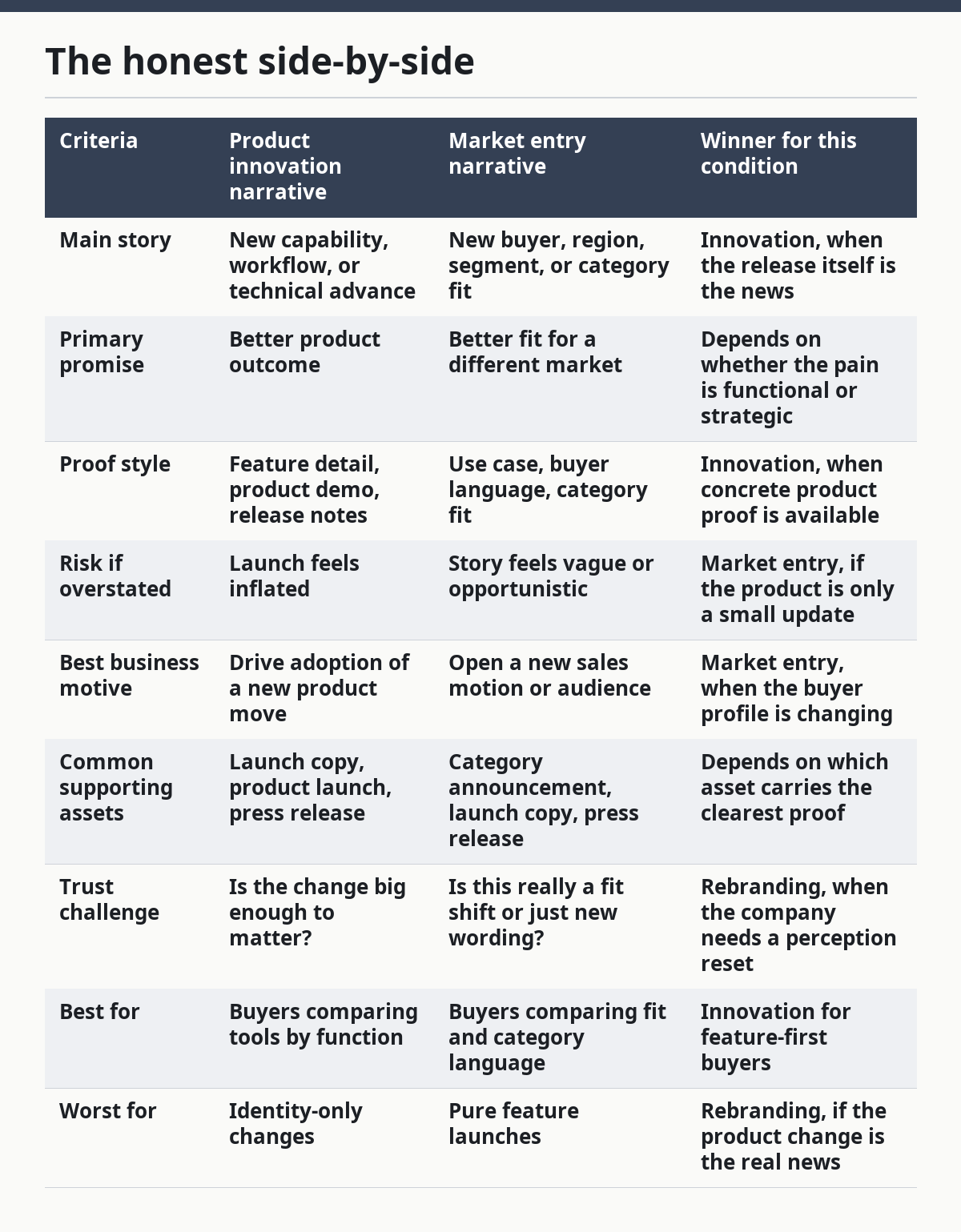
Overall, the comparison below is a practical way to choose the right frame. Innovation wins when the product is the reason for the announcement. Market entry wins when the audience shift is the story. Rebranding wins when the meaning of the brand is what changed most.
| Criteria | Product innovation narrative | Market entry narrative | Winner for this condition |
|---|---|---|---|
| Main story | New capability, workflow, or technical advance | New buyer, region, segment, or category fit | Innovation, when the release itself is the news |
| Primary promise | Better product outcome | Better fit for a different market | Depends on whether the pain is functional or strategic |
| Proof style | Feature detail, product demo, release notes | Use case, buyer language, category fit | Innovation, when concrete product proof is available |
| Risk if overstated | Launch feels inflated | Story feels vague or opportunistic | Market entry, if the product is only a small update |
| Best business motive | Drive adoption of a new product move | Open a new sales motion or audience | Market entry, when the buyer profile is changing |
| Common supporting assets | Launch copy, product launch, press release | Category announcement, launch copy, press release | Depends on which asset carries the clearest proof |
| Trust challenge | Is the change big enough to matter? | Is this really a fit shift or just new wording? | Rebranding, when the company needs a perception reset |
| Best for | Buyers comparing tools by function | Buyers comparing fit and category language | Innovation for feature-first buyers |
| Worst for | Identity-only changes | Pure feature launches | Rebranding, if the product change is the real news |
Which narrative is strongest for your goal?
The strongest narrative is the one that matches the business change most directly, and that is usually innovation for product-led launches, market entry for audience shifts, and rebranding for identity resets. If you force the wrong frame, the launch sounds noisy even when the company is doing something real.
Therefore, choose product innovation when the buyer needs to understand what is newly possible in the product itself. Choose market entry when the company is saying, in plain terms, that it now wants a different buyer or a different place in the market. Choose rebranding when the main work is to change how the company is read.
The trade-off is simple. Innovation gives precision but can miss the bigger business shift. Market entry gives strategy but can drift into vagueness. Rebranding gives clarity of identity but can look cosmetic if the product story is thin.
For readers comparing multiple launch channels, this is where the work becomes practical. A press release may sound like innovation, while the category announcement tells the market-entry story, and the launch copy carries the rebrand tone. The narrative is strongest when those channels agree.
If the company’s story changes by channel, the launch is probably doing more than one job. That is not bad, but it means the reader should judge which job is primary instead of accepting the loudest headline.
When should you change your judgment entirely?
You should change your judgment entirely when the launch is doing two jobs at once and the dominant one is not the obvious one. That happens in at least three cases.
First, if the product looks new but the language is mostly about audience or category, the real story may be market entry, not innovation. Second, if the product change is small but the branding changes sharply, the real move may be rebranding, not a feature launch. Third, if the press release, launch copy, and category announcement point in different directions, the company may be managing perception more than explaining change.
Then, a fourth exception is timing. If a launch lands near a bigger shift in company strategy, the narrative may be designed to prepare the market for a future move rather than describe the current one. That is common in brand repositioning and category announcements.
The practical rule is this: if the story needs a lot of interpretation to make sense, do not call it an innovation narrative first. If the buyer can understand the new product in one read, innovation may be the right frame. If the buyer needs context about who the company is now for, the story has moved toward market entry or rebranding.
What should you choose?
Ultimately, choose product innovation if the release changes what the product can do and that change is the main reason to pay attention. Choose market entry if the company is using the launch to reach a new buyer, market, or category position. Neither if the announcement is mostly a branding exercise with no clear product change and no clear market shift.
That is the cleanest call because it prevents the two most common mistakes: calling every launch a product story, and calling every identity shift a strategy story. The right choice depends on where the company is trying to move the buyer’s mind.
For broader launch intelligence work, this comparison fits best inside a larger system for reading public signals, not as a standalone guess. It belongs alongside other checks on launch copy, press releases, and category announcements, especially when the same company tells different stories in different channels.
How do you tell what kind of launch story a SaaS company is telling?
Because the answer depends on what the story treats as the main event, you tell by checking that center of gravity. If the copy centers product capability, the narrative is usually innovation-led. If it centers audience, category, or market fit, it is usually market-entry-led. If it centers tone, identity, or perception, it is usually a rebranding move.
What is the difference between an innovation launch and a rebrand?
In practice, an innovation launch says the product changed in a way that matters to buyers. A rebrand says the company wants to be seen differently, even if the product changed only a little or not at all. The first is about capability; the second is about meaning.
How can you compare the narrative across multiple launch channels?
Therefore, compare the promise, the problem framing, and the proof in each channel. If launch copy, press releases, and category announcements tell the same story, the message is stable. If one channel sounds like innovation and another sounds like market entry or rebranding, the company is likely using different stories for different audiences.
Drafted with AI; not yet reviewed by a person.