






For most SaaS teams, a 1-to-5 SaaS content refresh prioritization matrix is enough to rank pages by traffic drop, business value, and update cost so the…
Last updated: November 17, 2026
SaaS Content Refresh Prioritization Matrix
Quick Answer: For most SaaS teams, a 1-to-5 SaaS content refresh prioritization matrix is enough to rank pages by traffic drop, business value, and update cost so the right articles get fixed first. This article explains how to build a SaaS content refresh prioritization matrix for traffic drops, business value, and update cost without overcomplicating the backlog.
A SaaS content refresh prioritization matrix helps you rank pages by traffic drop, business value, and update cost so the right articles get fixed first. It is a practical way to turn a messy refresh backlog into a clear queue, and it works best when you score pages the same way every time.
Key takeaways

- A refresh matrix is for choosing order, not for writing the update itself.
- Traffic decline, organic value, conversion value, and update effort should all sit in the same scorecard.
- A page with a steep traffic drop is not always the first page to refresh if it has low business value.
- The matrix is most useful when the scoring rules are simple enough to repeat across a 50-page or 500-page backlog.
- The main trade-off is speed versus precision: the simpler the matrix, the easier it is to run.
Therefore, this belongs in the broader SaaS content operations and workflow systems stack, because the matrix decides what enters the refresh queue before any edits start. For related planning, see content operations and content refresh workflow.
What is a content refresh prioritization matrix?
A content refresh prioritization matrix is a scoring grid that ranks pages by value and effort so you know what to update first. For a SaaS library, it usually combines three things: traffic drops, business value, and update cost.
Because of that, the point is not to prove one page is “bad.” The point is to separate pages that need fast attention from pages that can wait. A page can lose organic traffic, still earn conversions, and be worth fixing before a newer post with lower business value.
Also, the matrix usually works with a 1-to-5 scale, a high/medium/low scale, or a weighted score. A 1-to-5 scale is easier to run on a backlog of 30 pages. A weighted score is better when one signal, like conversion value, matters more than the others.
However, the honest limit is simple: a matrix cannot replace judgment. It can tell you that a page with a traffic drop and high conversion value belongs near the top, but it cannot tell you whether the fix is a small update or a full rewrite. That still needs a human review.
Which signals should go into the matrix?

The matrix should use signals that tell you both how much a page matters and how much work it needs. A practical set is traffic decline signals, organic value, conversion value, and update effort.
Traffic decline signals include clear changes in organic sessions, clicks, impressions, or ranking position. The signal matters most when the drop is sustained, not just a 7-day dip from normal noise. A monthly view is often easier to trust than a weekly one.
In particular, organic value shows whether the page pulls in search demand or supports a topic cluster. A page with steady impressions, strong ranking keywords, or links from other pages can still be worth refreshing even if conversions are light. That is common with top-of-funnel explainers.
Meanwhile, conversion value tells you whether the page helps pipeline, trials, demos, or sign-ups. In SaaS, this matters more than pure traffic because a page with 200 visits and strong intent can be more useful than a page with 2,000 visits and no business outcome.
Finally, update effort is the work needed to make the page useful again. A 300-word tweak, a fact update, and a title rewrite are not the same as a full structure change, new screenshots, and approval from product marketing. Effort should cover writing time, review time, and the number of people who need to sign off.
How do you score refresh priority?
You score refresh priority by giving each page the same numbers for value and effort, then sorting from highest value to lowest effort. A 1-to-5 scale is enough for most SaaS teams, because it stays readable and does not turn the backlog into a spreadsheet exercise.
So, use one score for business value, one score for traffic risk or decay, and one score for update effort. Then combine them into a single priority number. The exact formula matters less than the consistency of the rules.
For example, a simple version is: if you are setting criteria for a SaaS content refresh prioritization matrix, and if a qualified SEO or content professional is helping review the model, use:
- Traffic decline score: 1 to 5
- Business value score: 1 to 5
- Update effort score: 1 to 5
- Priority = traffic decline + business value – update effort
That gives you a quick ranking, but it treats every signal equally. If conversion value matters more than traffic decline, weight business value higher. That is the right move for SaaS teams with a small number of high-intent pages.
| Scoring option | Best for | Strength | Trade-off |
|---|---|---|---|
| Equal scoring | Small backlog, simple process | Fast to run and explain | Can miss pages with strong revenue impact |
| Weighted scoring | Mature SaaS teams | Matches priority to business goals | Takes longer to define and maintain |
| High/medium/low bands | Early-stage content ops | Easy for a team to adopt | Less precise than numeric scoring |
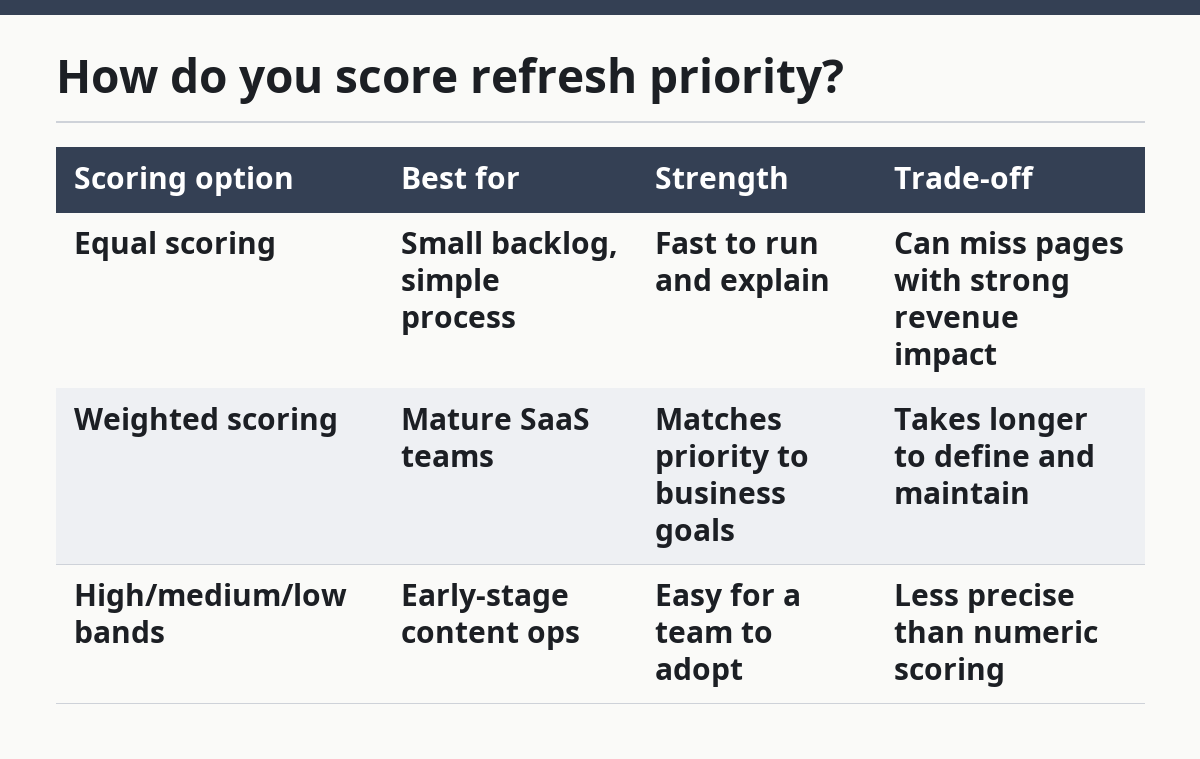
Overall, a useful rule is: if two pages land near each other, choose the one with the lower update effort first only when their business value is close. If one page supports a key conversion path, effort should not outrank value.
How do you build the matrix step by step?
You build the matrix by listing pages, assigning scores, and sorting the backlog into action buckets. The process is easiest in a spreadsheet, because you can filter, color code, and sort without adding software overhead. If you want a starting point, a SaaS content audit usually feeds the same backlog.
- Open a spreadsheet and list the backlog. Put one page per row and include URL, topic, primary keyword, and publish date so the backlog is traceable from the start. A list of 20, 50, or 200 pages can work the same way in a consistent scoring system.
- Add a traffic column and score the decline. Use recent organic signs such as clicks, impressions, or ranking drops, then score the page from 1 to 5 for urgency. A sustained fall should score higher than a single bad week.
- Add a business value column and score the page. Include organic value and conversion value in the same field if you need a simple first pass. Pages tied to demo requests, trials, or bottom-funnel intent should score higher than generic awareness posts.
- Add an effort column and score the work. Count the likely edit size, the need for new assets, and the number of reviewers. A page that needs only text changes should score lower than a page that needs new sections, new screenshots, and legal review.
- Calculate the priority score and sort the sheet. Put the highest-value, lowest-effort pages at the top so the content backlog becomes a refresh queue. The result should be a short list you can hand to an editor without extra explanation.
- Group the top pages into refresh bands. Use bands like “do now,” “do next,” and “wait” so the queue stays manageable. A three-band system is often enough for weekly planning and keeps the process from stalling on edge cases.
Because this step order works, it forces the same logic across the library. If you start with effort only, easy pages crowd out important ones. If you start with traffic only, you can over-prioritize pages that do not matter to the business. For related planning, see topic clusters.
What does a good scoring model look like?
A good scoring model makes the trade-off between business value and update cost visible. It should be simple enough to run in less than an hour for a normal backlog review, but strict enough that two people would give similar scores to the same page.
Specifically, the clearest model is a 3-part scorecard:
- Traffic decline: How much the page has slipped
- Business value: How much the page matters to organic and conversion goals
- Update effort: How much time and coordination the fix will take
If you want one number, use a weighted score. If business value is the main goal, give it more weight than traffic decline. If the content team is small, make effort a bigger penalty so the queue stays realistic.
Likewise, a good model also uses clear labels. For example, “high effort” should mean a full rewrite or major restructure, not just “feels hard.” “High value” should mean the page supports a key SaaS path, not simply that it gets views. Without those rules, the matrix turns into opinion.
Ultimately, the biggest mistake here is overbuilding the spreadsheet. A matrix with 14 columns, hidden formulas, and too many edge cases slows down refresh decisions. A lean model with 3 core signals and a few notes is usually better for a live content backlog.
What mistakes should you avoid?
However, you should avoid mixing problem signals with solution signals, because that makes the matrix harder to trust. A page can have traffic decline, but the real issue may be search intent drift, outdated examples, or poor conversion fit. Put the cause in notes, not in the priority score.
Another mistake is scoring every page against the same business goal. A top-of-funnel explainer and a pricing-adjacent guide do not serve the same purpose. If you score them the same way, you can end up refreshing pages that look valuable in a spreadsheet but do little for pipeline.
Next, a third mistake is ignoring update effort until the end. A page that needs 2 hours and a page that needs 20 hours should not sit in the same priority bucket unless the business value gap is huge. If effort is hidden, the backlog fills with big jobs that never get scheduled.
However, a fourth mistake is treating the matrix like a one-time project. Content decay keeps happening, especially in SaaS where products, competitors, and search intent shift. A monthly or quarterly review keeps the queue current and keeps the scorecard honest.
Overall, the trade-off is clear: a more detailed matrix gives better sorting, but it also asks for more maintenance. If the team will not update the scores, keep the model plain.
How does this fit a refresh backlog?
The matrix turns a refresh backlog from a list of problems into a ranked work queue. That matters because a backlog without order creates random work: the loudest page gets fixed first, not the most valuable one.
Therefore, the best use is triage. First, sort the backlog by score. Next, pull the top band into the next sprint or content cycle. Then, set aside the low-value, high-effort pages unless they support a major campaign or product launch.
In contrast, a healthy backlog also separates refreshes from other content actions. This page is about prioritization, not the workflow for editing, correcting, or deprecating content. That split matters because the matrix answers “what first,” while the workflow answers “what happens next.”
As a result, if the backlog is large, use a simple rule: pages with strong traffic decline and high conversion value go first, even if they need moderate effort. Pages with weak value and high effort go last unless they affect a critical product page or a strategic keyword set.
For SaaS teams, the real win is fewer debates. A shared matrix gives marketing, SEO, and product marketing one way to argue about priority without turning every page into a fresh discussion. See also SaaS content operations.
How do you decide what content to refresh first?
Ultimately, you refresh first by ranking pages with the strongest mix of traffic decline, business value, and low-to-moderate update effort. The first page in line is usually not the one with the biggest traffic drop; it is the one where a fix is most likely to improve a useful business outcome.
How do you score refresh effort against value?
Because you score effort against value by putting both on the same scale and comparing them in one view. A page with high business value and moderate effort should outrank a page with low value and low effort, unless the low-value page is part of a larger cluster or campaign.
What should you do after the matrix is built?
Finally, you should review the matrix on a set schedule and keep the scoring rules stable. A monthly or quarterly pass is enough for most SaaS libraries, as long as the team updates the backlog when major product or search changes land.
The matrix is not the finish line. It is the filter that decides which pages deserve writing time, design time, and editorial time first. Once that order is clear, the rest of the refresh system becomes easier to run and easier to defend.
Drafted with AI; not yet reviewed by a person.