






How to Build a SaaS Pricing Evidence Ownership Matrix for Marketing, Sales, RevOps, and Legal: A pricing evidence ownership matrix is a table that assigns…
Last updated: November 20, 2026
Quick answer: build a 5-field matrix, assign 1 primary owner and 1 reviewer per proof type, and review it on a monthly or quarterly cadence. In the SaaS pricing evidence ownership matrix for Marketing, Sales, RevOps, and Legal, the goal is to keep pricing proof current across public pages, quotes, records, and procurement responses. This guide is general information, not legal advice; consult a qualified lawyer or compliance professional for your situation.
Key takeaways
- A pricing evidence ownership matrix is not a policy deck; it is a map of who owns each proof artifact and who can challenge it.
- The matrix works best when each evidence type has one primary owner and one backup, even if several teams use the same source.
- Marketing usually owns public claims, sales owns quote-side proof, RevOps owns system fields and records, legal owns risk review, and procurement owns supplier-facing evidence.
- The hard part is not collecting proof. It is deciding who updates it, who approves a change, and who settles disputes.
- If the team cannot name one owner per artifact in 10 minutes, the matrix is too vague to help.
What is a pricing evidence ownership matrix?
A pricing evidence ownership matrix is a table that assigns each pricing proof item to one accountable team and one named function for review or escalation. It keeps the evidence chain clear when a public page, a sales quote, and a procurement packet all need to say different things for valid reasons.
This guide is for SaaS teams that already have marketing, sales, RevOps, legal, and procurement in the mix, and need a clean way to sort who owns what. It assumes the reader already has at least a basic list of pricing artifacts, such as public pricing pages, quote templates, discount rules, approval notes, and procurement responses. It also assumes the reader knows that rules vary by jurisdiction; this is general information and not legal advice, and a qualified lawyer should be consulted.
The matrix is not the same as a governance model, an audit trail, a surface map, or a change log. Those are separate tools. The matrix answers a narrower question: who owns the evidence, who updates it, and who can dispute it when the record and the claim do not match.
A clean matrix also prevents a common failure: a team thinks another team “has it,” but nobody has the final update. That gap matters because pricing proof is often used in customer-facing documents, procurement packets, and internal review, where a stale record can create avoidable risk. The point is not perfection. The point is a clear chain of responsibility.
Who should own each proof type?
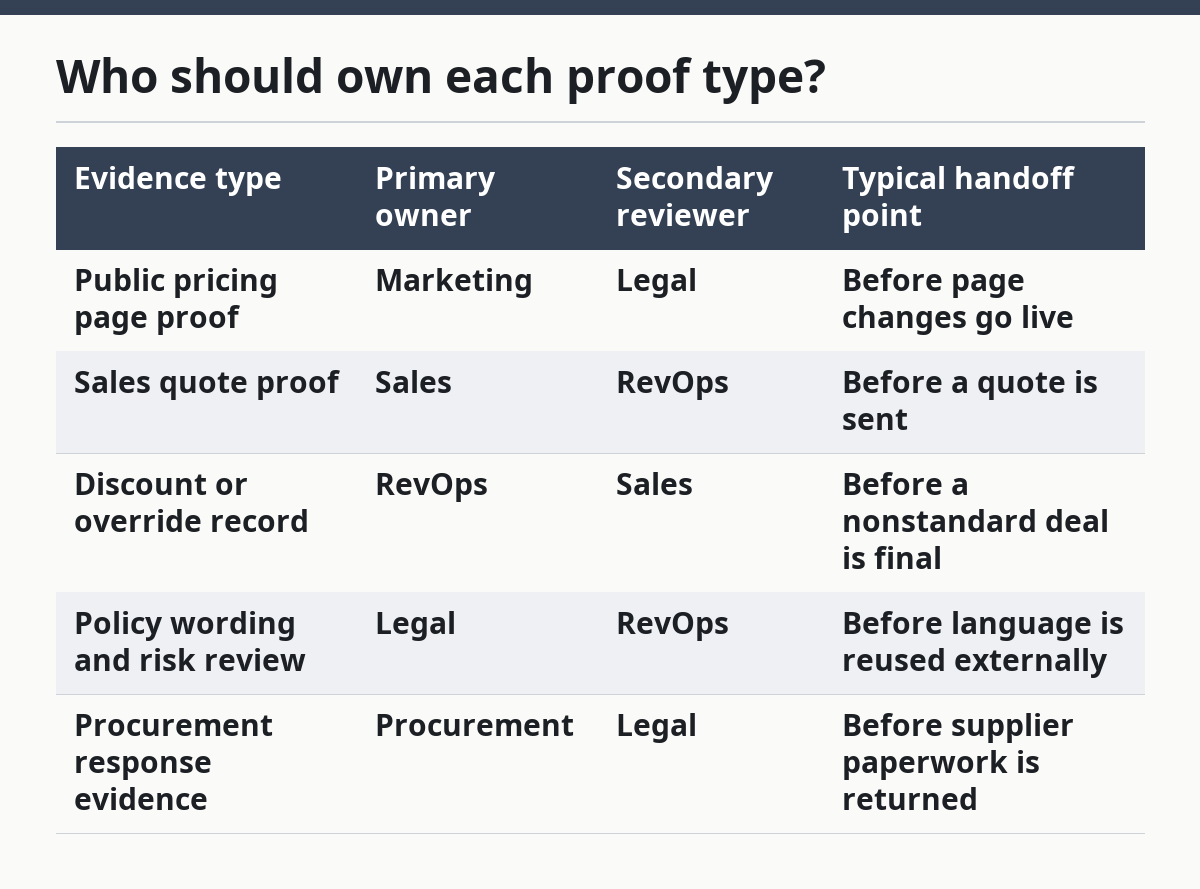
Each proof type should have one primary owner and one secondary reviewer, with legal reserved for risk questions rather than routine edits. In a SaaS setting, marketing usually owns public pricing statements, sales owns deal-level proof attached to quotes, RevOps owns the system of record, legal owns policy review and dispute calls, and procurement owns supplier-side evidence that supports buyer review.
The split works because each team touches a different point in the pricing flow. Marketing controls what the market sees, sales controls what a buyer hears during a deal, RevOps controls how the data is stored and repeated, legal controls what can be said safely, and procurement controls the evidence a vendor asks for in a buying process. If one team owns all of it, updates slow down. If no team owns it, the record drifts.
| Evidence type | Primary owner | Secondary reviewer | Typical handoff point |
|---|---|---|---|
| Public pricing page proof | Marketing | Legal | Before page changes go live |
| Sales quote proof | Sales | RevOps | Before a quote is sent |
| Discount or override record | RevOps | Sales | Before a nonstandard deal is final |
| Policy wording and risk review | Legal | RevOps | Before language is reused externally |
| Procurement response evidence | Procurement | Legal | Before supplier paperwork is returned |
The matrix should also say what the owner does not own. Marketing should not be the only team deciding sales quote language. Sales should not be the keeper of the master policy record. Legal should not be the first stop for every normal field update. That boundary keeps the matrix useful instead of turning it into a bottleneck.
How do you build the matrix step by step?
You build the matrix by listing the proof items first, then assigning one owner, one reviewer, one update trigger, and one dispute path for each item. Use a single sheet or table, but keep the fields fixed so the same logic applies to every artifact.
- List the pricing evidence items in one column, such as public page copy, quote footnotes, approval notes, procurement responses, and discount records; verify that each item appears once; problem sign is duplicate labels for the same proof.
- Classify each item by surface and use, such as marketing, sales, RevOps, legal, or procurement; verify the item belongs to only one primary home; problem sign is three teams all claiming the same file.
- Assign one primary owner per item and name the backup function, not a vague group; verify every row has a single accountable role; problem sign is “shared ownership” with no named follow-up.
- Set the review authority for each row, using one reviewer for routine changes and legal only for language that changes risk; verify the reviewer has enough context to approve or reject; problem sign is legal reviewing every 1-line edit.
- Define the update trigger for each artifact, such as a page edit, a quote revision, a policy change, or a procurement request; verify the trigger is specific and observable; problem sign is “when needed,” which means nobody knows when to act.
- Document the handoff boundary, meaning where one team stops and the next begins; verify the boundary is tied to the artifact, not the person; problem sign is an email chain that replaces the matrix.
- Record the dispute path in one line, naming who settles a conflict when two teams disagree; verify escalation ends with one decision-maker; problem sign is a loop that sends the issue back to the same two teams.
- Review the matrix on a fixed cadence, such as monthly or quarterly, and after any pricing policy shift; verify every row still matches current practice; problem sign is a matrix that survives longer than the workflow it describes.
The key is to keep each row narrow. A row should not hold every note about the artifact. It should answer four things: who owns it, who checks it, when it changes, and what happens when there is a dispute. If the row needs a paragraph, the structure is too loose.
What should the matrix include?
The matrix should include the artifact name, the primary owner, the review authority, the update trigger, and the dispute path. Those five fields are enough to stop most ownership confusion without turning the sheet into a policy manual.
A useful matrix also shows the difference between stewardship and approval. Stewardship means the team keeps the item current. Approval means the team has the right to say yes or no before it is used. Those are not the same job. A marketing owner can steward a public pricing statement while legal holds approval only for wording that changes exposure.
This is where RevOps often matters most. RevOps usually owns the systems and the record structure, so it is the natural home for fields like version label, last reviewed date, and source-of-truth location. That does not mean RevOps writes the business message. It means RevOps keeps the record consistent so the same proof does not drift across tools.
Keep procurement in the matrix even if it feels external. Procurement is often the function that receives or sends pricing evidence under a buyer’s process, and its role affects what proof gets reused. If procurement is left out, the team may answer a buyer with the wrong artifact or the wrong level of detail.
When does the standard split break down?
The standard split breaks down when one artifact serves two jobs, when legal language changes too often, or when a deal needs one-off proof that does not fit the normal path. In those cases, the matrix still works, but the row needs an exception note.
One artifact supports both a public claim and a contract term: this creates a risk of mixed ownership — split the artifact into two rows and give each row its own owner. A public pricing page and a deal quote may both mention the same number, but they do not serve the same legal function. The page may be marketing-owned while the quote is sales-owned, with legal reviewing the overlap.
Legal asks to review every row: this usually slows routine work — keep legal on the rows that change external language, buyer terms, or risk position. That keeps review focused on what actually needs it, rather than making legal a general editing desk.
RevOps owns the system field but not the business meaning: this is normal — let RevOps maintain the field and the naming standard, while the business owner writes the content. A field called “list price” should not be rewritten by five people with different meanings.
Procurement requests evidence that the public page does not contain: this means the matrix needs a separate row for supplier-facing proof — do not force marketing to answer it as if it were a public claim. The handoff should route the request to the artifact owner, not to the nearest teammate.
The sales team uses side emails for pricing proof: this is a record gap — move the proof into the matrix and the related system, or the evidence chain will stay incomplete. Informal threads are hard to keep current and harder to defend later.
What mistakes do teams make most often?
Teams usually make the same few mistakes, and each one creates a different kind of mess. The fix is simple, but only if the matrix is strict enough to enforce it.
A common error is assigning “shared ownership” to several teams. That sounds collaborative, but it often means nobody updates the row on time. The better choice is one owner and one reviewer. Shared work can still happen; shared accountability should not.
Another mistake is letting sales own records that RevOps should control. Sales knows the deal, but RevOps usually knows the system field and the versioning rule. When sales becomes the record keeper, the evidence often lives in scattered notes and inboxes instead of one source.
A third error is making legal the default approver for every artifact. That slows routine changes and trains the business to route around legal. The better pattern is narrow review authority: legal handles language and risk, while routine stewardship stays with the business owner.
A fourth mistake is using the matrix as a filing cabinet. If the sheet only lists documents without naming review authority or dispute paths, it does not solve ownership. It just catalogs the confusion. A working matrix should tell the team what happens next, not only what exists.
A fifth mistake is skipping procurement because it feels downstream. Procurement often receives pricing proof in a formal buyer process, so leaving it out can create a gap between internal records and external requests. If the matrix is meant to support pricing evidence, procurement belongs in the room.
Which sources should sit behind the matrix?
The matrix should point to the authoritative source for each artifact and not duplicate the evidence inside the matrix itself. The matrix is a control layer, not the proof repository. It should link to the current home of the document, the record field, or the approved template.
For legal and marketing language, the safest pattern is to keep the policy source separate from the public wording. That split helps when a public claim needs to change but the underlying approval rule does not. It also helps if a jurisdiction-specific rule applies, because the same row can point to a different source depending on the market.
Two good reference points for this kind of work are the U.S. Federal Trade Commission’s business guidance on advertising and marketing, and the International Association of Privacy Professionals’ resources on compliance workflow. See the FTC’s Advertising and Marketing basics and the IAPP’s Privacy program management resources. Those are not the only useful standards, and neither one replaces local legal advice, but they are the kind of external references a team can anchor to.
If the team works across borders, the matrix should mark where rules vary by jurisdiction. A proof item that is acceptable in one country may need a different review path in another. That is why a single global row often fails. The row needs a market field or a jurisdiction note. For companies with country-specific approvals, a legal review checklist can sit next to the matrix.
How do you keep the matrix useful over time?
The matrix stays useful when it changes on a fixed cadence and after any pricing or policy shift. A monthly or quarterly review is usually easier to sustain than a loose “as needed” check.
The review should ask four questions: did the owner change, did the review authority change, did the proof location change, and did any dispute path break? If the answer to any of those is yes, the row needs an update. If the team cannot answer those questions in a few minutes, the matrix is too complex.
A good result is simple to spot. One person can point to a row and say who owns the proof, who checks it, and what happens if the row is challenged. If that is not true, the matrix is only a spreadsheet with names in it.
Who owns pricing evidence?
Pricing evidence is usually owned by the team that maintains the artifact, not by every team that uses it. Marketing owns public claims, sales owns deal-side proof, RevOps owns the record, legal owns risk review, and procurement owns supplier-facing evidence. The exact split can vary by company and jurisdiction.
Which team should maintain pricing records?
RevOps is usually the best home for pricing records because it keeps system fields, version labels, and source links in one place. That does not mean RevOps writes the business message. It means RevOps keeps the record clean so other teams can rely on it. A pricing records template can help keep that structure consistent.
How do you assign ownership for pricing proof?
Assign ownership by artifact, not by department slogan. Name one primary owner, one reviewer, one update trigger, and one dispute path for each proof item. If a row cannot fit those four parts, split the row until it can.
Drafted with AI; not yet reviewed by a person.