


A SaaS launch tagline usually reveals 3 things in one glance: the category, the outcome, and the differentiator. Read How to Read a SaaS Launch Tagline…
Last updated: November 16, 2026
Quick Answer: a SaaS launch tagline usually reveals 3 things in one glance: the category, the outcome, and the differentiator. Read How to Read a SaaS Launch Tagline for Category, Outcome, and Differentiator that way, and a 10-word line becomes a useful signal instead of vague hype.
Key takeaways
- A launch tagline is not a full positioning statement; it is the shortest public claim the team wants repeated.
- The clearest taglines usually split into 3 parts: category cue, outcome promise, and differentiator.
- Headline, subhead, homepage hero copy, and launch banner often carry different jobs, so one line rarely does all 4 well.
- If the line is only broad benefits, you learn little about the product. If it is only a niche feature, you may miss the category fit.
- The best read is not “is this clever?” but “what would a buyer think this tool is for in 5 seconds?” for a quick first pass, then confirm with the rest of the page or a professional review if the stakes are high.
What is a SaaS launch tagline?
A SaaS launch tagline is the short line a product uses at launch to frame what it is, what it does, and why it matters. In How to Read a SaaS Launch Tagline for Category, Outcome, and Differentiator, it may sit in a headline, a subhead, a homepage hero, or a launch banner, and it often carries more strategic weight than the longer page below it.
That is why the line matters in SaaS product intelligence. A tagline is usually the most compressed version of the team’s message, and compression reveals priorities. If a launch banner says one thing and the subhead says another, the mismatch is often the clue. Nielsen Norman Group’s guidance on clear web writing supports that kind of scan-first reading, especially when users are deciding what a page is about in seconds. (Source: NN/g)
A generic marketing line tries to sound positive. A launch tagline has a tighter job: help a reader classify the product in 3 seconds. The difference is small on the page and large in meaning.
A good read starts with the assumption that the team had to make trade-offs. One line cannot explain every integration, use case, or buyer type. It has to choose. That choice is the signal.
How do you split category, outcome, and differentiator?
You split a SaaS launch tagline by asking 3 questions in order: what category is this, what result is promised, and what makes this version different? That order matters because a reader usually classifies the product before they care about the twist.
Use this quick procedure when you see a tagline, headline, or launch banner:
- Circle the product noun or category word. Look for terms like “CRM,” “workflow tool,” “AI agent,” or “analytics platform.” If you find one, you have the category cue. If you do not, the company may be trying to create a new category or hide one.
- Mark the verb phrase that promises a result. Words like “save,” “track,” “automate,” “simplify,” or “close” point to the outcome. The result is usually the part a buyer can picture using within a day, not a vague future benefit.
- Underline the phrase that says why this product is different. This may be a target user, a technical method, a speed claim, or a niche workflow. The differentiator often appears in 4 to 8 words, not a full sentence.
- Check the headline and subhead against each other. If the headline gives category and the subhead gives outcome, that is normal. If both lines say the same thing in different words, the launch copy is thin.
- Ask what the line leaves out. If the tagline says “AI for support teams” but never says what kind of support work it handles, the omission is part of the message. Missing detail is often a positioning choice.
A clean split helps because taglines often pack 2 jobs into one line. For example, “AI customer support for startups” carries category and audience, while “Resolve tickets in minutes” carries outcome. If one line tries to do both badly, the message gets muddy.
What counts as the category cue?
The category cue is the word or phrase that tells you what shelf the product wants to sit on. It is often the quickest way to know whether the launch is trying to sound like a CRM, a help desk, a data tool, a sales assistant, or something stranger.
The category cue can be explicit or implied. “Analytics platform” is explicit. “See what drives growth” is implied, but weaker, because the reader has to infer the category from the promise. When the category is vague, the launch may be early, broad, or trying to invent a new slot.
A reader should treat a category cue as a claim, not a fact, and if the distinction matters for procurement, compliance, or legal review, consult a professional and check the original source materials. Startups often stretch familiar labels to sound bigger or wider than they are. A “platform” may really be one workflow. An “AI agent” may really be a narrow assistant with 2 actions. For a neutral reference on category language and message clarity, see the HubSpot Marketing Statistics page, which is useful for checking how businesses describe products in public-facing copy.
The trade-off is simple. Broad category language makes the product easy to place, but easy to ignore. Narrow category language makes it easier to understand, but harder to imagine for a larger market. That is why a launch team often pairs a familiar category word with a sharper subhead.
The category cue also tells you what the team expects competitors to be. A line that says “for finance teams” is not only about audience; it implies the product belongs in a finance software lane, not a general productivity lane. That matters when you are mapping launches across a market. For market context, a SaaS product launch analysis can help you compare one launch against a broader set of launches.
What does the outcome promise actually say?
The outcome promise tells you what change the buyer should expect after using the product. It is the “so what” line, and it usually points to speed, clarity, savings, control, or growth rather than to the feature itself.
A strong outcome promise is concrete enough to imagine but broad enough to apply to more than one workflow. “Close tickets faster” is clearer than “work better.” “Cut manual reporting” is clearer than “modernize your team.” The first pair gives a working result; the second pair gives a slogan.
This is where many launch taglines get slippery. They use verbs that sound active but say little. “Transform,” “power,” and “optimize” can hide the actual result. If you cannot tell whether the user saves time, reduces errors, or gets more revenue, the outcome promise is weak.
A useful test is to turn the line into a plain sentence a buyer might repeat internally. If the tagline becomes “this tool helps us do the same thing faster,” the promise may be too vague to support a launch. If it becomes “this tool removes one manual step from our weekly reporting,” the promise is much stronger. That kind of specificity is common in good product messaging, including cases discussed in the product positioning examples archive.
The outcome promise matters more than the feature list in a launch because it tells you which pain the team thinks is most urgent. That pain may be accurate or not. A tag line aimed at “saving time” can miss a buyer who actually cares more about audit trails, approvals, or accuracy.
How do you tell differentiator wording from generic hype?
You tell differentiator wording from generic hype by checking whether the line names a real edge that narrows the product, or just repeats what almost every SaaS says. A differentiator should change how you compare the tool, not just how you feel about it.
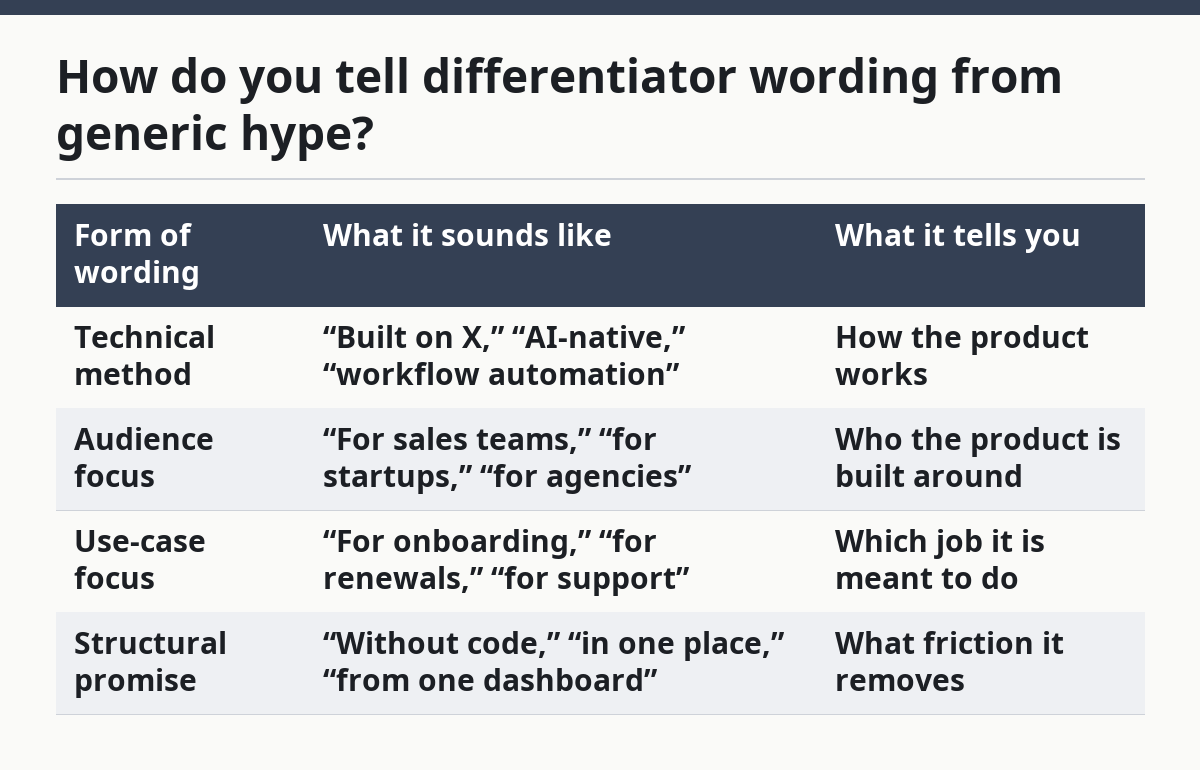
Look for 4 common forms of differentiator wording:
| Form of wording | What it sounds like | What it tells you |
|---|---|---|
| Technical method | “Built on X,” “AI-native,” “workflow automation” | How the product works |
| Audience focus | “For sales teams,” “for startups,” “for agencies” | Who the product is built around |
| Use-case focus | “For onboarding,” “for renewals,” “for support” | Which job it is meant to do |
| Structural promise | “Without code,” “in one place,” “from one dashboard” | What friction it removes |
A real differentiator usually reduces uncertainty. It gives you one fewer question to ask. Generic hype does the opposite. “Smarter productivity for modern teams” sounds broad and friendly, but it does not tell you what is different in a way a buyer can test.
The honest limit is that a differentiator in a tagline is often only partial. A company may lead with one sharp edge and hide another. That is not a flaw by itself; it is the nature of launch copy. The mistake is treating the tag as the whole product story, especially before you compare it with the homepage, pricing page, and help docs. For a broader framework, see SaaS launch intelligence systems.
A tagline is wrong for you when the differentiator is the only clear thing in the line and the category is absent. That usually means the product is trying to be mysterious. Mystery can help a launch get attention, but it makes comparison harder for the reader.
Where do headline, subhead, homepage hero copy, and launch banners differ?
They differ because each piece has a different job, even when they sit within the same launch. The headline grabs, the subhead explains, the homepage hero copy frames, and the launch banner compresses.
A headline often carries the category cue or the outcome promise. A subhead usually adds the other half. If the headline says “The new AI help desk,” the subhead may say “Resolve more tickets without adding headcount.” That pairing works because the first line classifies and the second line clarifies.
Launch banners are usually the shortest and least forgiving. They have to do the job in a tiny space, often beside a logo or product name. Because of that, they lean on familiar category words and sharp verbs more than full explanations.
Homepage hero copy has more room than a banner, so it can carry 2 or 3 signals at once. That extra room can help, but it also tempts teams into saying too much. If a hero section needs 3 lines to explain the same point, the launch message may not be sharp enough yet.
The reader should compare these elements instead of reading only one. If the banner says “AI scheduling” and the hero says “reduce admin work,” the sequence tells a story: category first, outcome second. If the subhead introduces a totally different audience or use case, the launch likely has a broader positioning problem. For a related workflow, the launch banner analysis page can help separate signal from decoration.
What should you ignore in a weak tagline?
You should ignore padding, praise words, and vague scale claims, because they rarely tell you anything useful. A tagline that says “powerful,” “modern,” “simple,” or “next-gen” may sound polished, but those words do not help classify the product.
Weak lines often hide behind 3 tricks. First, they use abstract nouns like “efficiency” or “performance” instead of a named result. Second, they stack adjectives instead of making a claim. Third, they use a broad audience label like “teams” when the real buyer is a narrower group.
That does not mean every vague line is useless. Sometimes the vagueness is a clue that the launch is early, the category is crowded, or the team is still testing message fit. In those cases, the tagline tells you less about the product than about the company’s confidence.
A good rule is to separate signal from decoration in 15 seconds. If a phrase changes the category, the outcome, or the differentiator, keep it. If it only adds tone, drop it. This cuts the line down to its job.
This is also where launch intelligence work benefits from a standard reading method. The same 3-part split works across headline, subhead, hero copy, and launch banner, which keeps one launch from being overread just because the design looks polished. For the broader system this page sits in, see the hub on SaaS launch intelligence systems.
When should you trust the tagline, and when should you treat it as noise?
You should trust the tagline when it gives a clear category cue, a plain outcome, and one plausible differentiator in a single line or paired headline-subhead set. That is a sign the team knows what it wants to be understood as.
Treat it as noise when the line is all mood and no claim, or when the category and outcome pull in different directions. A launch that says “all-in-one revenue platform” but then only mentions one narrow task is probably stretching. A launch that says “for everyone” is also weak, because a product that fits everyone usually fits no one well.
The trade-off is that a launch tagline is a snapshot, not a full dossier. A sharp line does not prove the product is good, and a weak line does not prove the product is bad. It only tells you how the team wants to be read on day one. If the choice affects a purchase, ask a qualified professional or verify against the product’s documentation before acting on it.
That makes the best use of the tagline practical, not poetic. Use it to sort launches, compare adjacent products, and spot message shifts over time. Do not use it as the final word on fit or quality.
For a reader scanning many launches, that discipline saves time. It turns a 6-word promise into a structured note: category, outcome, differentiator, and the gaps between them.
What does a SaaS launch tagline usually reveal?
It usually reveals the category the product wants to claim, the result it wants to promise, and the one feature or angle it thinks will separate it from similar tools. A short line can also hint at audience and maturity, but those signals are weaker. Read the tagline as a compressed claim, not as the full product story.
How do you tell category from differentiator in a headline?
You tell them apart by asking whether the phrase places the product on a shelf or explains why it stands out on that shelf. “CRM for agencies” is mostly category plus audience, while “close deals from one inbox” is closer to a differentiator or outcome. If the line only helps you label the product, it is category; if it changes comparison, it is differentiator.
What makes a launch tagline more specific than generic marketing copy?
It names a real product type, a clear user result, or a narrow use case instead of piling on praise words. “Automate weekly reporting for finance teams” is more specific than “smarter work for modern businesses” because it gives a job, an audience, and a task. Specificity makes the launch easier to classify in under 10 seconds.
Drafted with AI; not yet reviewed by a person.