





How to Build a SaaS Editorial Governance Model for Ownership, Review, and Updates: use 4 roles, 3 review bands, and 1 named owner per page to build a SaaS…
Last updated: November 17, 2026
Quick answer: use 4 roles, 3 review bands, and 1 named owner per page to build a SaaS Editorial Governance Model for Ownership, Review, and Updates. A good model gives every piece of content one owner, one review cycle, and one clear rule for updates, so writers, editors, and subject matter experts stop working from memory.
Key takeaways
- A governance model is the rule set that says who owns content, who reviews it, and what happens when it changes.
- Give each article one content owner, even if several people contribute to it.
- Set a review cadence in months, not in vague “as needed” language.
- Separate routine updates from full rewrites so small fixes do not get stuck in approval loops.
- Keep approval rules simple enough that an editor can act without waiting on multiple people for a 500-word change.
What is a SaaS editorial governance model?
A SaaS editorial governance model is the operating rulebook for content decisions. It defines ownership, review timing, update paths, and removal rules so the same article does not get edited in three different ways by three different people.
For a SaaS team, that matters because product pages, help content, and thought leadership age at different speeds. A pricing explainer may need a review after a product change, while a general guide may only need a 6- or 12-month check. If the model is vague, the work becomes a queue of half-finished edits and unanswered comments.
Therefore, the model should name four roles in plain language: editor, writer, subject matter expert, and content owner. The editor controls the process, the writer drafts or revises, the subject matter expert checks accuracy, and the content owner makes the final call when the team is split. The point is not hierarchy for its own sake; it is faster decisions with fewer handoffs.
According to Nielsen Norman Group, content governance is a repeatable system, not an ad hoc approval habit. This is the right system for SaaS teams that publish often and revise often. It is not for a team that publishes only a few pages a year and can review each one manually without delay. If the content base is small, a 2-step signoff may be enough. If the site has dozens or hundreds of articles, the model needs more structure.
Who owns each article?
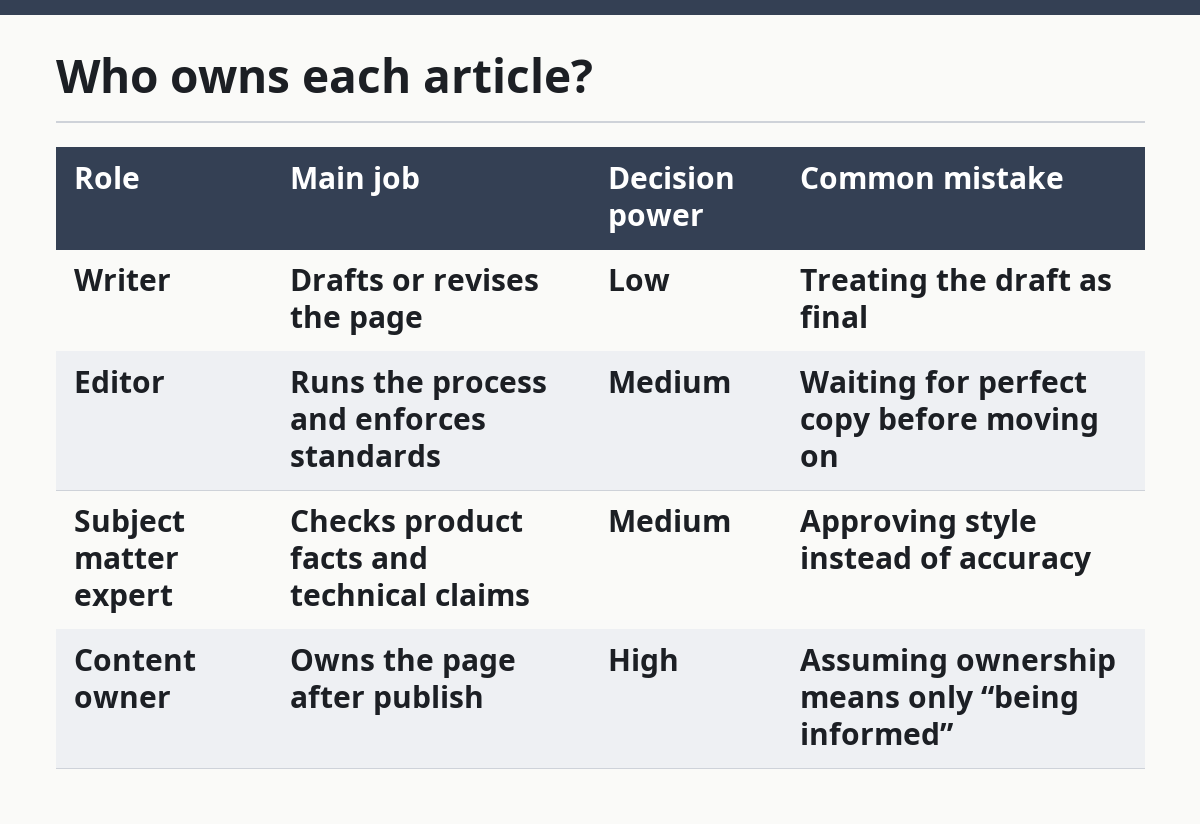
Each article should have one named content owner, even if three people touch it before publish. The owner is the person responsible for the page after it goes live, not just the person who wrote the first draft.
Therefore, the owner should be able to answer three questions in under a minute: who approves this page, when is it next due for review, and what happens if the product changes before then. If no one can answer those questions, the page is unowned in practice, even if a spreadsheet lists a name.
A simple ownership model can work well for SaaS teams:
| Role | Main job | Decision power | Common mistake |
|---|---|---|---|
| Writer | Drafts or revises the page | Low | Treating the draft as final |
| Editor | Runs the process and enforces standards | Medium | Waiting for perfect copy before moving on |
| Subject matter expert | Checks product facts and technical claims | Medium | Approving style instead of accuracy |
| Content owner | Owns the page after publish | High | Assuming ownership means only “being informed” |
In practice, the trade-off is not absolute control versus speed. A single owner keeps things moving, but the owner must have enough product context to make a call. If ownership sits with a general content team that never sees product changes, updates will lag. If ownership sits only with product teams, copy quality often slips because no one is watching structure, tone, or search intent.
For example, one useful rule is to make ownership follow the page type. Product-led pages can belong to a product marketer or lifecycle lead. Educational articles can belong to the editorial lead. Support-adjacent pages can belong to the person closest to the product truth. What should not happen is shared ownership with no final decision maker.
How do you set the review cycle?
A review cycle should be set by content risk, not by habit. Pages tied to product facts, pricing language, or screenshots need a tighter cycle than evergreen explainers.
A practical model uses a 3-part schedule:
- High-change pages: review every 1 to 3 months.
- Standard educational pages: review every 6 months.
- Low-risk evergreen pages: review once a year.
Those are operating bands, not laws. The right interval depends on how often your product, pricing, compliance language, and category terms change. If your team ships weekly and updates onboarding language often, a 12-month review is too slow. If your article explains a stable concept with no product references, quarterly review is probably too much.
Because of that, the review cycle should be attached to the page itself, not kept in someone’s head. The editor should know the next review date from the CMS, spreadsheet, or task tracker within 30 seconds. If the date exists only in Slack, it does not exist.
The biggest mistake is using one review date for the whole library. That creates waste. A page that needs attention in 2 months gets ignored while a page that is still accurate gets reviewed again for no reason. A second mistake is using “as needed” as the default. That is not a cycle; it is a hope.
If the team already uses a content inventory or editorial calendar, the governance model should sit above it. The calendar says when something is planned. The governance model says who owns it, how often it is checked, and what triggers a change before the next planned review.
How do you build the update workflow?
You build the update workflow by defining one path for small fixes, one path for major changes, and one path for removal. That keeps a 2-sentence correction from getting trapped in the same process as a full rewrite.
Start with this order:
- Identify the trigger, such as a product change, broken claim, new competitor term, or scheduled review date. The result is a reason to act, not a vague sense that the page “feels old.”
- Classify the update as minor, moderate, or major. Minor means a line edit or fact check; moderate means several paragraph changes; major means the angle, structure, or recommendation needs a rewrite.
- Assign the right people. Minor updates may need only the editor and content owner; moderate updates add the writer and subject matter expert; major updates may need a full approval pass.
- Set the deadline. A minor fix should not sit open for 2 weeks if it only changes one claim; major rewrites can take longer, but they still need a target date.
- Publish, then log what changed. The result is a visible record that makes the next review faster.
Because of that, the key decision is how much review each change deserves. A 200-word article note does not need the same approval path as a homepage claim or a pricing comparison. If every update needs full review, the team will start avoiding updates entirely. If nothing needs review, accuracy slips.
A useful rule is to let the editor approve minor edits without waiting for the full chain, while the subject matter expert only reviews claims that touch product behavior, pricing language, integrations, or technical limits. That keeps the workflow moving without turning the process into a free-for-all.
According to Google Search Central, content should stay useful and current for readers. Slow is not neutral; slow means outdated. The workflow should be fast enough that a stale article can be fixed in days, not lost in a month-long queue.
What should approval rules cover?
Approval rules should define who signs off on facts, who signs off on style, and who can publish without another round. The model needs this because “approval” means different things to different people.
At minimum, the rules should say:
- Which content types need subject matter expert review.
- Which edits the editor can approve alone.
- Which changes require content owner approval.
- Which changes require removal instead of update.
A blog article about industry trends may need only editor approval after a fact check. A page that mentions feature behavior, integrations, or compliance language may need the subject matter expert to sign off before publish. A page that changes product meaning or business claims may need the content owner to make the final call.
A narrow approval model often works best. If the rules cover every possible exception, nobody will remember them. A 1-page decision chart often works better than a long policy document. It can list the content type, the risk level, the approver, and the expected turnaround time.
A common mistake is treating all approvals as equal; if your workflow includes legal, compliance, or regulated claims, consult a qualified professional and use a role-based policy instead of a one-size-fits-all rule. Another is letting everyone comment but no one decide. Comments are useful; decision rights are better. The governance model should name the decision maker for each page type so there is no debate when two reviewers disagree.
This is also where you should decide what “done” means. Done should mean the page is accurate, readable, and matched to the current product state, not that every reviewer had time to leave feedback. If the standard for approval is too high, old content will survive because no one can finish the last step.
What does good content maintenance look like?
Good content maintenance means the library gets cleaned on a schedule, not only after complaints. It is the part of governance that keeps old pages from drifting away from the product.
Therefore, the maintenance routine should include four checks:
- Accuracy: are the facts still true?
- Relevance: does the page still match the product and audience?
- Performance: is the page still serving a useful purpose?
- Fate: should the page stay, merge, rewrite, or be removed?
That last point matters. Not every page deserves a refresh. Some pages should be retired because the topic is duplicated, the angle is outdated, or the product no longer supports the claim. If the governance model does not include removal rules, the team will keep repairing pages that should have been cut.
Maintenance also needs a written record. A simple log with the review date, owner, change type, and final decision is enough. Without that record, the team repeats the same debate every 6 months. With it, the next editor can see why a page stayed, changed, or disappeared.
A mature model makes maintenance feel ordinary. The editor does not need to ask three people whether a broken screenshot should be fixed. The subject matter expert does not need to re-learn the page’s purpose. The content owner knows whether the article is still worth keeping. That is the real benefit of governance: fewer surprises, fewer stalled pages, and fewer stale claims.
If the site also maintains a SaaS topic cluster map, this governance model belongs beside it. The map shows what to publish; the governance model shows how to keep it accurate after publish.
What goes wrong if the model is too loose?
A loose model creates duplicate work, long delays, and content that looks current but is not. The problem is usually not bad writing; it is missing rules.
The first failure is shared ownership with no final decision maker. That leads to pages sitting in review because everyone thinks someone else will close the loop. The second is a review cycle that exists only in a plan, not in the actual workflow. The third is one approval path for every change, which makes simple fixes feel as heavy as full rewrites.
Therefore, the fix is to keep the model small enough to follow. One owner, one review cadence, one clear approval path per content type, and one maintenance log are enough for most SaaS teams. More detail should only be added when the team has a real failure mode that needs it.
A governance model is not a policy binder. It is a working agreement that keeps content from drifting. If it is too long, nobody uses it. If it is too short, nobody trusts it. The useful version sits in the middle: clear enough to act on, light enough to maintain, and specific enough that a new editor can run it in the first week.
Who should own SaaS content updates?
The content owner should own SaaS content updates. That person should have enough context to decide whether a page needs a small fix, a full rewrite, or removal, even if the editor or subject matter expert does the hands-on work. For product-led pages, the owner is often the person closest to the product change.
How often should SaaS articles be reviewed?
SaaS articles should be reviewed on a cadence that matches the risk of the page. High-change pages may need review every 1 to 3 months, standard educational pages around every 6 months, and low-risk evergreen pages once a year. The right interval depends on how often the product, pricing, or claims change.
What is an editorial governance model?
An editorial governance model is the rule set for who owns content, who reviews it, and how updates get approved. It also covers maintenance and removal decisions, so the team does not rely on memory or ad hoc judgment. In SaaS, it keeps content aligned with the product as it changes.
Drafted with AI; not yet reviewed by a person.