





How to Build a SaaS Launch Narrative Map for Problem, Promise, and Differentiator Changes: To build a SaaS launch narrative map, extract the problem…
Last updated: November 17, 2026
To build a SaaS launch narrative map, extract the problem framing, promise statements, and differentiators from historical release assets, then arrange them chronologically in a three-part matrix to trace strategic positioning shifts over time. The most effective launch narrative map isolates core value claims from superficial promotional copy, exposing exactly how a software product repositions itself against the market.
Key takeaways
- A launch narrative map tracks changes in commercial thesis rather than development velocity or release dates.
- Deconstruct every launch asset into three primary layers: the pain point described, the future state promised, and the mechanism claimed as unique.
- Narrative changes reveal customer segment upgrades, category departures, and defensive moves against competitors.
- Tracking copy drift across public surfaces requires timestamped, immutable source records to avoid revisionist marketing bias.
This work directly supports broader research into SaaS product launch and rollout intelligence by converting external marketing signals into structured competitive telemetry.
What is a launch narrative map?
A launch narrative map is a structured visual framework that records how a software company’s go-to-market argument changes across successive product versions and announcements. It documents the evolution of three distinct components: problem framing, promise statements, and differentiators. Instead of tracking when software code deploys, this artifact tracks when and why the commercial story changes.
“`
+———————————————————————————–+
| LAUNCH NARRATIVE MAP |
+——————-+———————–+——————-+——————-+
| Launch Version | Problem Framing | Promise Statement | Differentiators |
+——————-+———————–+——————-+——————-+
| v1.0 (Base) | Manual task execution | 10x faster output | Proprietary script|
| v2.0 (Expansion) | Broken team workflows | Unified team data | Native sync engine|
| v3.0 (Enterprise) | Governance & sprawl | Total audit control| SOC 2 + Role RBAC|
+——————-+———————–+——————-+——————-+
“`
Software teams alter their public messaging whenever their ideal customer profile shifts, when churn reveals weak value propositions, or when new market entrants commoditize older features. A baseline narrative map establishes an audit trail of these messaging adjustments across a 12-month to 36-month timeline. The framework pulls raw data from public assets such as changelogs, homepages, press releases, Product Hunt launches, and paid campaign headlines.
Tracking these changes matters because product updates rarely fail due to technical defects alone. Launches underperform when the market problem described does not match the actual friction buyers experience, or when differentiators describe features rather than competitive advantages. By laying out the historical narrative progression side by side, analysts can spot when a company has abandoned a failing category narrative to pursue a higher annual contract value.
Why do problem framing and promise wording change?
Problem framing and promise statements change because customer economics change as a software company matures. In early stages, software targets tactical pain points felt by end-user practitioners, using hyper-specific operational language. As average contract values scale from $1,200 self-serve accounts to $50,000 enterprise agreements, the problem framing must shift from individual friction to business risk, compliance liability, or organizational efficiency.
Promise statements evolve in tandem with this target buyer elevation. A v1.0 release might promise “Automated CSV cleanup in 5 seconds,” appealing directly to the individual operator. By v3.0, that promise wording transforms into “Centralized pipeline hygiene for revenue operations,” addressing the executive buyer who writes the check. If the promise statement fails to evolve alongside the pricing tier, enterprise buyers dismiss the tool as a single-purpose utility rather than an enterprise platform.
Competitive encroachment also forces sudden positioning shifts. When a well-funded competitor launches a free tier matching your core utility, your original promise statement loses its commercial power overnight. Teams must reposition their promise from execution speed to structural advantages, such as integration ecosystems, bespoke data isolation, or workflow governance.
[Tactical Problem Framing] ----> Shifts with Contract Value ----> [Enterprise Risk Framing]

(Manual end-user task)                                            (Systemic data sprawl)

          |                                                                 |

          v                                                                 v

[Execution Promise]        ----> Shifts with Competition   ----> [Strategic Outcome Promise]

("Clean CSVs in 5s")                                              ("Governed pipeline health")
Documenting these phrasing changes exposes the exact inflection point where a product stopped competing on tactical execution and began competing on system-level architecture.
How do you build a SaaS launch narrative map?
Building a launch narrative map requires extracting public messaging assets, deconstructing the text into structural layers, and organizing the data chronologically in a standardized record. The process uses structured document parsing to separate marketing rhetoric from core commercial hypotheses.
Follow these five steps to assemble the map:
- Use Wayback Machine APIs to capture historical homepage snapshots, pricing pages, and product release pages across your chosen 12-month window. Store each capture as an immutable HTML or PNG file tagged with the exact ISO 8601 publication date.
- Open a tabular workspace like Google Sheets or Airtable, creating a 6-column ledger formatted with fields for Date, Release Asset, Target Audience, Problem Framing, Promise Statement, and Differentiators.
- Open the earliest collected launch asset, locate the primary H1 headline, and extract the problem framing by writing down the direct operational pain or inefficiency the text claims to eliminate. Do not summarize; transcribe the exact positioning language used in the hero module.
- Extract the primary promise statement by recording the direct business outcome or transformation the launch copy guarantees within the supporting subhead. Identify whether the statement promises cost reduction, time savings, revenue generation, or risk mitigation.
- Identify the stated differentiators by extracting the 3 bulleted features or capabilities the text highlights as exclusive, logging them alongside the underlying technical mechanism referenced.
- Apply standardized category tags to the entry—such as “Workflow Automation,” “System of Record,” or “Analytics Layer”—to benchmark how the product self-categorizes over time.
- Repeat this extraction for every minor point-release announcement (e.g., v1.1, v1.2) and major version rollout (e.g., v2.0) across the product timeline.
| DATA EXTRACTION TEMPLATE FOR NARRATIVE MAPPING |
+————————————————————————————–+
| Field Name | Sample Value |
+——————-+——————————————————————+
| Date | 2024-03-15 |
| Release Asset | Homepage Hero + Launch Blog |
| Target Audience | Senior Platform Engineers |
| Problem Framing | “Cloud infrastructure provisioning takes 3 weeks across tickets” |
| Promise Statement | “Zero-latency developer environments spun up in 60 seconds” |
| Differentiators | Kernel-level virtualization, ephemeral storage, GitOps sync |
| Category Tag | Internal Developer Platform (IDP) |
+——————-+——————————————————————+
“`
When this pipeline runs across 5 to 10 consecutive product milestones, the spreadsheet reveals clear historical message evolution. Shifts in word choice signal intentional strategic pivots before they are officially announced in company earnings or press releases.
How do you track differentiator changes across versions?
Tracking differentiator changes requires measuring whether the company claims superiority based on price, technical architecture, integration depth, or user experience. Differentiators represent the most fragile component of any launch narrative because rivals actively copy successful features. Tracking how these claims change over a multi-quarter lifecycle reveals how well a product’s competitive moat is holding up.
To monitor differentiator changes, classify each unique mechanism claimed in the launch copy using the following matrix:
| Differentiator Type | Primary Evidence in Launch Copy | Strategic Purpose | Risk Factor |
|---|---|---|---|
| Architectural | Mentions on-prem deployment, local-first data, proprietary algorithms, sub-millisecond latency | Defends against incumbent enterprise software | Difficult to explain to non-technical buyers |
| Workflow / UX | Mentions “no-code builders,” “single-click setup,” canvas interfaces, shortcut systems | Attracts non-technical departments and small teams | Highly vulnerable to fast-follower design copies |
| Ecosystem / Integration | Mentions 200+ API connectors, two-way sync, certified app marketplace extensions | Locks in platforms with high switching costs | Requires continuous developer maintenance |
| Commercial / Delivery | Mentions usage-based pricing, transparent tiers, open-source core, seat-free licensing | Lowers acquisition friction against legacy vendors | Triggers margin compression during price wars |
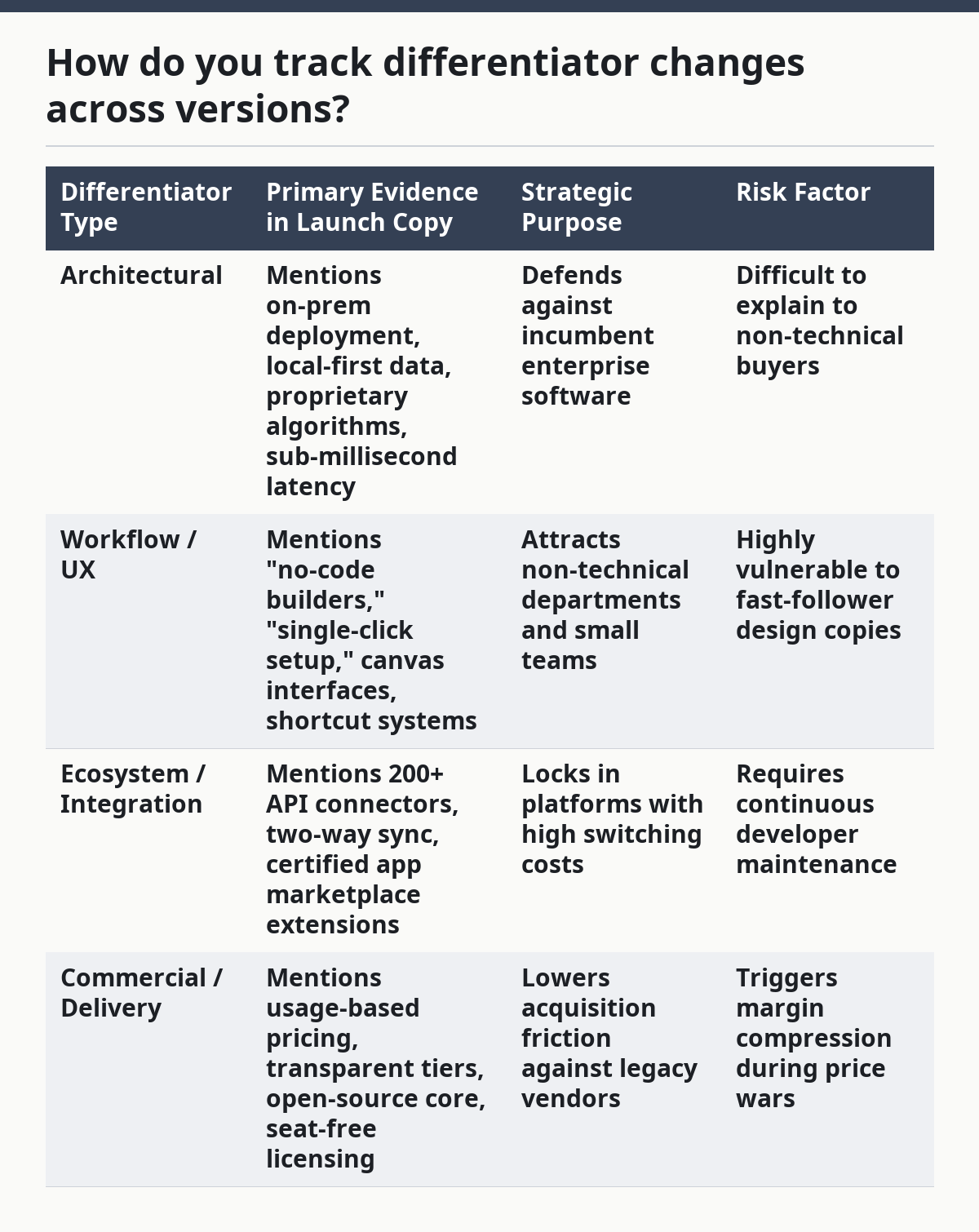
When mapping changes, note when a product drops an architectural differentiator in favor of an ecosystem differentiator. This specific change regularly happens around month 18 of a SaaS lifecycle, signaling that the proprietary technology has stabilized into an industry standard and the company must now build network effects to prevent customer defection.
Tracking the frequency of differentiator revisions also highlights team confidence. A product that changes its core differentiator three times in an 8-month period is struggling to establish a sustainable market advantage, cycling through positioning angles to discover an underserved buying persona.
What mistakes distort launch narrative analysis?
The most common mistake that distorts launch narrative analysis is treating decorative conversion copy as a genuine positioning shift. Conversion rate optimization experiments often swap button colors, test clickbait hero text, or alter seasonal headlines without changing the company’s underlying commercial thesis. If an analyst logs a 14-day holiday promotion headline as an intentional shift in problem framing, the narrative map becomes noisy and inaccurate.
Another frequent failure is analyzing launch assets out of chronological sequence, especially when dealing with retroactive content marketing. Startups regularly update old blog posts with fresh product imagery and revised slogans to capture search traffic, overwriting their own historical record. Relying on live URLs without verifying the original publication state through an indexed archive like the Library of Congress Web Archiving Program guidelines leads to inaccurate conclusions about when a particular messaging change actually occurred.
Finally, narrative mapping fails when analysts evaluate product launch messaging in total isolation from pricing changes. Messaging rarely evolves in a vacuum. A significant adjustment in promise statements—such as moving from “Free forever for individuals” to “Built for SOC 2 Type II compliant organizations”—almost always accompanies a restructuring of tier thresholds and seat minimums.
[Common Analytical Traps]

├── Logging temporary A/B test copy as a strategic repositioning

├── Parsing overwritten historical blogs instead of archived HTML

└── Mapping messaging shifts without checking simultaneous pricing changes
Analyzing copy changes alongside real commercial pricing changes prevents misinterpreting tactical marketing tests as genuine product strategy revisions.
Who should not use a launch narrative map?
Early-stage startups operating before product-market fit should not invest time in building launch narrative maps. Teams operating prior to their first $500,000 in annual recurring revenue routinely change their value propositions week by week based on single discovery calls. Documenting these rapid, unvalidated micro-shifts creates administrative documentation overhead without yielding actionable market intelligence.
This framework is also unsuitable for tracking highly regulated horizontal commodities or utility software where the problem framing remains entirely static for decades. In markets such as pure-play SFTP hosting or transactional SMTP relay services, the underlying consumer problem and core promise do not fundamentally change over time. The launch copy in these verticals changes purely for cosmetic modernization, not strategic category repositioning.
Teams lacking the resources to extract at least four sequential historical baselines should also avoid this method. A narrative map requires a baseline, an iteration, and an inflection point to produce meaningful strategic signals. Without multi-quarter source material, attempting to map message evolution generates speculation rather than reliable competitive intelligence.
Frequently asked questions
How do you map changes in launch messaging?
You map changes in launch messaging by gathering historical public assets, including homepage hero modules, launch blogs, and changelogs, arranged chronologically. For each release, extract the target problem, the core promise, and the stated differentiator into dedicated columns. Comparing these columns across consecutive quarters exposes where the commercial argument shifted from tactical efficiency to enterprise risk, or where competitive pressure forced a new value proposition.
What is a launch narrative map?
A launch narrative map is a chronological matrix that tracks how a software company repositions its problem framing, promise statements, and technical differentiators over time. It documents strategic positioning shifts rather than internal engineering sprints. By analyzing changes across release assets, the map reveals adjustments in ideal customer profiles, pricing strategy, category definitions, and competitive moats across the full commercial product lifecycle.
How do you compare positioning across launch assets?
To compare positioning across launch assets, parse the text into three structural layers: the problem statement, the transformation promise, and the operational mechanism. Compare these components across simultaneous distribution channels, such as the homepage hero module, the technical changelog, and external PR releases.
Drafted with AI; not yet reviewed by a person.