





How to Build a SaaS Content Retirement Framework for Merges, Redirects, and Deletions: A content retirement framework tells you which SaaS pages to merge…
Last updated: November 17, 2026
A content retirement framework tells you which SaaS pages to merge, redirect with a 301, or delete so old URLs stop competing with better ones. It works best when you already know your pages, their purpose, and the destination for each old URL. If the page belongs to the hub on SaaS content operations and workflow systems, this is the part that decides what gets removed, what stays, and what points elsewhere.
Key takeaways
- A retirement framework is a decision system, not a cleanup sprint.
- Use merges for pages with the same intent, redirects for URLs that still have useful signals, and deletions for pages with no useful role left.
- Treat URL retirement as a routing job: every old page needs a clear next step or a clear reason to disappear.
- Keep the rules simple enough that a second person can apply them the same way a month later.
- The hardest part is not the redirect itself; it is deciding when a page still deserves to exist at all.
What is a content retirement framework?
A content retirement framework is a set of rules for what happens to obsolete articles, merged pages, and retired URLs. It gives one answer to three questions: keep, consolidate, or remove.
For SaaS teams, this matters because old pages often split ranking signals, attract stale links, or keep showing the wrong product details. A framework prevents one-off decisions. It also makes it easier to explain why a page got a 301 redirect instead of a deletion, or why two posts were merged into one stronger page.
The framework should be simple enough to apply in one sitting, but strict enough to survive handoffs. A page with a current use may stay. A page with overlapping intent may move into a merged page. A page with no value and no links may be deleted. That sounds blunt, but a messy middle usually hurts more than a clean decision.
This is a content operations tool, not a publishing style rule. It does not tell you how to invent new topics or how to refresh a live article line by line. It decides what to do when a page has outlived its job.
Who should use this framework?
This framework is for SaaS editors, content leads, and search teams that need a repeatable way to handle old URLs. It assumes you can already see your published pages and know which ones are obsolete articles, duplicates, or near-duplicates.
It also assumes you understand the basic terms. A 301 redirect sends one URL to another permanently. A merged page combines the useful parts of two or more pages into one destination. Content pruning means removing pages that no longer earn their keep. URL retirement is the end state for a page that should not remain live.
This framework is not a fit for teams that still need to figure out what exists in the first place. It also does not solve page mapping, site-wide taxonomy, or update planning. Those need their own process before retirement decisions make sense.
If a page still drives unique traffic, supports a legal need, or holds a policy that must remain public, the framework needs a human review before any delete or redirect call. In those cases, a 301 is not automatically the right move. The same goes for pages with one important inbound link from a trusted source.
How do you build the framework step by step?
You build it by defining decision rules, assigning a destination for each old URL, and checking that every action has a reason. The process is easiest when you use one spreadsheet, one rule set, and one reviewer for exceptions.
- List every candidate URL in a single sheet and tag each as live, obsolete, merged, or retired. Use one row per URL and one destination column. Verify that every URL has a status. A blank status means the page can slip through uncategorized.
- Classify the page by intent, not by topic label. Group pages by the job they do for the reader, such as comparison, definition, or feature explanation. Verify that pages with different intent are not forced into one merge. If the intent is mixed, the page may need splitting before retirement.
- Measure the overlap between pages with the same intent and mark candidates for merging. Two pages that answer the same question in slightly different ways are merge candidates, even if their headlines differ. Verify that the destination page can absorb both sets of useful sections in fewer than two separate URLs. If the destination would become a patchwork, the merge is weak.
- Check each URL for backlinks, internal links, and references in product docs. A page with strong links can justify a 301 redirect to the best match. Verify that the destination preserves the reader’s path. If there is no close destination, the redirect may confuse more than it helps.
- Choose one action for each URL: merge, 301 redirect, delete, or keep. Do not leave a page in two states. Verify that every obsolete article has exactly one final outcome. If a row has two actions, the framework is too vague to run twice the same way.
- Write the redirect rule before publishing the change. Use a permanent redirect only when the old URL should not return as a standalone page. Verify that the target resolves cleanly and does not chain through another redirect. A redirect chain adds friction and makes the route harder to maintain.
- Remove the page when deletion is the right call and no useful destination exists. Confirm that the URL no longer serves the old content and that search engines can see the intended status. If the deleted page still returns content by mistake, the retirement is incomplete.
- Review the final list after the change and spot-check the top cases again after 2 to 4 weeks. That window is enough to catch a bad destination, a broken redirect, or a page that should have stayed live. If the old URL still ranks for the wrong query, the framework needs a tighter merge rule next time.
The tool that makes this usable is not a CMS button; it is the decision rule. If a second editor can take the same list and reach the same call in 10 minutes, the framework is strong enough to keep. If not, it is only a cleanup note.
Which pages should be merged, redirected, or deleted?
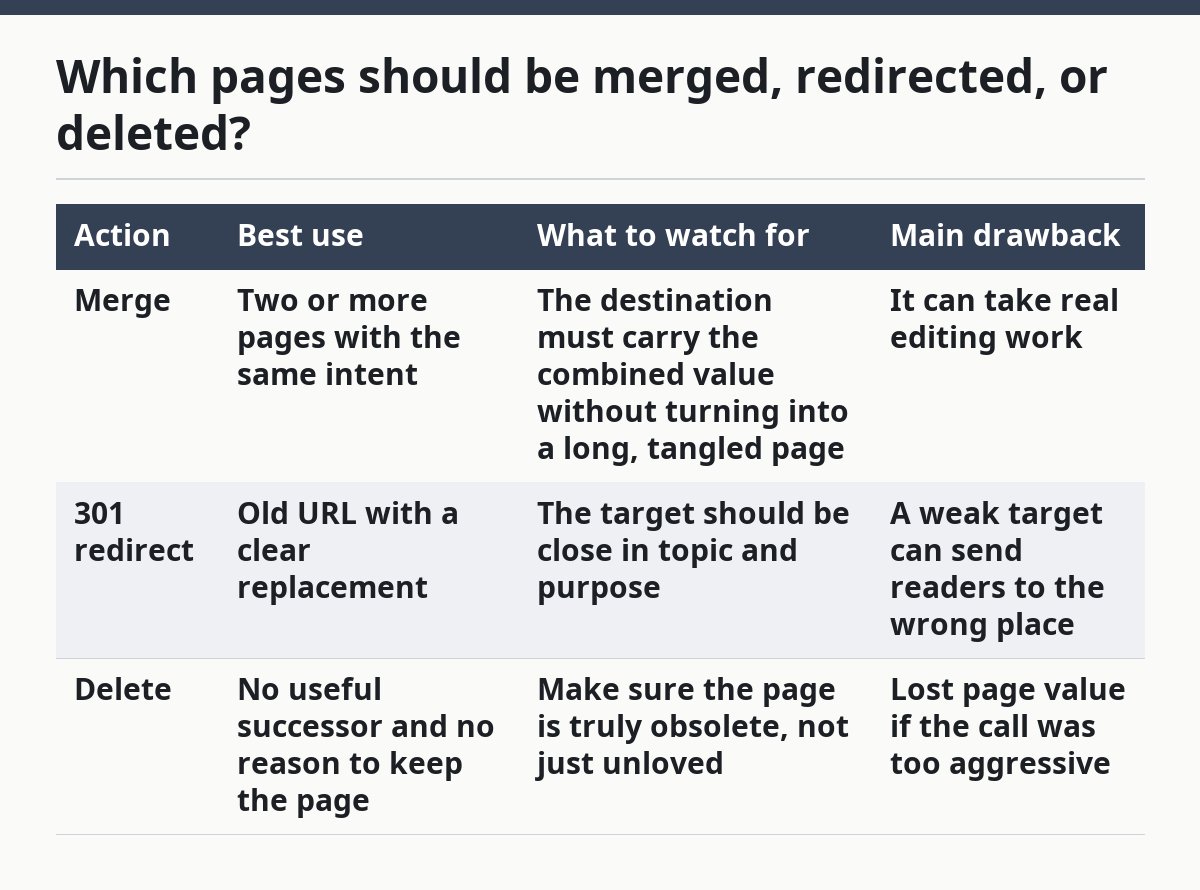
Pages should be merged when they answer the same intent, redirected when they still carry useful signals, and deleted when they have no clear value left. That is the core split, and it is more useful than asking whether a page is “good” or “bad.”
Use a merge when two pages cover the same reader question but each has useful sections that belong together. Use a 301 redirect when a page has an obvious successor and you want users and search engines to reach the newer or stronger URL. Use deletion when the page is obsolete, thin, and has no meaningful destination.
| Action | Best use | What to watch for | Main drawback |
|---|---|---|---|
| Merge | Two or more pages with the same intent | The destination must carry the combined value without turning into a long, tangled page | It can take real editing work |
| 301 redirect | Old URL with a clear replacement | The target should be close in topic and purpose | A weak target can send readers to the wrong place |
| Delete | No useful successor and no reason to keep the page | Make sure the page is truly obsolete, not just unloved | Lost page value if the call was too aggressive |
A merged page is not just a redirect with extra text. It should become the main page for that topic. A deletion is not a shortcut for indecision. It is a final call that says the page has no continuing role.
What should the redirect rules be?
Redirect rules should be strict enough that the same URL always goes to the same kind of destination. A 301 is the normal choice for permanent URL retirement, because the page is not coming back as-is.
The first rule is closeness. The target should match the original intent, not just share a keyword. The second rule is simplicity. One old URL should point to one destination, not through multiple hops. The third rule is stability. Do not aim a retired URL at a page that is likely to move again next month.
Use the redirect when the old page has links, mentions, or user value that should not be lost. Use deletion when there is no worthwhile replacement. Google Search Central and MDN both document permanent redirects and status codes, which is why this is a routing decision, not a guess.
A bad redirect rule creates a mismatch. A reader clicks one thing and lands on another. Search engines can still process that, but the user has already felt the cost. That is why the rule should be about relevance, not just preservation.
When should a page be deleted instead?
A page should be deleted when it has no useful destination, no meaningful link value, and no reason to keep serving it. That is the cleanest outcome for true dead ends.
The content is obsolete and cannot be mapped cleanly: the page refers to a feature, product state, or policy that no longer exists — delete it if no close replacement exists.
The page has thin or duplicate value: the same point already lives in a stronger merged page — delete the old copy and route attention to the main URL.
The page would mislead users if kept alive: the title, body, or promise no longer matches the product — retire it rather than redirecting to something off-topic.
The page has no useful inbound signals: there is little reason to preserve the URL for continuity — deletion can be cleaner than forcing a weak redirect.
The destination would be a bad fit: sending the old URL to a loosely related page would confuse readers — remove the page instead of pretending the match is close enough.
Deletion is the sharpest tool in the box, so it needs the most care. It is wrong for pages that still attract real traffic or still answer a real query. It is also wrong when the page is only “old,” because age alone is not a reason to remove content.
What mistakes cause the most damage?
The biggest mistakes are vague rules, bad matches, and too many half-decisions. A retirement framework fails when every page gets treated like a special case.
One common error is redirecting everything to the homepage. That often breaks intent and gives the reader a dead end in disguise. The correct alternative is a close-topic destination or a deletion if no close destination exists.
A second error is merging pages that do not share the same intent. The result is a crowded page that tries to do too much and reads like a patchwork. The correct alternative is to keep separate pages or remove the weaker one.
A third error is deleting pages that still have strong links. That can cut off useful paths and waste existing signals. The correct alternative is a 301 to the closest relevant page.
A fourth error is leaving old URLs live after a merger. That creates duplicate signals and makes it harder to know which page matters. The correct alternative is a clear retirement rule and a final redirect or deletion.
A fifth error is treating every obsolete article the same way. Some should be merged, some redirected, some removed. The framework should reflect that split, or it is just a cleanup habit with no logic behind it.
What should change in edge cases?
Edge cases need a modified rule when the normal merge, redirect, or delete choice would hide something important. Those cases are usually rare, but they matter because they are the ones that can create the worst mismatch.
If a page is legally or operationally required, keep it live or move it to the proper location rather than retiring it casually. If a page has seasonal or campaign value, use a redirect only after the campaign has truly ended. If a page has a strong backlink from a major source, prefer a close 301 over deletion so the link does not land nowhere.
If two pages are both useful but one is older and one is stronger, do not merge them just because they look similar. Sometimes the right move is to keep both and narrow the scope of each. That is not a failure of the framework; it is the framework telling you the pages are not actually duplicates.
If the team is unsure, delay the final call and mark the page for review. A bad retirement decision is harder to unwind than a delayed one. In a change set of 10 pages or 100, the hardest pages are usually the ones that almost fit the rule.
What does a good result look like?
A good result is a smaller set of pages with clearer jobs and fewer old URLs competing with them. The retired pages either point to the right destination or disappear for a clear reason.
You should be able to look at any old URL and say why it was merged, redirected, or deleted in one sentence. The framework works if the same page would get the same answer tomorrow. It also works if the site loses less confusion after the cleanup, not more.
A weak result looks tidy on paper but breaks in practice. A strong result is boring: one rule, one action, one destination, no guesswork. That is what makes content retirement useful instead of decorative.
FAQ
When should you delete versus redirect content?
Delete when the page has no close successor and keeping it live would only preserve noise. Redirect when there is a clear replacement that matches the old intent. If the page still has useful links or a clear reader path, a 301 is usually the more careful choice.
How do you retire obsolete SaaS articles?
Start by deciding whether the article should merge, redirect, or disappear. If the article overlaps with a stronger page, fold the useful parts into the main URL and retire the old one. If it has no useful replacement, remove it and make sure the old URL no longer serves the outdated content.
What happens to links after content consolidation?
Internal and external links still point to the old URL until they are updated or the redirect catches them. A 301 helps preserve the path, but it does not fix every old reference by itself. The cleaner the destination match, the less likely those links are to create confusion.
Drafted with AI; not yet reviewed by a person.