






How to Build a SaaS Content Prioritization Scorecard for Effort, Fit, and Strategic Value: Use 3 criteria, score each topic from 1 to 5, and sequence the…
Last updated: November 20, 2026
Quick Answer: Use 3 criteria, score each topic from 1 to 5, and sequence the top topics first. A SaaS content prioritization scorecard helps you rank content ideas by effort, fit, and strategic value so an editorial roadmap starts with the right topics, not the loudest requests. If your team has 20 topic opportunities and only time for a few, this is the cleanest way to decide what comes first and what stays parked.
Key takeaways
- A scorecard turns opinion into a repeatable choice, which matters when stakeholders all want different content ideas.
- The three buckets that do the most work are effort, strategic fit, and business value.
- A simple 1-to-5 scale is usually enough; more than 5 levels often slows the decision.
- The scorecard should rank topic opportunities, not replace judgment when one topic has hidden risk or a timing issue.
- The strongest output is often a sequenced editorial roadmap, not a long list of “yes” and “no” labels.
What does a SaaS content prioritization scorecard do?

A SaaS content prioritization scorecard decides which topic gets written first by comparing effort, fit, and value in one place. It gives stakeholders a shared score instead of a debate that starts over every week.
That matters because content teams rarely lack ideas; they lack a way to sort them. A scorecard lets you compare a short how-to post, a product comparison page, and a deeper buyer guide on the same 1-to-5 scale, then sort them into a sensible queue.
The scorecard is not a content brief template, a content intake workflow, or a content gap analysis. Those tools answer different questions. This one is about sequencing: which content ideas deserve the next slot in the editorial roadmap, and why.
A useful scorecard also keeps the conversation honest about trade-offs. A topic can have strong strategic value and still be a bad near-term choice if it needs heavy research, legal review, or input from three stakeholders who never answer on time. In that case, the right move is not to force it to the top. It is to document why it waits.
Two public models are worth knowing because they shape how many teams think about ranking: Intercom’s RICE-style scoring and Atlassian’s guidance on prioritization. Both point to the same basic habit: make the trade-off visible before the team spends hours on a topic. See Intercom’s RICE framework and Atlassian’s prioritization guidance for related methods. RICE prioritization framework and content gap analysis are useful companion reads.
How do you build the scorecard?
You build the scorecard by defining three to five criteria, scoring each idea on a 1-to-5 scale, and sorting the results into a ranked list. That is the core engine; the rest is cleanup around the edges.
-
List the topic opportunities you want to compare. Keep the list to a real working set, not every idea anyone has ever mentioned. Ten to 20 topics is enough for a first pass, because the goal is a decision, not a catalog.
-
Choose the scoring criteria and write a short rule for each one. Use plain language such as “low research effort,” “direct fit for our SaaS audience,” or “clear business value.” A rule matters more than a label because it keeps two people from scoring the same idea in opposite ways.
-
Use a 1-to-5 scale for each criterion. A 5 means strong alignment or high value, while a 1 means weak alignment or high effort, depending on the criterion. A five-point scale is simple enough for fast scoring and detailed enough to separate similar ideas.
-
Weight the criteria if one factor matters more. For example, strategic value can count twice if the team is under pressure to support a launch or a core product line. If you do not need weights, keep all criteria equal and move on.
-
Score each topic with the same people in the same meeting. Bring in the stakeholders who know the product, demand, and editorial limits. One person scoring in a vacuum creates drift; three people scoring together creates a better average.
-
Sort by total score, then check the top five by hand. The numbers tell you what rises first, but a quick human review catches bad fits, duplicate themes, and topics that depend on missing assets. That last check usually takes less than 15 minutes.
-
Turn the results into an editorial roadmap. Place the top topics in the next available slots, mark the middle group for later, and park the lowest-scoring ideas without deleting them. The scorecard should feed sequencing, not become a graveyard for decent ideas.
What criteria should a content scorecard use?
A good content scorecard should use effort, strategic fit, and strategic value as the main criteria, then add one or two support checks if needed. Those three cover the most important question: can the team do this, should the team do this, and is it worth doing now?
| Criterion | What it asks | Score meaning | Common signal |
|---|---|---|---|
| Effort | How hard is it to create? | 1 = heavy lift, 5 = light lift | Research time, stakeholder review, technical depth |
| Strategic fit | Does it match the plan? | 1 = weak fit, 5 = strong fit | Audience match, product line, pillar support |
| Strategic value | Will it move something important? | 1 = low value, 5 = high value | Demand, pipeline support, launch support |
| Optional check: risk | Could it slow or complicate the work? | 1 = low risk, 5 = high risk | Compliance, approvals, technical edits |
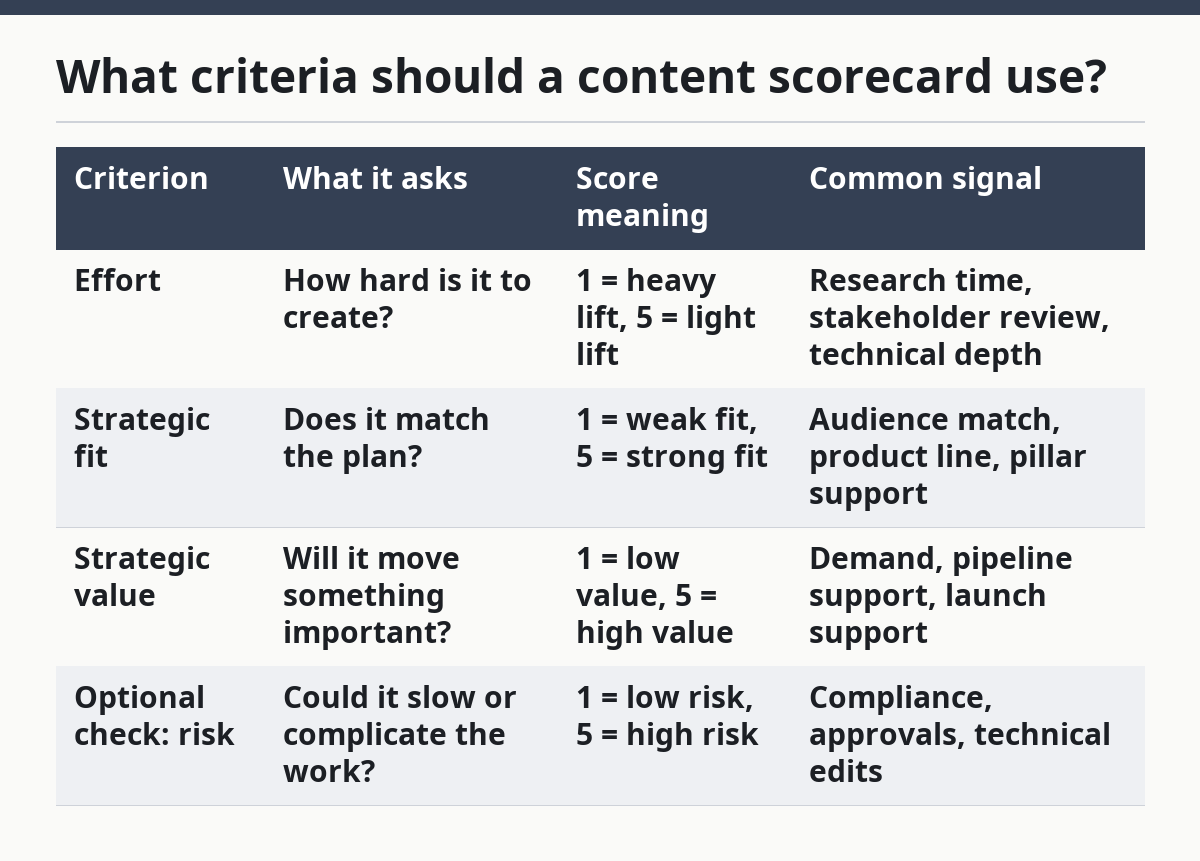
Effort should cover the real cost of making the piece, not just the writing time. A topic that needs screenshots, subject-matter review, or product input from two teams is harder than a topic that needs one writer and a clear outline. If you ignore that, your roadmap will look full and feel impossible.
Strategic fit should answer whether the topic belongs on this site, for this audience, and in this phase of the plan. A strong fit usually means the idea supports the SaaS topic planning and editorial strategy hub, fits the target reader, and can sit beside other content without breaking the site’s focus.
Strategic value should capture what the topic helps the business do. That can mean support for a launch, stronger visibility for a product area, better coverage of a buyer question, or a clearer path from public signals to content decisions. If a topic has no clear value, it should not outrank one that does.
A common mistake is to give every criterion the same weight when the business does not care about them equally. If one quarter is tied to a launch, strategic value may matter more than easy production. In a quieter period, effort may matter more because the team needs volume and consistency.
How do effort, fit, and strategic value differ?
Effort, fit, and strategic value answer three different questions, and mixing them causes bad rankings. Effort is about the cost to produce; fit is about relevance; strategic value is about payoff.
A topic can be low effort and still be a bad choice if it misses the audience or the site’s purpose. A quick post about a broad trend may be easy to write, but if the site’s job is SaaS product intelligence from public signals, that topic may not belong near the top.
A topic can also be high effort and still deserve a top spot. A deeper buyer guide or a technical comparison may take longer than a list post, but if it supports a core product line or a major editorial theme, the extra time is worth it.
The cleanest way to think about the three is this: effort tells you how expensive the bet is, fit tells you whether the bet belongs in the portfolio, and value tells you whether the bet can pay off. That framing helps a stakeholder stop saying “I like this idea” and start saying “This idea scores well enough to earn the next slot.”
If you need a simple starting rule, score fit first, then value, then effort. That order can help the team avoid pushing an easy topic ahead of a better one just because it is cheap to make, but use professional judgment or consult a qualified editor if the trade-offs are unclear. For related guidance, see Atlassian’s prioritization advice and the RICE model from Intercom.
How do you rank and sequence topics?
You rank and sequence topics by sorting scores from highest to lowest, then grouping them into next, later, and hold. That gives the editorial roadmap a practical shape instead of a single long list.
Start with the top scorers, but do not treat a one-point gap as sacred. A topic that scores 14 can be nearly as good as one that scores 15 if the lower one has less risk, fewer dependencies, or a cleaner deadline. Use professional judgment, and consult a qualified content strategist if the decision affects launch timing or resource planning. The scorecard is a guide, not a machine that decides for you.
Use tie-breakers when two ideas land in the same band. Choose the topic with the clearer audience match, the lower review burden, or the one that fills a more obvious slot in the sequence. That is often where stakeholder judgment matters most.
The point of sequencing is to create momentum. A strong roadmap usually alternates heavier pieces with lighter ones so the team does not stack three difficult topics in a row. That pattern keeps production moving and makes the list easier to defend in the next review.
This is also where the scorecard helps with stakeholder management. When sales, product, and marketing all want their idea first, the ranking shows what moved up and what did not. That does not remove disagreement, but it gives the discussion a common sheet instead of a contest of who asked loudest.
What breaks a scorecard?
A scorecard breaks when people score the same idea by different rules, or when the team treats the total as truth instead of a decision aid. The result is a neat spreadsheet that nobody trusts.
The first failure is vague criteria. If “fit” means audience relevance to one person and brand tone to another, the score is useless. Write the rule down in one sentence before scoring, even if that feels slow at first.
The second failure is too many categories. Once the sheet grows past 5 to 7 criteria, the team spends more time debating the form than choosing the topic. Most SaaS teams do better with three core criteria and one optional risk check.
The third failure is over-weighting the easiest work. A topic that takes less effort can look attractive because it is simple to ship, but that choice can crowd out more valuable work for months. That is the hidden cost of a scorecard that rewards speed without balance.
The fourth failure is skipping stakeholder input. A lone editor may not know that a “simple” topic needs product screenshots, legal review, or data the team does not have. A 15-minute review with the right people can save a week of rework.
One useful limit: this tool is not for teams that need a full topic universe map or a broad content gap analysis. It works best after the ideas already exist and the job is to order them. If the real problem is that no one knows what topics should be in play, a scorecard is the wrong first step.
Which scorecard setup should a small SaaS team use?
A small SaaS team should use the simplest version that still distinguishes hard work from high-value work. A three-criterion scorecard with a 1-to-5 scale is usually enough to start.
Keep the criteria to effort, strategic fit, and strategic value. Add a risk check only if content approval is slow or the topics are sensitive. That keeps the sheet easy to maintain when the team has limited time and only one person owns the roadmap.
Use one shared sheet, one scoring meeting, and one rule for each score. That is enough structure for a first pass and enough discipline to stop random requests from jumping the line. If the team later needs more nuance, weights can come after the basics work.
The main trade-off is speed versus precision. A simple scorecard is faster and easier to maintain, but it will not capture every detail. A more complex scorecard can be more accurate, but it may slow decisions until the team stops using it.
FAQ
How do you prioritize SaaS blog topics?
You prioritize SaaS blog topics by scoring each idea against effort, strategic fit, and strategic value, then sorting the results into a ranked list. The best topics are not always the easiest ones. The right order is the one that gives the editorial roadmap the most value for the least unnecessary work.
What criteria should a content scorecard use?
A content scorecard should use effort, strategic fit, and strategic value as the core criteria. Those three show how hard the topic is, whether it belongs, and whether it matters now. A risk check can help when reviews, compliance, or technical dependencies are likely to slow the work.
How do you rank content ideas by value?
You rank content ideas by value by scoring the business outcome each one can support, then comparing that score with effort and fit. A topic with strong demand, clear audience match, and a direct link to a business goal should rise ahead of a topic that is merely easy to produce.
Drafted with AI; not yet reviewed by a person.