





A SaaS launch channel matrix usually has 6 fields per channel and 5 core channels in a launch: blog, email, Product Hunt, LinkedIn, and X. In How to Build…
Last updated: November 16, 2026
Quick answer: A SaaS launch channel matrix usually has 6 fields per channel and 5 core channels in a launch: blog, email, Product Hunt, LinkedIn, and X. In How to Build a SaaS Launch Channel Matrix for Blog, Email, Product Hunt, and Social, the matrix keeps one offer from turning into five mismatched posts, and it gives each channel a clear job.
A SaaS launch channel matrix helps you decide what each channel does, who owns it, and which message belongs where. For a launch with blog, email, Product Hunt, LinkedIn, and X, the matrix keeps one offer from turning into five mismatched posts. If you are unsure how to adapt a launch for your audience, consult a marketing professional and review the channel guidance from HubSpot and Product Hunt’s launch resources.
Key takeaways
- A channel matrix is not a calendar. It is a map of purpose, owner, asset, and message for each channel.
- Blog, email, Product Hunt, LinkedIn, and X should not all carry the same message length or the same call to action.
- The hardest part is not writing more copy. It is deciding what each channel must say once and what it must never repeat.
- One simple matrix can help reduce mixed messaging, double posting, and last-minute approval chaos.
- A plain matrix can fit on a 1-page sheet, but the exact format should be adjusted to your team’s workflow.
What is a SaaS launch channel matrix?
A SaaS launch channel matrix is a 1-page planning sheet that assigns one launch job to each channel. It shows what the blog, email, Product Hunt, LinkedIn, and X are for, who owns each one, and how the message changes from channel to channel. For a broader planning framework, see our SaaS launch plan template.
The point is not to make every channel say the same thing. It is to keep the launch story consistent while giving each channel its own role. Blog can carry depth, email can carry urgency, Product Hunt can carry discovery, LinkedIn can carry credibility, and X can carry repetition and reach. According to Product Hunt, public launch pages are designed for discovery, which makes channel fit matter.
A generic launch plan can fail here because it treats channels as interchangeable. A blog post written like a Product Hunt submission sounds bloated. An email written like a LinkedIn post sounds vague. A matrix helps by forcing a channel-by-channel inventory before any draft is final. If your team needs help deciding ownership or approval flow, consult a launch or marketing lead and compare it with the channel roles described by Mailchimp and LinkedIn Marketing Solutions.
Use this if you are launching a new feature, a new plan, or a new product and need the message to travel across 5 places without breaking. It is not the right tool if you only need a single announcement post or a single newsletter send.
A simple way to think about it is: one launch, 5 channel jobs, 1 message spine.
What should go in the matrix?
The matrix should hold 6 fields for each channel: purpose, audience, owner, asset, message angle, and call to action. Those 6 fields keep the sheet useful when the launch gets busy.
Use a table with one row per channel and one column per field. If the sheet grows beyond 1 page, it is usually trying to do planning, writing, and approval all at once.
| Channel | Purpose | Main audience | Asset type | Message angle | CTA |
|---|---|---|---|---|---|
| Blog | Explain the launch in full | Existing readers, search visitors | Long-form post | Problem, solution, use case | Read, learn, sign up |
| Drive direct response | Current list | Short announcement | Immediate value and action | Click through | |
| Product Hunt | Create discovery and early traffic | Makers, early adopters, startup audience | Launch page and maker comments | Product value in a compact form | Upvote, visit, try |
| Build credibility | Professional network | Post, company update, founder post | Outcome and business relevance | Comment, share, click | |
| X | Create fast reach and repeat exposure | Followers, launch watchers | Thread, short posts | Sharp benefit and proof points | Click, reply, repost |
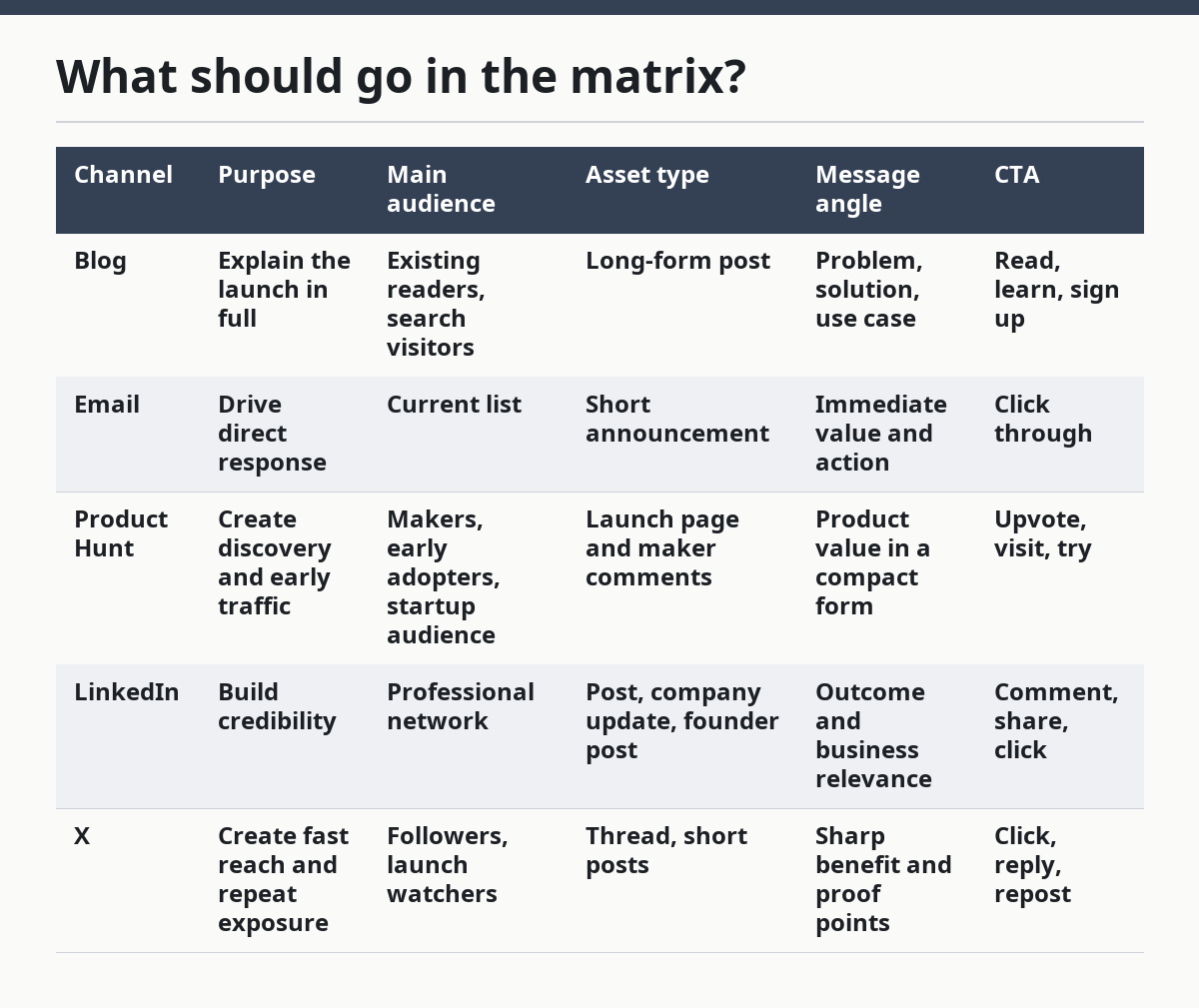
That table does one job well: it keeps each channel from swallowing the others. A blog post should not be written to satisfy X. An X post should not try to replace the blog. The matrix gives each one a lane.
The trade-off is obvious. A tight matrix leaves less room for last-minute improvisation. That is the cost of not scrambling on launch day. For a related workflow, see our launch messaging framework.
How do you build it step by step?
You build it by defining the launch story once, then mapping that story to each channel in order. The cleanest version usually takes 5 steps, but consult your team’s workflow and a launch specialist if the process needs approval gates or legal review. Content Marketing Institute and HubSpot both describe planning as a structured process, not a one-size-fits-all template.
-
Write the one-sentence launch claim. Keep it to 1 clear sentence that says what changed and why it matters. If you need 2 sentences, the message is still too broad.
-
List the 5 channels in separate rows. Use blog, email, Product Hunt, LinkedIn, and X as the base set. If a channel is missing from the row list, it will usually get forgotten later.
-
Assign one job to each channel. Give each channel a single purpose, such as educate, announce, drive traffic, or build trust. A channel with 2 jobs tends to get muddy copy and weak action.
-
Match one asset to each row. Blog gets a long post, email gets a short send, Product Hunt gets a launch page plus maker comments, LinkedIn gets a professional post, and X gets short-form updates. If an asset type does not fit the channel, the message will feel forced.
-
Set ownership and review order. Name who drafts, who approves, and who posts. For a small team, even a 3-person chain is enough to stop confusion.
-
Mark the sequencing. Decide which channel starts the story and which one follows. A common pattern is blog first for depth, then email for direct reach, then Product Hunt for public launch energy, then LinkedIn and X for amplification. The order matters because the same line means different things before and after the main announcement.
-
Add a consistency check. Compare the headline, benefit claim, and CTA across rows. They should match in meaning even if the wording changes. A launch that says 3 different things across 5 channels looks careless.
That process is useful because it turns launch writing into a set of decisions, not a pile of drafts. It is not for teams that want every channel to be fully independent. Independence creates drift, and drift is expensive on launch week.
How do blog, email, Product Hunt, LinkedIn, and X differ?
They differ in depth, speed, and expectation, so the same message should not be copied across all 5. The table below shows the practical split.
| Channel | Best role in the launch | Message length | Best for | Common mistake |
|---|---|---|---|---|
| Blog | Full explanation | Long | Product context and details | Writing too much like a press release |
| Direct action | Short | Conversions from an existing list | Burying the ask in too much background | |
| Product Hunt | Public discovery | Medium | Early attention and social proof | Treating it like a blog article |
| Business framing | Short to medium | Credibility and network reach | Sounding too promotional | |
| X | Fast repetition | Very short | Frequency and reach | Copying the same sentence in every post |
Blog gives the most room, which makes it the best place for context, examples, and the “why now” story. Email is the most direct, so it should carry the clearest action and the fewest extra lines. Product Hunt rewards a sharp value statement and active maker participation, not a wall of text; its public launch pages are built for discovery, according to Product Hunt.
LinkedIn works best when the launch is framed around outcome, team insight, or customer value. X works best when the launch story is broken into short beats instead of one long block. If you put the same 120-word paragraph everywhere, each channel will underperform in its own way.
The honest trade-off is that channel specialization takes more planning up front. The payoff is cleaner messaging and less repetition fatigue.
How do you keep the message consistent across channels?
You keep the message consistent by fixing 3 things before writing: the main claim, the proof point, and the CTA. If those 3 stay the same, the wording can vary by channel without the launch feeling scattered.
A practical check is to write a small message spine at the top of the matrix:
- Claim: what changed
- Proof: what makes it credible
- CTA: what the reader should do next
Then write each channel row from that spine. Blog may use 3 supporting sections. Email may use 2 short paragraphs. Product Hunt may compress the proof into a few lines. LinkedIn and X may each pull a different angle from the same spine.
The biggest mistake is giving every channel a different headline. That makes reporting harder and confuses anyone who sees the launch in more than 1 place. If the blog says one thing, email says another, and Product Hunt says a third, the team has not created multichannel presence. It has created inconsistency.
A second mistake is changing the CTA by channel without a reason. If the blog asks readers to sign up and X asks them to “learn more” with no clear difference, the matrix is hiding a weak decision. Choose the action first, then adjust the phrasing to fit the channel.
If you want a clean standard, keep the meaning identical across all 5 rows and change only the sentence length, tone, and amount of detail. That is the simplest way to protect message consistency without making every post sound cloned.
What mistakes should you avoid?
You should avoid turning the matrix into a content calendar, because that pushes timing over purpose. A calendar tells you when to post. A matrix tells you why the post exists and what it must say.
The second mistake is giving one person all 5 channels by default. That usually creates bottlenecks and copy that sounds the same in every row. Ownership needs to be explicit, even if the same person drafts 2 channels and another person approves them.
The third mistake is overloading Product Hunt with the same language used in email. Product Hunt is a public launch surface, not a newsletter. If the launch page sounds like a direct email blast, it will feel off to the audience that found it there.
The fourth mistake is leaving out the blog because it feels slower. The blog often acts as the source of truth, especially when the other channels need a deeper link. Without it, the team has no stable reference for the launch story.
The fifth mistake is ignoring sequencing. If X goes out first, email second, and Product Hunt later, the launch may still work, but the shape of the story changes. Sequencing matters because it controls which audience gets the first version of the message.
A good matrix can help prevent all 5 mistakes by making the launch readable in 1 pass. If a row cannot be explained in 1 sentence, that row is not ready.
Which channels should do the heavy lifting first?
The blog and email usually do the heavy lifting first, while Product Hunt, LinkedIn, and X amplify the message. That split works because blog gives depth, email gives direct reach, and the social channels extend the same story to new audiences.
Use blog first if the launch needs explanation, screenshots, or a longer value story. Use email first if the list already knows you and the goal is quick response. Product Hunt should come when the launch page and maker notes are ready to stand alone in public view.
LinkedIn is strongest when the launch needs professional credibility, not just clicks. X is strongest when the message can be broken into several short posts over a few hours or days. A 1-post plan on X is often too thin; a small series works better.
The wrong choice is to make every channel equally important. That sounds fair, but it usually makes the team weak everywhere. A matrix works because it ranks channels by role, not by vanity.
For a broader system around this kind of planning, the hub on SaaS launch intelligence systems can sit above this page and connect the channel matrix to the larger launch workflow.
FAQ
Which launch channel should you check first?
Start with the blog if you need the most complete version of the launch message. Start with email if your list is already warm and the main goal is direct action. In a 5-channel setup, the first check should be the channel that holds the source message, because the other rows should follow it.
How do you organize launch messages by channel?
Organize them by purpose, not by order of writing. Put blog, email, Product Hunt, LinkedIn, and X into separate rows, then assign one job, one owner, and one CTA to each row. That makes the matrix easier to scan than a long document with 5 mixed drafts.
What belongs in a launch channel matrix?
A launch channel matrix should include purpose, audience, owner, asset type, message angle, and CTA for each channel. It should also show sequencing, so the team knows which channel starts the story and which ones repeat it. If the sheet cannot answer those questions in under 1 minute, it is too thin or too crowded.
Drafted with AI; not yet reviewed by a person.