






How to Build a SaaS Launch Source Confidence Score for Docs, Press, and Social Posts: A launch source confidence score is a simple way to rank docs, press…
Last updated: November 17, 2026
A launch source confidence score is a simple way to rank docs, press releases, social posts, product pages, and release notes by how much trust they deserve for a launch claim. Build it on a 0–5 or 0–100 scale, give source types fixed weights, then raise or lower the score when two or more sources agree or when a claim sits only in a fast, weak post.
Key takeaways
- Put docs and release notes above social posts when the claim affects what a product actually does.
- Use one fixed scale, such as 0–5, so every source gets judged the same way.
- Cross-check at least 2 source types before you trust a launch claim.
- Treat a product page as stronger than a post, but weaker than docs when the detail is technical.
- Lower the score when the claim appears once, disappears later, or changes wording across sources.
What should the score answer?
The score should answer one question: “How much can I trust this launch claim right now?” That sounds obvious, but most teams build a score that mixes trust, speed, and importance into one mushy number. Keep the score focused on source confidence only, then use other fields for timing or impact.
A clean model works well on a 5-point scale. A score of 5 means the source is primary and stable, such as a product page, release note, or documentation page that states the claim plainly. A score of 1 means the source is weak, such as a one-line social post with no supporting detail. This keeps the score useful for launch monitoring across docs, press, and social without pretending every source should count the same.
The score should also reflect where the claim lives. A launch note buried in docs usually deserves more trust than a screenshot in a social post, even if both mention the same feature. The reason is simple: source control, edit history, and the chance of correction are usually better in owned pages than in a short post.
This page supports the hub on SaaS product launch and rollout intelligence, but this article stays on one job: building the confidence score itself.
How do you score source reliability?
You score source reliability by using a fixed rubric, scoring each source type on the same 3 factors, and then combining the points into one number. That keeps the result repeatable instead of subjective.
-
List the source in a spreadsheet and tag it as documentation, press release, social post, product page, or release notes.
A plain table is enough at this stage, and the column names should never change once you start. -
Assign a base weight from 1 to 5 for the source type.
Start with the source class before you read the claim, because a press release and a social post do not deserve the same starting point. -
Score evidence strength from 1 to 5 for how directly the source states the claim.
A source that names the feature, scope, and release context earns more than one that hints at it in marketing language. -
Adjust the score by 1 point for corroboration from another independent source, up to your cap.
If docs, release notes, and a product page all say the same thing, the score should move up. -
Subtract 1 point for ambiguity, old dates, or wording that depends on interpretation.
A claim that needs guesswork is weaker than a claim written in plain language.
A simple formula is enough for most teams: base weight + evidence strength + corroboration – penalty. Keep the final score inside your chosen range, such as 0 to 5. If you prefer percentages, the same logic works, but a 5-point scale is easier to read in a review queue.
| Source type | Typical starting weight | Why it starts there | Common penalty |
|---|---|---|---|
| Documentation | 5 | Usually the clearest owned record of how the product works | Can lag behind a live release |
| Release notes | 5 | Built to record what changed and when | Can be brief or vague |
| Product page | 4 | Often current and public | Marketing language can blur specifics |
| Press release | 3 | Useful for official intent and launch timing | Promos can overstate scope |
| Social post | 2 | Fast and visible | Short, incomplete, and easy to misread |
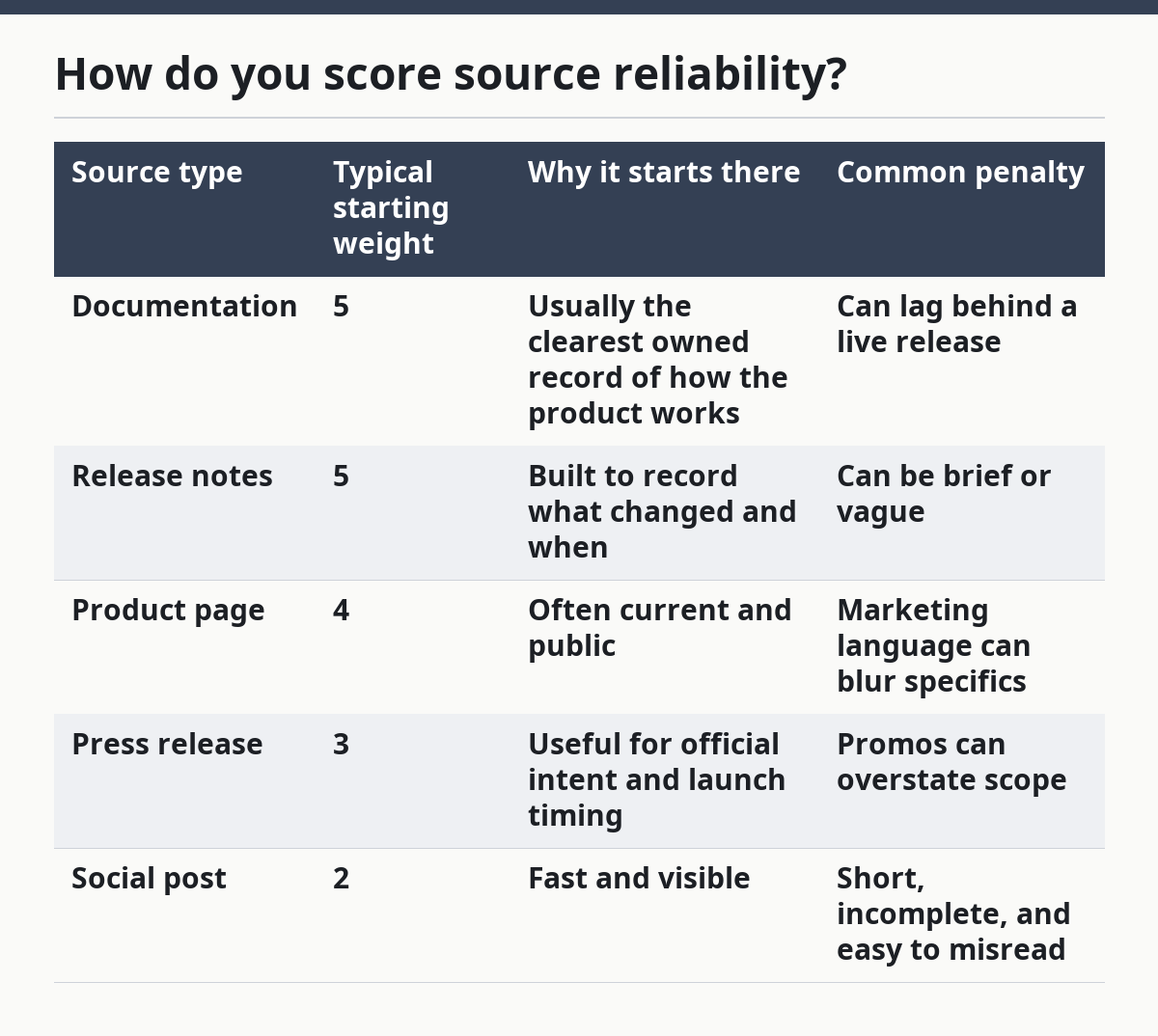
The trade-off is speed versus certainty. A social post often appears first, but first is not the same as trustworthy. If you need to know whether a launch happened, a low-confidence fast source can still be useful. If you need to know exactly what shipped, the same post should not carry much weight.
Which launch sources are most trustworthy?
Documentation, release notes, and product pages are usually the most trustworthy launch sources, but they are not always the most current. That is the main trade-off.
Documentation is strongest when it describes a feature in a stable way, because it tends to carry exact names, steps, and limits. Release notes are strong when you need a dated change record. Product pages sit in the middle: they can reflect the current offer, but they also carry sales language, so the wording may be broad.
Press releases deserve a middle score because they are official, but they are written to announce, not to prove. A press release can confirm that a launch was planned or announced on a specific date, yet it may not tell you the exact rollout scope. Social posts are the fastest source and often the weakest for confidence. They are useful as a signal, not as final proof.
A practical ranking for launch verification usually looks like this:
- Release notes
- Documentation
- Product pages
- Press releases
- Social posts
That order is not absolute. A product page can outrank docs if the docs are stale by 30 days and the page was updated yesterday. A press release can outrank a product page if the page is generic and the release names the exact launch terms. The score should reward the source that is both current and specific, not the one with the loudest headline.
How do you compare docs, press, and social in one score?
You compare them by using one source hierarchy and one penalty table, then scoring each claim the same way every time. That lets you compare a 280-character post with a 2,000-word help page without guessing.
The cleanest method is to score three layers:
- Source type: documentation, press release, product page, release notes, or social post
- Claim clarity: direct, implied, or vague
- Cross-source match: one source, two sources, or three or more
A product page that says “new workflow automation is now available” should score higher than a post that says “big news today.” The page gives the claim shape. The post gives only a hint.
Use a 3-level confidence band if you want to keep the workflow simple:
- High: 4–5, use for operational decisions
- Medium: 2–3, use for monitoring
- Low: 0–1, keep for alerting only
This is where many generic guides go wrong: they rank sources as if the same source type always wins. It does not. A stale doc page can mislead you more than a fresh press release, and a detailed social thread can sometimes beat a vague product page. The score should reflect that tension, not flatten it.
How should cross-source validation change the score?
Cross-source validation should raise the score when two or more independent source types point to the same launch claim. It should lower the score when the sources disagree on wording, date, or feature scope.
A good rule is simple: one source can start the score, two sources can stabilize it, and three sources can make it strong enough for action. That does not mean three sources always equal truth. It means the chance of a one-off mistake drops when the claim appears in documentation, release notes, and a product page instead of only in a social post.
Use this table to keep the logic consistent:
| Pattern | Score change | What it means |
|---|---|---|
| One weak source only | Lower by 1–2 points | Treat as a signal, not proof |
| One strong source only | Keep base score | Usable, but still watch for follow-up |
| Two matching sources | Raise by 1 point | Claim is getting support |
| Three matching sources | Raise by 2 points | Claim is likely stable |
| Two sources conflict | Lower by 2 points | Do not trust without review |
The main drawback of cross-source validation is delay. If you wait for every source to agree, you may miss early rollout signals. If you trust the first source too much, you can overcall a launch that later changes. The answer is not to choose one or the other. It is to give each source a score that reflects both speed and certainty.
What mistakes break the score?
The biggest mistakes are mixing source confidence with launch importance, using no fixed scale, and treating every source like a yes-or-no checkbox. Those errors make the score look precise while hiding the real judgment.
One common mistake is giving a press release the same score as release notes because both are official. That costs you accuracy. Press releases often describe intent; release notes describe change. Another mistake is giving social posts too much weight because they appear first. That costs you trust, especially when the post uses vague launch language or a single screenshot.
A third mistake is never penalizing outdated pages. A product page with no visible update can still look polished, but polish does not equal freshness. If the page and release notes disagree, the score should drop until the conflict clears. A fourth mistake is scoring every claim in the same way, even when the claim is technical, commercial, or timing-related. One source may be strong on timing and weak on scope.
What to do instead is keep a short rulebook with 3 parts:
- source type weight
- evidence strength
- corroboration penalty or bonus
That is enough for most teams. If the rubric grows past 10 rules, people stop using it and start arguing about edge cases.
When should you trust the score less?
You should trust the score less when the source is vague, the claim changes across pages, or the launch message is promotional rather than factual. Those are the moments when a score can still help, but only as a filter.
Social posts are the clearest example. A post can point you toward a launch within minutes, but it often leaves out scope, limits, and rollout timing. Press releases have the opposite problem: they are cleaner but can read like a pitch deck. Product pages can drift between sales copy and product truth, which makes them useful but not final.
A good check is to ask whether the source could stand alone if the other sources vanished for 24 hours. If the answer is no, lower the score. If the source names the feature, the date, and the change in plain language, keep it higher.
This is also where this page differs from a source watchlist or an evidence scorecard. A watchlist tells you what to track. A confidence score tells you how much to trust what you found. That line matters, because a launch team that blurs the two ends up with a dashboard full of noise.
FAQ
How do you score source reliability?
You score source reliability by starting with a fixed weight for the source type, then adjusting for clarity and corroboration. A 0–5 scale works well because it is easy to apply to documentation, press releases, product pages, release notes, and social posts without turning every review into a debate.
Which launch sources are most trustworthy?
Documentation and release notes are usually the strongest sources, followed by product pages, then press releases, then social posts. That order can shift when a page is stale or a press release is more specific than the product page, so the score should always account for freshness and detail.
How do you compare a press release against product docs?
You compare them by asking which source is more direct, current, and specific about the same claim. Product docs usually win on technical detail, while a press release may win on launch timing or official announcement language. If they disagree, lower confidence until another source resolves the gap.
Drafted with AI; not yet reviewed by a person.