





How to Build a SaaS Launch Source Governance Page for Review Rules, Ownership, and Escalation: A SaaS launch source governance page is the single place…
Last updated: November 17, 2026
A SaaS launch source governance page is the single place that says which launch signals count, who approves changes, and what happens when sources disagree. Build it as an operating page, not a policy memo: list the source, the owner, the review rule, and the escalation path in one place.
Key takeaways
- The page exists to stop launch signal drift, not to document every process in the company.
- One source needs one named owner, one reviewer, and one clear fallback when a signal conflicts.
- Review rules should say what gets checked, when it gets checked, and what happens if the evidence changes.
- Escalation works best when it is short: analyst to editor to product marketer, then to the source owner.
- If a rule takes more than a few lines to explain, it probably belongs on another page.
What should this page do?
This page should tell a reader, in under 5 minutes, whether a launch signal can be trusted today. It should name the source, the source owner, the editor or analyst who checks it, and the rule for approval or escalation.
That sounds simple, but the page has a narrow job. It is not the place for a full editorial policy, a content SLA, or a claims scorecard. Those are sibling pages in the same cluster. This page stays focused on source maintenance for launch signals, so the team can use it during release tracking without digging through three other docs.
The best version is practical and short. Think in rows, not essays: source name, signal type, owner, review cadence, approval rule, conflict rule, and escalation contact. A 1-page or 2-page layout usually works better than a long handbook because the people using it are checking a release, not studying process.
A generic governance page often fails here because it mixes three jobs: ownership, review, and change control. Split them in the text even if they live on the same page. That makes the page readable for an editor, an analyst, a product marketer, and a researcher, each of whom needs a different answer from the same source.
How do you set the source list?
You set the source list by naming only the signals that actually drive launch decisions, then classifying each one by type and risk. Start with the sources tied to product releases, pricing changes, feature flags, landing pages, changelogs, docs updates, app store notes, or partner announcements.
Use a simple list with 4 fields for each source: source name, signal type, owner, and update trigger. If a source changes daily, mark it daily. If it changes only when a release lands, mark it by event. Do not add vague buckets like “important sources” or “other channels”; those are how pages get cluttered and then ignored.
A useful filter is this: if a source cannot affect a launch decision within 24 hours, it probably does not belong on the launch source governance page. That keeps the page tight and keeps maintenance work inside a manageable scope. It also protects the analyst from being buried in low-value sources.
The trade-off is obvious. A smaller source list is easier to run, but it can miss edge signals. A larger list catches more change, but it slows review and creates more conflicts. Pick the list size based on how many signals the team can actually inspect in one cycle, then write that limit into the page.
Who owns launch source tracking?
Launch source tracking should have one source owner, one reviewer, and one escalation contact, not a shared pile of names. The source owner is responsible for accuracy, the reviewer checks the rule, and the escalation contact makes the final call when the source is disputed.
This is where many pages get messy. If a source has three “owners,” no one knows who updates the record when a signal changes. If an analyst owns the check but the product marketer owns the release note, the page must say which person resolves a mismatch. A clean ownership line prevents the “I thought you had it” problem.
A simple ownership model works well:
- Source owner maintains the source record.
- Analyst checks the signal and flags drift.
- Editor confirms wording, naming, and format.
- Product marketer decides whether the signal changes launch interpretation.
- Researcher adds context when the source needs outside evidence.
You do not need all five on every source, but you do need to name who is active and who is backup. If the primary owner is away for 3 days, the page should show the backup. Without that, a launch can sit in limbo while someone waits for approval that never comes.
What review rules belong on the page?
Review rules belong on the page when they tell someone exactly what to check before a source is marked approved, changed, or retired. The rule should name the check, the standard used, and the result expected after the check passes.
This is the right place for a small, rigid rule set. Use language such as “review source name against the current launch note,” “confirm the date on the release item,” or “verify the signal still matches the product surface.” If the source is cited in more than one place, say which version wins when the versions differ.
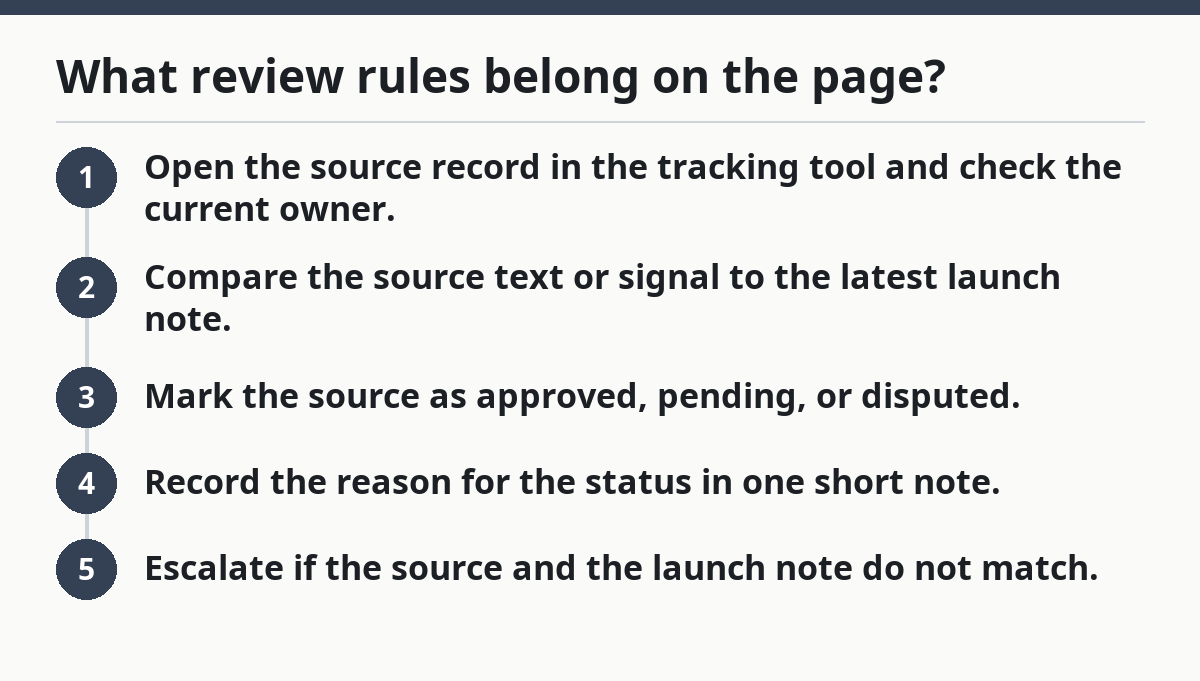
A practical way to write the rule is as an ordered list:
- Open the source record in the tracking tool and check the current owner.
- Compare the source text or signal to the latest launch note.
- Mark the source as approved, pending, or disputed.
- Record the reason for the status in one short note.
- Escalate if the source and the launch note do not match.
This is the same logic used in formal requirement language such as RFC 2119, where words like “must” and “should” are used with care. The point is not legal style; the point is consistency. The page should read like a rulebook, not a brainstorm.
How do you handle conflict and escalation?
You handle conflict and escalation by giving each disagreement a path that takes no more than 3 handoffs. When a source signal conflicts with another signal, the analyst flags it, the editor checks the record, and the product marketer or source owner makes the decision.
The page should say what counts as a conflict. A conflict might be a pricing page that changed but a launch note that did not, or a feature mention that appears in one channel but not another. Name the kind of mismatch, then name the order of review. That keeps the team from debating whether a disagreement is “real enough” to escalate.
A clear escalation line usually looks like this:
- Level 1: analyst checks the source record.
- Level 2: editor checks naming, date, and wording.
- Level 3: product marketer or source owner decides whether the source is approved, changed, or paused.
If you want the page to stay useful, do not let escalation become a meeting request. The outcome should be a status update, not a discussion thread that runs for 2 days. Put the decision field on the page so the next person can see what changed and why.
The trade-off is speed versus certainty. Fast escalation keeps launch tracking moving, but it can miss context. Slower escalation gives a fuller read, but it can delay updates. This page should state which side wins for launch signals, because different teams make different calls here.
What should the maintenance duties be?
Maintenance duties should say who keeps the page current, how often it is checked, and what gets retired. If the page names 10 sources, it should also name the duty that keeps those 10 sources from becoming stale.
The maintenance section should cover 4 tasks: add new sources, retire dead sources, review conflicts, and confirm owners. That is enough for most teams. If the page goes beyond that, it starts to turn into a process manual, which makes it harder to use during a launch.
A useful maintenance schedule is event-based plus periodic:
- Event-based when a source changes, a launch lands, or ownership shifts.
- Periodic when the team does a full review on a fixed cycle such as 30 days or a sprint boundary.
Keep the maintenance note short. If a source has not been touched in a while, mark it stale and send it back through review. Do not leave old sources in active status just because nobody has looked at them. Stale sources create false confidence, and false confidence is the fastest way for a launch page to stop being trusted.
This is also the place to note who closes the loop. A researcher may find the new signal, but the source owner should close it. An analyst may spot the conflict, but the editor should record the approved state. That split is what keeps the page from becoming one person’s private notebook.
How should the page be structured?
The page should be structured as a short reference page with a table at the top and rules below it. A 2-part layout works well: first the source register, then the governance rules that explain how the register changes.
The table is the part people use most. A simple layout with 6 columns is enough: source, signal, owner, reviewer, approval rule, escalation path. If you want to add a seventh column, use “last checked.” That gives the reader a fast way to tell whether the page is live or stale.
A plain-text block can sit below the table for the exceptions. Keep the exception block small and concrete. For example, if a source is approved only after two checks, say that. If a source must be rechecked after a product update, say that too. The goal is to make exceptions visible without forcing the reader to scan the whole page.
The honest downside of a tight structure is that it can look dry. That is fine. A governance page is not supposed to persuade anyone. It is supposed to settle a question fast, the way a good checklist does. If it looks too lively, it probably contains too much prose.
What should you avoid?
You should avoid vague rules, duplicate owners, and approval language that nobody can apply in 1 minute. A governance page breaks down when it says “review carefully” instead of naming the exact check.
Three common mistakes show up again and again. First, the page lists sources but not owners, so no one knows who updates the record. Second, it names a reviewer but not the approval rule, so every change becomes a judgment call. Third, it creates an escalation path with no final decision maker, which turns disputes into open loops.
The fix is to make every row answer the same 4 questions: who owns it, who checks it, what counts as approval, and what happens if it conflicts. If one row cannot answer those questions, the row is incomplete. A page with 8 complete rows is more useful than one with 20 half-finished ones.
This page is not for teams that want a broad editorial policy or a full evidence model. Those needs belong on their own pages. If this page tries to do everything, it stops being the source of truth and becomes another place where people guess.
FAQ
Who should own launch source tracking?
The source owner should own launch source tracking, with an analyst and editor supporting the check. That keeps the record tied to one accountable person instead of a loose group. If the source affects a release decision, the product marketer should also be named as the decision contact when the signal is disputed.
What rules govern source updates?
Source updates should follow a short rule set that says what gets checked, what counts as approval, and when a source is marked stale. The rule should name the current launch note or source of truth, then state what happens if the source no longer matches it. A simple 5-step review process is enough for most teams.
How do you escalate disputed launch signals?
You escalate disputed launch signals from analyst to editor, then to the product marketer or source owner for the final call. The page should name the conflict type, the reviewer at each step, and the expected result. If the dispute takes more than 3 handoffs, the page is too vague and needs revision.
Drafted with AI; not yet reviewed by a person.