






How to Build a SaaS Launch Source Triage Matrix for Press Releases, Docs, and Social Posts: a SaaS launch source triage matrix usually ranks 5 source…
Last updated: November 18, 2026
Quick Answer: a SaaS launch source triage matrix usually ranks 5 source types, gives each one a first-review order, and lets a team settle most launch checks in under 5 minutes. A SaaS launch source triage matrix tells you which launch signal to review first when press releases, product docs, blog posts, and social posts all mention the same release. It gives each source a rank, a reason, and a review order so one launch does not get documented four times.
Key takeaways
- Therefore, put source order ahead of source volume, or you will waste time on repeat signals.
- Treat product docs as the anchor only when they describe the shipped feature, not the tease, and check that judgment against the source mix you have.
- Give press releases and social posts a role, but do not let them outrank the source that names the change in plain language.
- Resolve duplicates by choosing one primary source and one backup source, not by averaging everything.
- A good matrix is short, repeatable, and tied to the same review path every time.
What should the matrix do?
A launch source triage matrix should tell you which public source to check first, which one to use as backup, and which one to ignore unless the first two conflict. That is the whole job: reduce review order to a simple rule that works for press releases, product documentation, blog posts, social media posts, and release announcements.
The matrix is not a coverage map, a confidence score, or an audit trail. It does not try to list every channel or track every retrieval step. It only answers the question, “Which source deserves first review when the same SaaS launch appears in more than one place?” That difference matters because a launch team can have 5 signals and still need only one source of truth for the first pass.
A useful matrix usually has 4 fields: source type, expected signal strength, duplicate risk, and review priority. A line for product documentation might say “highest priority when it names the shipped change.” A line for social posts might say “fast to detect, low priority unless it links to docs or a release note.” That keeps the matrix usable on a phone screen and in a spreadsheet with only a few columns.
Therefore, the honest trade-off is speed versus certainty. If you want the quickest review, you will trust the source with the clearest change description. If you want the safest write-up, you will usually spend longer checking whether a press release says the same thing as the docs, and for high-stakes decisions you should consult a qualified reviewer or professional editor. A matrix works only when it makes that trade-off visible.
For a broader workflow around this kind of research, the hub on SaaS product launch intelligence and release tracking sits above this page.
How do you build one?
You build a SaaS launch source triage matrix by listing the source types, ranking them by reliability for a launch claim, and assigning a single first-review path for each type. The matrix should be simple enough to use in under 5 minutes and strict enough that two people would make the same first choice.
- List the source types in a spreadsheet with one row each: press releases, product documentation, blog posts, release announcements, and social media posts.
- Rank the rows by how directly each source describes the shipped change, not by how polished it looks.
- Label each row with its role: primary source, backup source, or alert source.
- Assign a review order number so the team knows which source to open first when the same launch appears in several places.
- Add a duplicate rule for each row, such as “skip if docs and release note match” or “escalate if social only mentions the launch without feature details.”
- Store the matrix where the team already works, then review it after a few launches to remove rows that never change the decision.
Because of that, the safest starting point is usually product documentation, because it is often the most likely place to spell out the shipped behavior in plain terms, though teams should still verify it against the release announcement or another official source. Press releases often frame the launch for public relations, so they may lead with market language instead of the exact feature change. Blog posts can be useful, but they often sit between docs and social in priority. Social posts are best treated as alerts, not final evidence, unless they point back to the docs or release announcement, and for a disputed launch you should consult a professional reviewer if the stakes are high.
A good matrix also includes one note about timing. A release announcement posted on the same day as the docs can outrank an older blog post if the blog still describes the pre-launch state. That usually prevents stale pages from taking priority just because they are longer or easier to find, though a reviewer should still check the dates and the actual shipped state.
Which source should come first?
The first source should be the one that describes the shipped feature in the least ambiguous way, which is often product documentation or a release announcement. That is the source most likely to tell you what changed, while press releases and social posts often tell you why the company wants you to care.
Here is a simple way to rank the common source types for launch review:
| Source type | Typical role | What it is good for | Main risk |
|---|---|---|---|
| Product documentation | Primary | Exact feature behavior and naming | Can lag a public announcement |
| Release announcement | Primary or backup | Launch date and official wording | May be brief and light on detail |
| Blog post | Backup | Context, examples, and rollout notes | Can mix marketing language with product facts |
| Press release | Backup | Public positioning and partner mentions | Often polished, not precise |
| Social media post | Alert | Early mention and link discovery | Too short to stand alone |
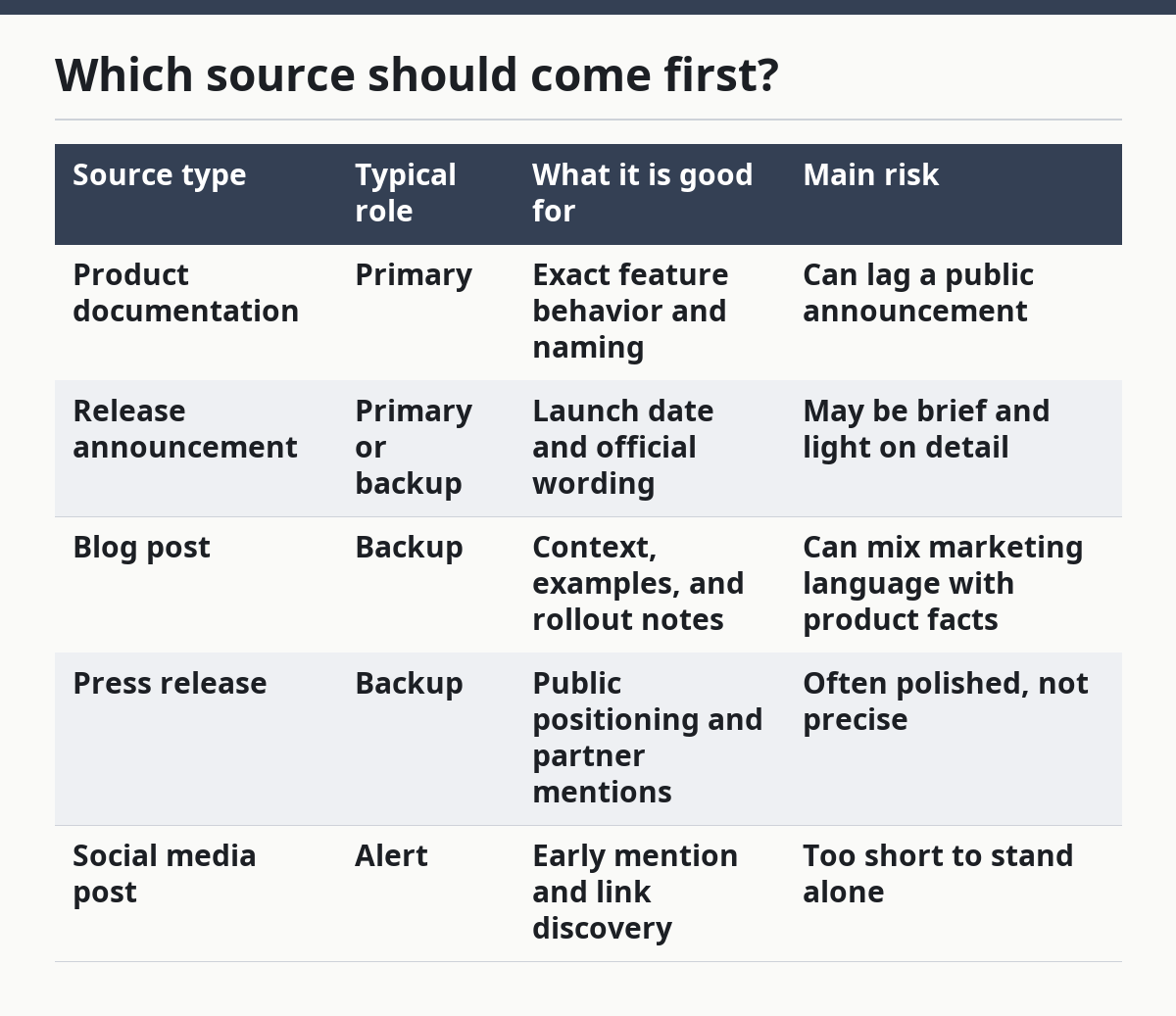
The matrix should reflect the job you are doing. If you are tracking what a launch actually does, docs outrank a press release. If you are trying to spot a launch early, social can come first as an alert source, but it should not become the final source of record.
Specifically, one useful rule is to give each source a 3-part test: does it name the feature, does it describe the change, and does it point to another official source? A source that passes all 3 is stronger than one that only announces the launch. That rule also makes duplicate handling easier because you can see which source adds new detail and which one repeats it.
The trade-off here is that a highly polished source can still be weak evidence. A press release may look complete, but if it never explains the actual product change, it should not outrank documentation. The matrix should reward specificity, not polish.
How do you handle duplicates?
You handle duplicates by choosing one primary source, one backup source, and one discard rule before you start writing. That prevents the same launch from being treated as four separate events when it is really one release expressed in four formats.
A clean duplicate rule usually has 3 parts. First, pick the highest-priority source that names the shipped change. Second, keep one lower-priority source only if it adds a missing detail such as a rollout note or official date. Third, discard sources that repeat the same claim without adding new information. That is enough for most launch reviews.
Duplicate handling matters most when social posts mirror release announcements and blog posts mirror docs. In those cases, the matrix should tell you which version wins when wording differs slightly. If the docs say the feature is available and the press release says it is “coming soon,” the docs should usually win for product status, while the press release may still matter for launch framing.
A common mistake is to merge every source into one blended note. That sounds careful, but it hides which source actually carried the useful detail. It also makes later reviews harder because nobody remembers where the claim came from. The matrix should force one answer per row: keep, defer, or ignore.
Another mistake is to give equal weight to every source that links to the launch. That costs time and creates false symmetry. A social post may be the fastest signal, but speed is not the same as reliability. A matrix that treats both as equal will slow down the team and still leave the source order unclear.
If two sources conflict, the matrix should tell the reviewer to go back to the source that is closer to the shipped product, not the source with the louder headline. That keeps the process grounded in evidence instead of tone.
What makes a source reliable enough?
A source is reliable enough when it states the launch in plain terms, uses stable product naming, and matches at least one other official source. That does not mean it is perfect; it means it is useful as a first-pass source in a triage matrix.
The clearest signs of reliability are boring ones. The source names the feature, gives a concrete description of the change, and avoids vague phrases like “new experience” or “major update” without detail. Product docs and release announcements often do better here than press releases or social posts because they are built to tell users what changed, not just why the company cares.
The matrix can mark reliability with words instead of numbers if you want to keep it simple. For example, use “high,” “medium,” and “low” rather than a 1–5 scale. That keeps people from pretending the difference between two sources is exact when it is really a judgment call. A label is easier to use than a score when the team is comparing a short release note against a long blog post.
The honest limit is that source reliability is context-dependent. A release announcement may be the best first source for one launch and a weak one for another. That depends on whether it describes the actual product change or just the company story around it. The matrix should make room for that shift instead of freezing every source into one permanent rank.
If you want to keep the matrix simple, do not add extra columns for every possible nuance. Two or three decision fields are enough for most teams. Once the sheet becomes a catalog of edge cases, people stop using it.
What does a good matrix look like in practice?
A good matrix looks like a short spreadsheet that anyone can read in 30 seconds and use in 1 pass. It should show source type, first-review order, duplicate rule, and a one-line reason for the rank. If a row needs a paragraph to explain itself, the matrix is too complicated.
Here is a workable pattern:
- Product documentation: first review when it clearly describes the shipped feature.
- Release announcement: second review when docs are thin or delayed.
- Blog post: third review when it adds rollout context or use cases.
- Press release: fourth review when you need the official public framing.
- Social post: first alert only, unless it links to stronger sources.
That order is not universal, and it should not pretend to be. A launch matrix is only useful when it matches the team’s review habit and the source mix it actually sees. If your launches often appear first in social, the matrix should say so. If your docs are always the clearest source, the matrix should say that too.
The best test is simple: when 2 people use the matrix on the same launch, do they pick the same first source? If the answer is no, the row labels are too vague or the review order is too loose. Tighten the rule before adding more sources.
A matrix like this is not for teams that want one perfect number for source trust. It is for teams that want to stop arguing about where to start. That makes it useful for launch tracking, but not for deep evidence scoring or full source lineage work.
Which launch source should you trust first?
I trust the source that describes the shipped change most directly, which is often product documentation or a release announcement. That source usually tells you what the feature does, not just how the company wants it framed.
If the docs and the press release disagree, the matrix should send the reviewer back to the more product-specific source first. A polished headline does not outweigh a clearer feature description.
How do you decide between conflicting launch sources?
You decide by favoring the source that is closer to the product and by keeping one backup source for comparison. If a blog post, press release, and social post all describe the same launch differently, the matrix should point to the source with the clearest feature language.
The practical rule is to keep the most specific source and mark the others as supporting or secondary. That keeps the review order stable instead of turning every conflict into a fresh debate.
What makes one launch source more reliable than another?
One source is more reliable when it names the feature clearly, matches the shipped state, and does not rely on vague promotional language. Product documentation often wins here because it is written to explain the product, not sell the story around it.
Press releases and social posts can still be useful, but they are usually better as alerts or context than as the first source to trust. The matrix should rank them lower unless they point back to stronger product evidence.
Helpful source references
For general content quality and source discipline, the Google Search documentation on helpful content is a useful reference: Creating helpful, reliable, people-first content. For public release language and announcement style, the Associated Press Stylebook is a familiar reference point, even when the launch write-up is not a news story.
Those references do not build the matrix for you. They do help keep the source order tied to clarity, specificity, and reader value instead of hype.
Drafted with AI; not yet reviewed by a person.