






SaaS contract operations is the 5-part workflow that keeps software contracts moving from draft to signature to renewal without losing money, time, or…
Last updated: November 18, 2026
Quick answer: SaaS contract operations is the 5-part workflow that keeps software contracts moving from draft to signature to renewal without losing money, time, or control. This guide to SaaS contract operations — The Complete Guide is for SaaS teams that sell recurring deals, handle amendments, and need a clean handoff between sales, legal, finance, and customer success. I write about software operations and vendor risk, so this guide stays focused on the contract work that shows up in real SaaS teams, not theory.
Key takeaways
- SaaS contract operations is the process layer around contracts, not just the contract text.
- It matters most when renewals, amendments, and approvals start crossing team lines.
- A good setup cuts delay, reduces missed renewals, and makes contract terms easier to find later.
- The biggest failure is not legal risk alone; it is broken handoffs between sales, legal, finance, and CS.
- Small SaaS companies can start simple, but they still need one owner, one workflow, and one place to store contract truth.
What is SaaS contract operations?
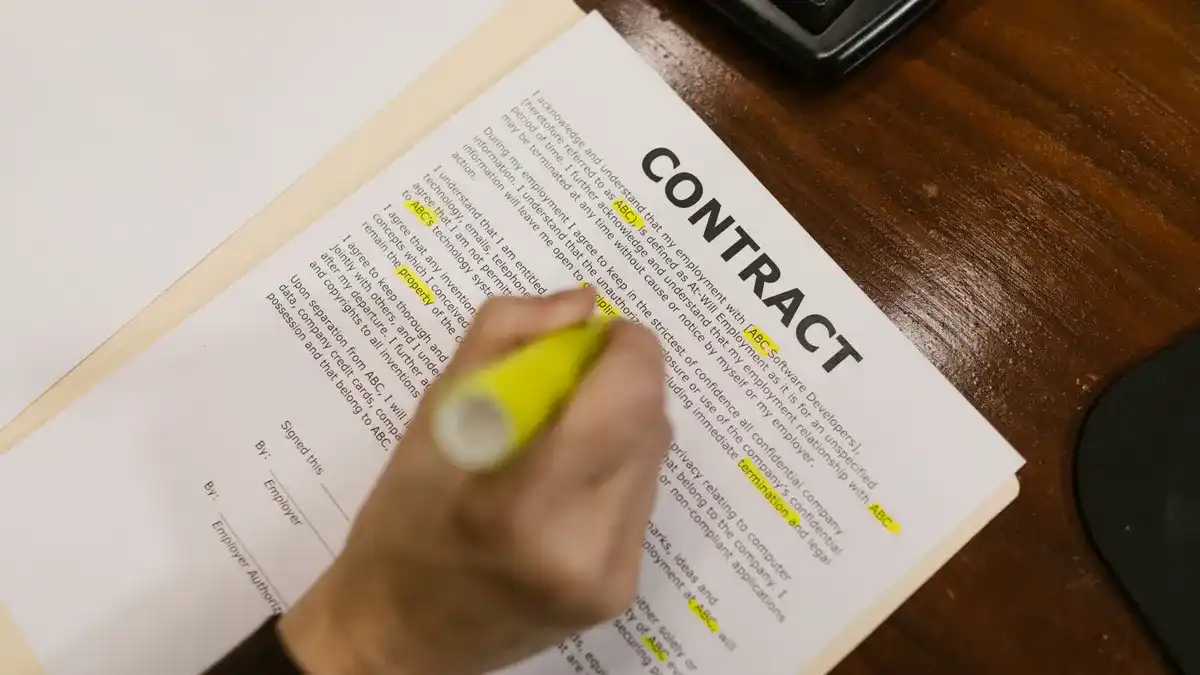
SaaS contract operations is the set of people, steps, and systems that manage contract work across the full life of a software deal. It covers drafting, redlining, approvals, signature, storage, renewal tracking, and the changes that happen after signature, such as an amendment, expansion, or termination notice.
In plain terms, it is the control room for the contract lifecycle. Sales wants a deal closed, legal wants terms protected, finance wants billing aligned, and customer success wants renewal risk visible. Contract ops ties those needs together so the same MSA, DPA, order form, and renewal date do not get lost in four different inboxes.
The job is broader than contract administration. Contract administration usually means keeping documents organized and dates tracked. Contract operations also looks at flow: which clauses slow deals, which approvals repeat, which fields should be standard, and where the system breaks when volume rises. That is why SaaS contract ops often sits close to CLM software, CRM data, billing records, and approval policies.
A simple way to think about it is this: legal writes or reviews the rules, while contract ops makes the rules usable at scale. In SaaS, that matters because contracts are not one-off purchases. They renew, expand, shrink, and change form more often than most other B2B agreements.
The core deliverable is not a document. It is a reliable path from request to signed contract to managed obligation. If the team cannot tell, on the same day, who signed what, when it renews, and what changed in the last amendment, the contract operation is weak even if the paper looks polished.
According to the NIST Cybersecurity Framework, repeatable governance, ownership, and documented controls matter in systems that touch many teams; that is a useful model for SaaS contract operations even though it is not a contract standard. Another relevant reference is ISO/IEC 27001, which many SaaS buyers already recognize when they ask about vendor controls.
Why does SaaS contract ops matter?
SaaS contract ops matters because recurring software revenue is easy to damage with small process failures. A missed renewal date, a wrong billing term, or a lost redline can turn into delayed cash, confused customers, and extra legal work that never should have happened.
The strongest case for contract ops is not dramatic legal risk. It is everyday friction. A contract that takes five extra days to approve can stall a quarter. A renewal that never hits the calendar can roll over on bad terms. A DPA or security exhibit that lives in one email thread can be impossible to find when a customer asks for it six months later.
This is where SaaS differs from a one-time software license. SaaS contracts often include subscription terms, usage limits, service levels, data protection language, auto-renewal clauses, and expansion rights. Those details are not just legal decoration. They affect billing, retention, support, and the customer’s trust in the vendor.
Contract ops also helps with consistency. Without it, the same customer can end up with three versions of the truth: the redlined MSA, the final order form, and the billing system record. That gap creates disputes. It also makes it hard to answer simple questions like whether a discount expired, whether a seat count changed, or whether a notice period is 30 days or 60 days.
A good contract ops function makes the business faster in the places that matter. It does not remove legal review. It removes avoidable rework. That is the difference between a team that reacts to every contract and a team that runs a repeatable motion. For teams building that motion, a related guide on SaaS revenue operations can help connect contract flow to billing and forecasting.
The trade-off is real: contract ops adds structure, and structure takes discipline. If a company only closes a few contracts a month, a heavy process can slow the team down more than it helps. In that case, the goal is not a full enterprise setup. The goal is one clean workflow, one repository, and one owner.
Who should own it?

SaaS contract operations should be owned by one named function, usually in operations, revenue operations, legal ops, or a contract specialist role, with clear support from legal and finance. It should not sit in a shared inbox with no owner, because nobody can fix a broken workflow that nobody owns.
The right owner depends on where the pain is. If the biggest problem is clause review and risk, legal ops may fit best. If the biggest problem is revenue leakage, order form errors, and renewals, revops or finance ops may be stronger. If the team is still small, a contracts manager or operations generalist can own the process as long as legal defines the guardrails.
What matters most is decision rights. Contract ops should know which terms are standard, which need approval, which contracts need escalation, and which changes must hit downstream systems. Without that authority, the function becomes a courier service: it forwards documents but cannot solve the problem.
A clean owner also improves accountability. Sales knows where to send the paper. Legal knows what will be escalated. Finance knows which terms affect invoicing. Customer success knows where renewal dates live. That is much better than asking each team to remember the process from memory.
This role is usually not a fit for a company that treats contracts as rare events; if there are only a handful of vendor agreements and customer contracts per quarter, a dedicated operations function may be too much, and a light process with templates, naming rules, and a shared tracker may be enough. If you are unsure, consult legal or an operations professional before building a heavier model. For a broader framework, see contract lifecycle management.
The key failure to avoid is splitting ownership by department without one final process owner. A SaaS deal often touches six or more teams, but it still needs one person or team to keep the system honest. Otherwise, every department optimizes its own step and nobody protects the end-to-end flow.
Manual tracking or CLM?
Manual tracking works for low volume, but a CLM system wins once contract volume, renewal risk, and approval complexity start piling up. The reason is simple: spreadsheets can store data, but they do not reliably run workflows, send reminders, or keep one source of truth when contracts change.
Here is the honest comparison.
| Criteria | Manual tracking | CLM system | Winner for this condition |
|---|---|---|---|
| Setup speed | Fast to start with a spreadsheet and shared drive | Slower because fields, workflow, and permissions need configuration | Manual for very early-stage teams |
| Renewal visibility | Easy to miss dates if reminders depend on people | Can centralize renewal dates and alerts | CLM when renewals matter |
| Audit trail | Usually scattered across email threads | Better at storing versions, approvals, and timestamps | CLM for regulated or reviewed deals |
| Clause control | Depends on memory and template discipline | Can standardize clause libraries and fallback language | CLM when legal edits repeat |
| Cross-team handoffs | Prone to dropped emails and unclear ownership | Can route tasks between sales, legal, finance, and CS | CLM for multi-step approvals |
| Reporting | Hard to summarize without manual cleanup | Easier to report on cycle time, bottlenecks, and volume | CLM when leadership wants metrics |
| Cost to run | Low tool cost, but higher human effort | Higher tool overhead, lower manual chase work | Manual for very small teams |
| Error risk | Higher as volume rises | Lower if the workflow is set up well | CLM at scale |
| Flexibility | Easy to change on the fly | More structured, sometimes harder to customize | Manual for unusual one-off processes |
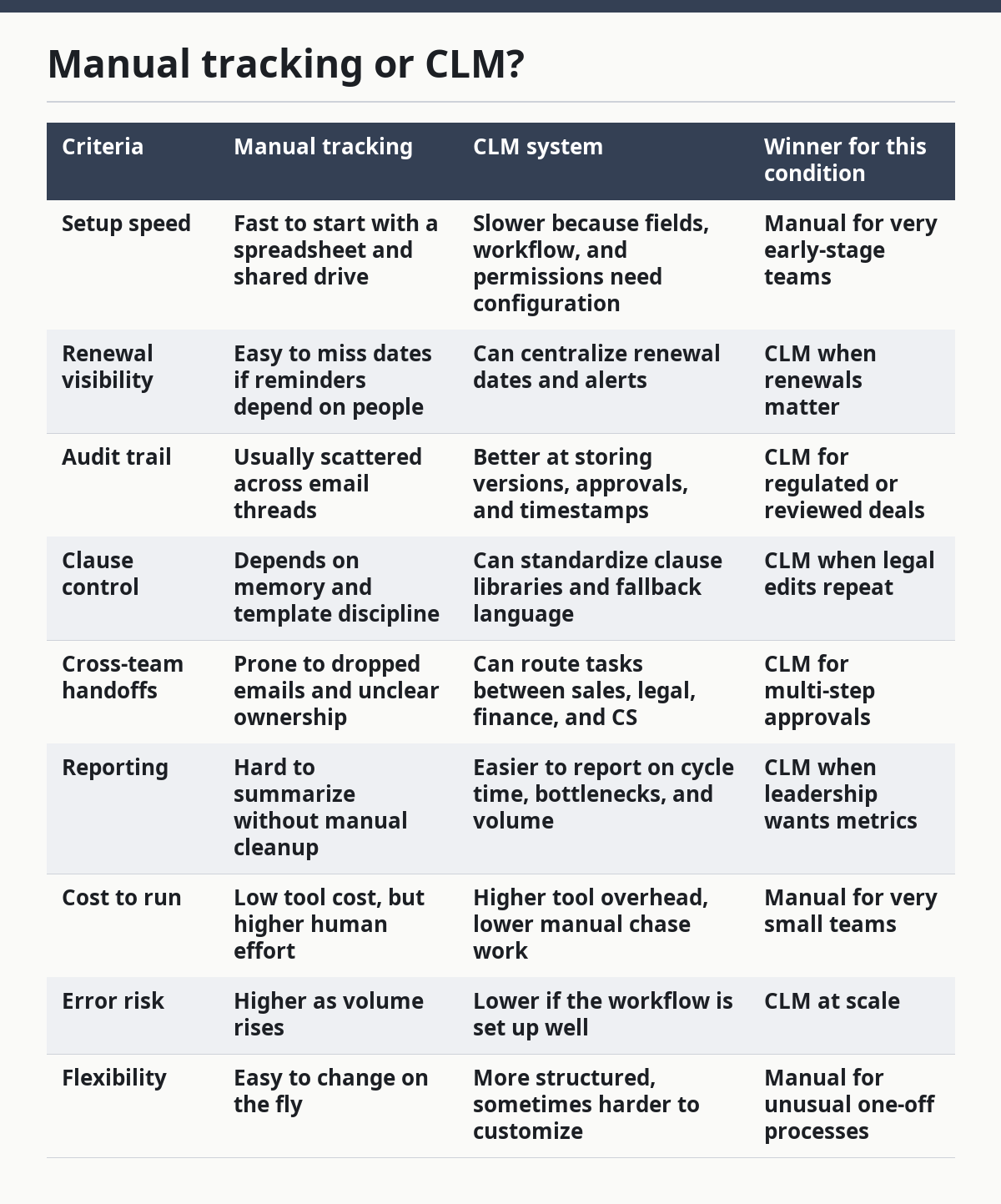
Manual tracking wins only when the contract load is light and the team can keep the spreadsheet current without extra work. That usually means a small SaaS company with limited legal review, few renewal exceptions, and little need for audit history. Even then, manual tracking should still include a version rule, a naming convention, and a shared place for the final signed copy.
CLM wins when the cost of missed steps is higher than the cost of system setup. That is common in SaaS because contract changes can affect revenue recognition, customer notices, privacy terms, and annual renewals. The downside is that a CLM system can become a slow, overbuilt process if the company buys software before it has a basic workflow.
That is the trap: some teams buy a system to fix a process they have not defined. The tool then hardcodes bad habits. The right sequence is process first, then system. A CLM should support the workflow, not invent it. For implementation detail, see CLM software for SaaS.
What does the workflow look like?
SaaS contract operations usually follows one repeatable workflow: request, draft, review, approve, sign, store, and monitor. Each step needs a named owner and a clear handoff, or the contract will stall somewhere between a sales rep’s urgency and a lawyer’s inbox.
The request step starts with the business need. Someone wants a new customer contract, a renewal, a pricing change, a DPA, or an amendment. Contract ops should require the basic facts upfront, such as legal entity, term, products, billing plan, approvers, and any nonstandard clause request. Missing data here causes rework later.
Drafting is next, and this should use approved templates for the MSA, order form, DPA, NDA, or statement of work. The stronger the template library, the less time legal spends rewriting common language. In SaaS, standard templates are not a nice-to-have. They are the main defense against a different contract every time.
Review and redlining should follow a rule-based path. Standard requests can move fast. Nonstandard issues, such as liability caps, data processing language, service credits, assignment rights, or indemnity changes, go to the right reviewer. If every issue goes to every reviewer, the cycle gets slow fast.
Approval is where many teams break. Finance may need to confirm billing terms. Security may need to confirm a DPA or vendor exhibit. Legal may need to approve a deviation from the model paper. The workflow should define which approvals are required by dollar value, risk level, or clause type, not by habit.
Signature should be the cleanest step in the process, but it often is not. The final version must match the approved version, and the signatory must be correct. A contract ops process should check that the executed copy is stored with the final attachments and linked to the CRM record or customer file.
Storage matters because contracts become evidence later. A good repository is searchable by customer, renewal date, product, and document type. If a team cannot find the final DPA or order form in two minutes, the repository is not doing its job.
Monitoring is where SaaS contract ops earns its keep after signature. Renewals, usage caps, notice deadlines, and amendment triggers should be visible before they become emergencies. This is where the team should see that the work is not finished at signature. In SaaS, signature is the middle, not the end.
A useful standard to keep in mind here is ISO 9001, which is about quality management and process consistency. Contract ops does not need to be certified against it to benefit from the logic: document the process, assign ownership, and watch for repeat failure points.
What breaks most often?
The most common SaaS contract ops failures are bad data, unclear ownership, template sprawl, and missed renewals. Those problems show up even when the contract language itself is fine, which is why many teams underestimate them.
Bad data is the first failure. If the contract record does not match the billing system, CRM, or legal file, nobody knows which version is current. That creates confusion on invoice dates, term length, renewal timing, and customer commitments. One wrong field can force manual cleanup across more than one team.
Unclear ownership is the second failure. If sales thinks legal owns the renewal notice and legal thinks finance owns it, the notice may never go out. A contract is only as strong as the person responsible for the next step. That person must be named in the workflow, not implied.
Template sprawl is another problem. When different teams keep different versions of the MSA or order form, the company loses consistency. A clause can disappear from one version and show up in another, which creates avoidable negotiation and risk. A SaaS team should have one controlled source for each document type.
Missed renewals are especially costly in recurring software contracts. They can come from weak reminders, wrong dates, or a contract buried in email. The issue is not just the lost revenue. It is also the customer experience when a renewal is handled late or with surprise terms.
There is also the hidden problem of exception creep. One custom clause may not matter. Twenty custom clauses do. Each exception becomes a future manual step. That is why contract ops should track exceptions by type and frequency. If the same exception appears often, it may need a new template, not another one-off approval.
The honest drawback of strong process control is that it can feel slower at the start. Teams may resist because it adds fields, steps, or review gates. That frustration is real. But the alternative is faster chaos, and that costs more when contracts start scaling.
When does this not need a heavy process?
SaaS contract operations does not need a heavy process when contract volume is low, terms are standard, and only a few people touch each deal. In that case, the right answer is a light, disciplined workflow rather than a full operating model.
A very early-stage SaaS company may only need a template MSA, a simple approval rule, a shared folder for signed copies, and a spreadsheet for renewals. If the same two or three people handle sales, legal review, and billing, a large process layer can slow things down more than it helps. The job is control, not ceremony.
This is also true when the company sells to a narrow customer set with predictable terms. If almost every deal uses the same paper and the same billing model, there is less need for a formal contract operations function. The main goal becomes keeping the paper current and the renewal dates visible.
The picture changes when the contract set gets more complex. Multiple products, multiple entities, annual price changes, security addenda, DPAs, and negotiated renewal terms all push the company toward stronger ops. At that point, the absence of contract ops stops being a simplicity gain and becomes a risk.
The honest line is this: if contracts are still easy to explain in one meeting, a light system may be enough. If the team needs three meetings just to answer who approved the latest amendment, the process is already underbuilt.
One useful outside standard here is SOC 2, which many SaaS buyers care about in vendor review. Even though SOC 2 is not a contract ops framework, the same idea applies: documented controls matter more once customers start asking for proof. That pressure is usually a sign that contract handling needs to become more formal. For adjacent vendor diligence work, see vendor risk management for SaaS.
What should a good setup include?
A good SaaS contract ops setup includes one intake path, one template library, one approval map, one repository, and one reporting view. Those five parts are enough to prevent most of the avoidable mess without building a bureaucracy.
The intake path should ask for the same core details every time. That usually means counterparty name, contract type, term, products, billing terms, requested exceptions, and business owner. Without that front-end discipline, the rest of the workflow will keep asking the same questions later.
The template library should cover the main contract types used in SaaS, such as MSA, order form, DPA, NDA, and amendment. Each template should have the approved fallback language ready to use. If legal keeps rewriting the same clauses by hand, the library is not doing its job.
The approval map should define who approves what. That includes legal review triggers, finance review triggers, security review triggers, and escalation paths for exceptions. The point is not to add reviewers. The point is to avoid guessing.
The repository should store the signed version, the redline history if needed, and any linked exhibits or schedules. It should be searchable by customer, renewal date, contract type, and status. If the storage system cannot answer basic questions quickly, it is just a folder, not an operating tool.
The reporting view should show the few metrics that matter. Cycle time, renewal visibility, exception rate, and backlog are often enough to expose the main bottlenecks. A dashboard is only useful if it changes behavior. If nobody makes a decision from it, it is decoration.
The honest trade-off is setup time. A clean contract ops system takes thought and maintenance. But every missing part moves work into email, memory, and ad hoc follow-up. That is where SaaS teams lose speed.
The honest side-by-side
A disciplined contract ops function wins when the company needs repeatable control; a loose, manual process wins only when the contract load is small and simple. The difference is not style. It is whether the team can keep one version of the truth as the business grows.
| Criteria | Manual contract handling | SaaS contract operations | Winner for this condition |
|---|---|---|---|
| Contract volume | Fine for a few contracts at a time | Better when volume grows | Manual for low volume |
| Renewal management | Depends on memory and spreadsheets | Uses process and reminders | SaaS contract operations when renewals matter |
| Cross-team work | Easy to lose handoffs | Built for handoffs | SaaS contract operations |
| Risk control | Inconsistent | More repeatable | SaaS contract operations |
| Speed at launch | Fast to start | Slower to build | Manual at the beginning |
| Visibility | Limited | Better across legal, sales, finance, CS | SaaS contract operations |
| Consistency | Varies by person | Template-led | SaaS contract operations |
| Cost of setup | Low upfront | Higher upfront, lower rework later | Manual if the team is tiny |
| Reporting | Hard to measure | Easier to report | SaaS contract operations |
| Scalability | Breaks under more exceptions | Scales better | SaaS contract operations |
The main mistake is treating manual handling as a permanent plan. It is not. It is a starter condition. Once the team is managing recurring subscriptions, amendments, and renewals across more than one department, contract ops stops being optional process polish and becomes basic operating hygiene.
The second mistake is treating contract ops like a legal-only problem. It touches revenue, billing, customer experience, and risk, so if you are unsure how to assign that mix, consult legal or an operations professional before setting the ownership model. That is why the best setups use legal’s judgment while keeping the whole process outside legal’s inbox. For a related workflow view, see SaaS contract templates.
What questions should a beginner ask first?
SaaS contract operations should start with four questions: who owns the flow, what documents are standard, where are the dates stored, and which exceptions slow deals the most? Those four answers expose most of the weak spots before any software purchase or process redesign.
The first question is ownership. If no one owns the process, the process will drift. Even a simple setup needs a named person or team to manage templates, approvals, and storage. Ownership is more important than sophistication.
The second question is document scope. Which contract types does the business actually use today: NDA, MSA, order form, DPA, amendment, or something else? A team cannot standardize what it has not named. This is where many companies discover they have three versions of the same paper.
The third question is source of truth. Where do renewal dates, signatory details, and final terms live? If that answer changes depending on who is asked, the system is weak. One clean repository matters more than a fancy dashboard.
The fourth question is friction. Which clause, approval, or handoff causes the most delay? That answer tells the team where to focus first. Fix the bottleneck before polishing the rest. There is no point building reporting around a broken step.
These are the same kinds of controls that standards like NIST SP 800-53 and ISO/IEC 27001 emphasize in broader governance work: define controls, assign ownership, and keep records that can stand up to review.
What is the verdict?
Choose a dedicated SaaS contract operations setup if contracts renew, change, and pass through multiple teams. Choose a light manual process if the company is still small, the paper is standard, and one person can keep the dates and documents straight. Neither is right if the company has no named owner, no template control, and no reliable place for the final signed copy.
The strongest choice for most growing SaaS teams is the dedicated setup because it protects revenue and reduces rework. The weakness is that it takes discipline to maintain, and that makes it a poor fit for a tiny team with only a few simple contracts a month. The wrong answer is not software or no software. The wrong answer is pretending process does not matter until the first missed renewal.
FAQ
Is SaaS contract operations the same as legal ops?
No, SaaS contract operations is related to legal ops but not the same thing. Legal ops usually covers a wider field, including outside counsel, legal budgeting, and legal process management. Contract ops is narrower and more operational: it focuses on contract flow, approvals, storage, and renewals.
Do small SaaS companies need contract ops?
Yes, but usually in a light form rather than a full program. A small SaaS company may only need one owner, one template set, one repository, and one renewal tracker. If there are few contracts and little negotiation, a heavy workflow can add more drag than value.
What is the biggest mistake SaaS teams make with contracts?
The biggest mistake is letting each team keep its own version of the truth. Sales, legal, finance, and customer success can end up with different copies, dates, and approval rules. That creates missed renewals, billing errors, and long searches for the final signed paper.
Should contract ops live in legal, sales, or finance?
It should live where the main pain is, but it must have one clear owner. Legal is a fit when risk review is the main issue. Finance or revops is a fit when billing and renewals are the main issue. Shared ownership without one final owner usually creates confusion.
When should a company move from spreadsheets to a CLM?
It should move when spreadsheets can no longer keep up with renewals, approvals, and version control. If the team is spending time chasing dates, checking copies, or fixing handoff mistakes, the process is already too fragile. A CLM then becomes a control tool, not a luxury.
Drafted with AI; not yet reviewed by a person.